L O A D I N G
Please view on larger screen for full picture.

 Back to top
|
Back to top
|
1953
I
1957
1986
VII
1990
1991
VIII
1995
1996
IX
2000
2001
X
2005
2006
XI
2010
2011
XII
2015
2016
XIII
2020
China's Five-Year Plan (FYP) is one of the country's most importantpolicy blueprints. Drawn up since 1953, it sets medium-term goals for China's social and economic development and is the barometer against which progress is measured.
2020 is the last year of the 13th Five-Year Plan, which was adopted on March 15, 2016. The 14th plan (2021–2025) is currently being developed.
This table shows the outlines of each of China's FYPs*. The length of the 1st FYP (1953-1957), which served as the foundation for future plans, is longer than the rest. Its total word count is 80,295.
By comparison, the number of policies drops for several years after 1953 but starts to climb consistently in 2006.
*The second to sixth FYPs are not listed, as they are not available.
Here we delineate the primary objectives of the FYPs from 1953 to date.
The primary objectives include economic reform and industrial restructuring.
Starting from the 7th FYP (1986–1990), every FYP projected an average annual GDP growth rate for the period. It became an important indicator measuring the national economy for the next five years. However, China announced on May 22 that there would be no specific target set for its economic growth in 2020 because it is facing some unpredictable factors in its development as well as high uncertainty regarding the COVID-19 pandemic and the global economic and trade environment.
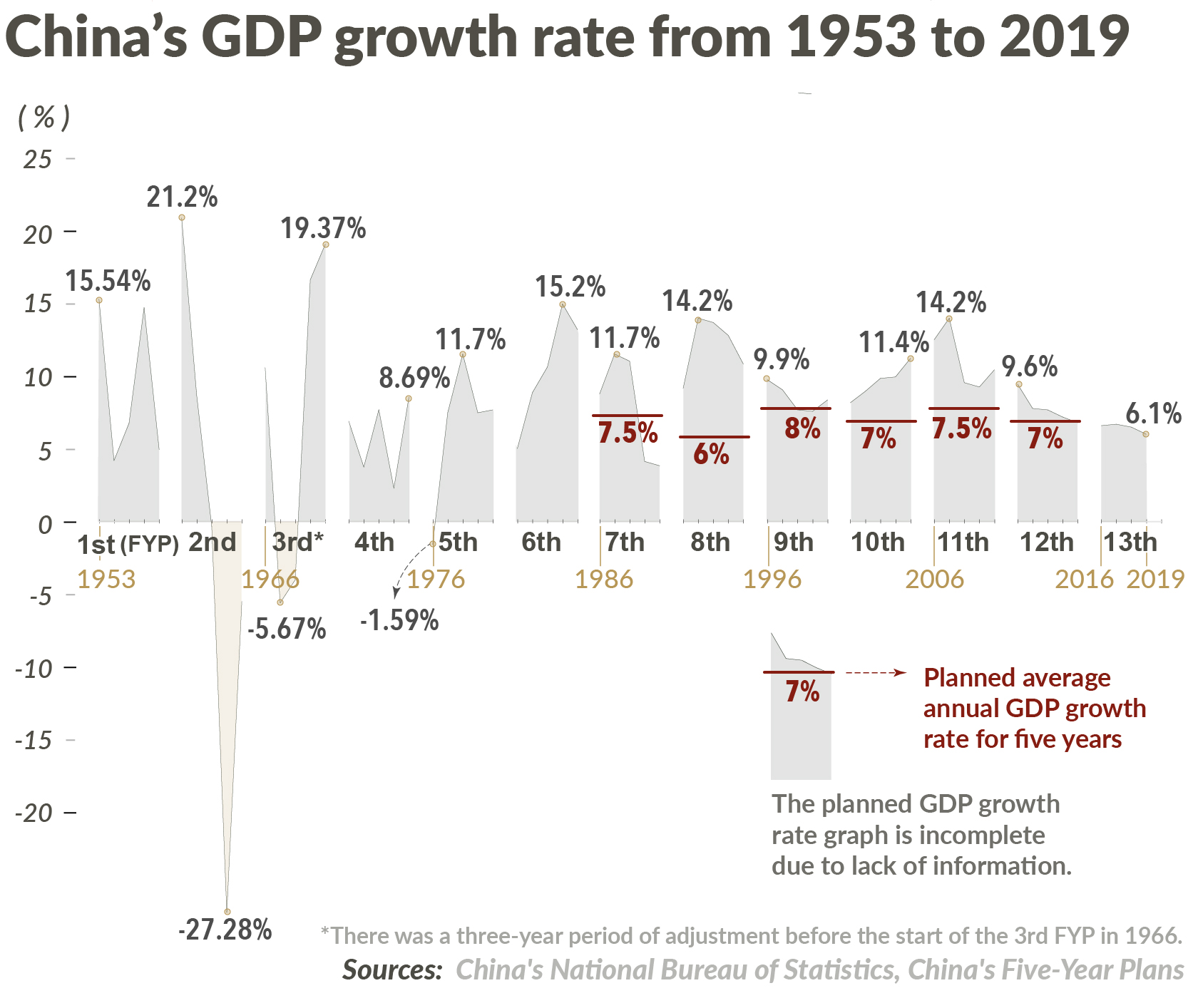
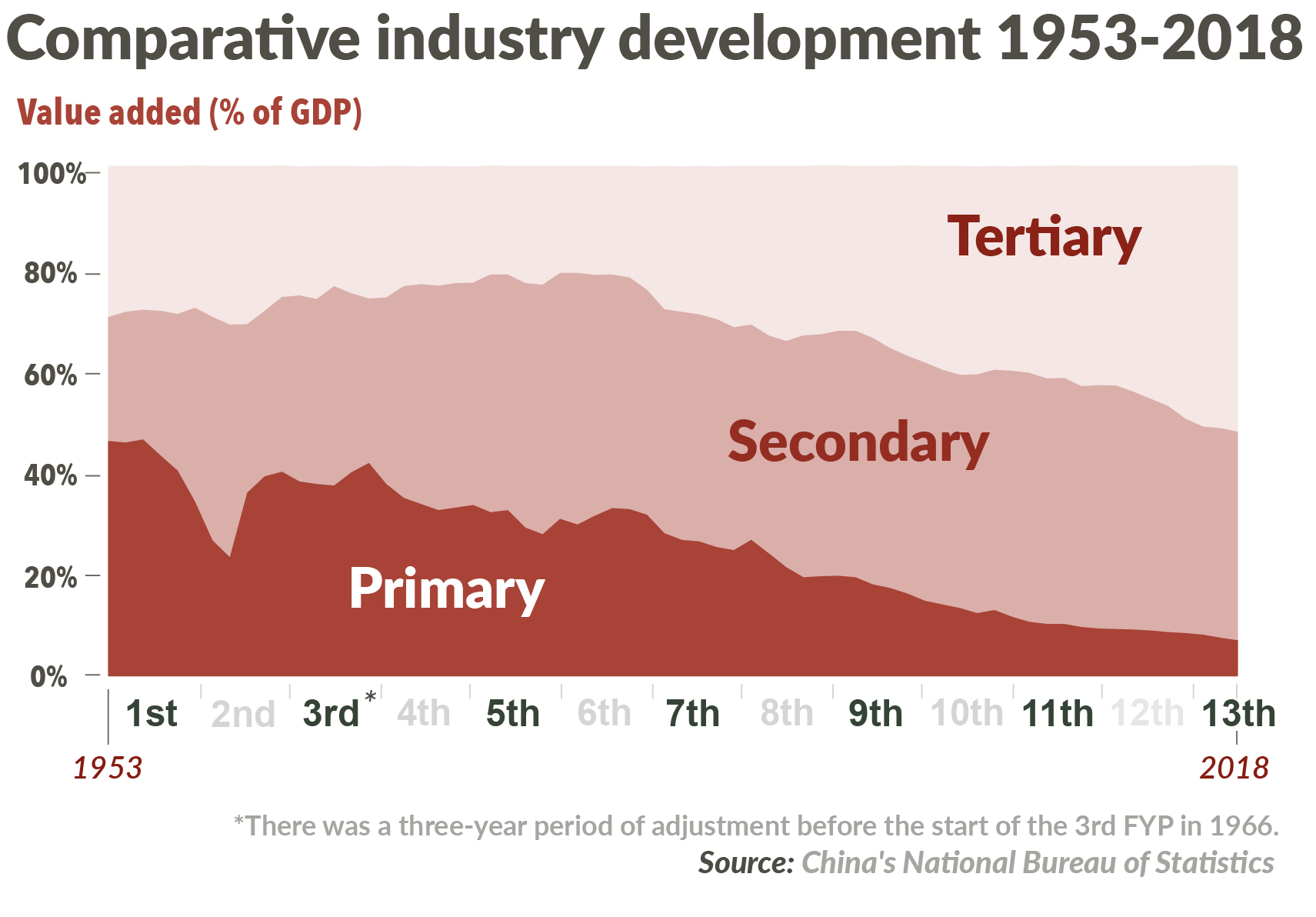
In terms of contribution to the GDP, the secondary sector maintained a bigger share with a dwindling primary sector and a growing tertiary sector.
Here we highlight all the texts related to the industrial sector.
The related content accounts for nearly half of the 1st FYP.
As China diversifies its approach to national development, the number of policies directly related to the industrial sector has fallen.
 Industry
Here are the titles of the chapters or sections on industry.
During the 1st FYP, China focused on developing its heavy industry.
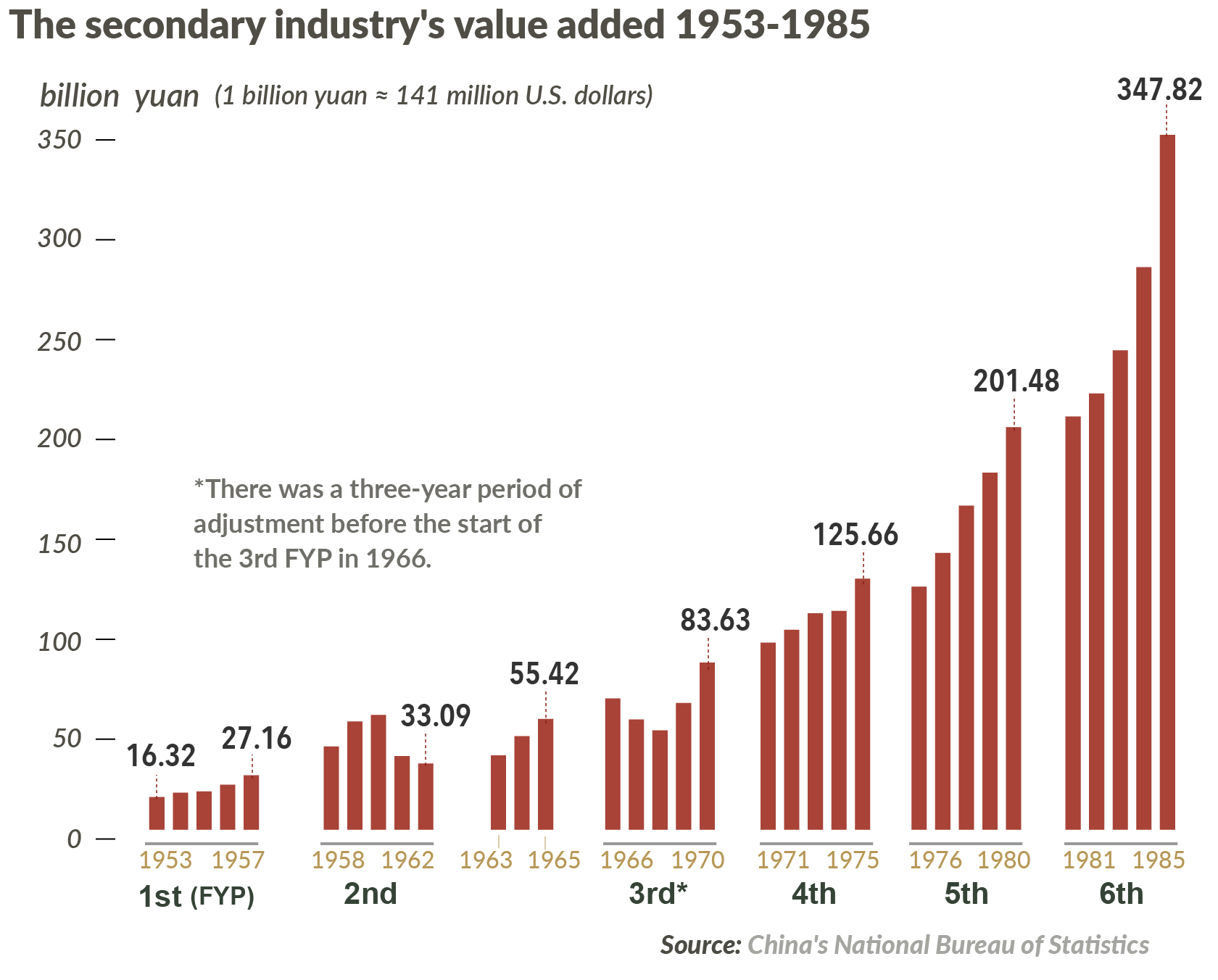
The annual value added of the industrial sector declined at the end of the 2nd FYP (1958–1962) but rallied during the three-year period of adjustment that followed. It dipped to 49.7 billion yuan in the 3rd FYP (1966–1970) but has remained above 80 billion yuan since the 1970s.
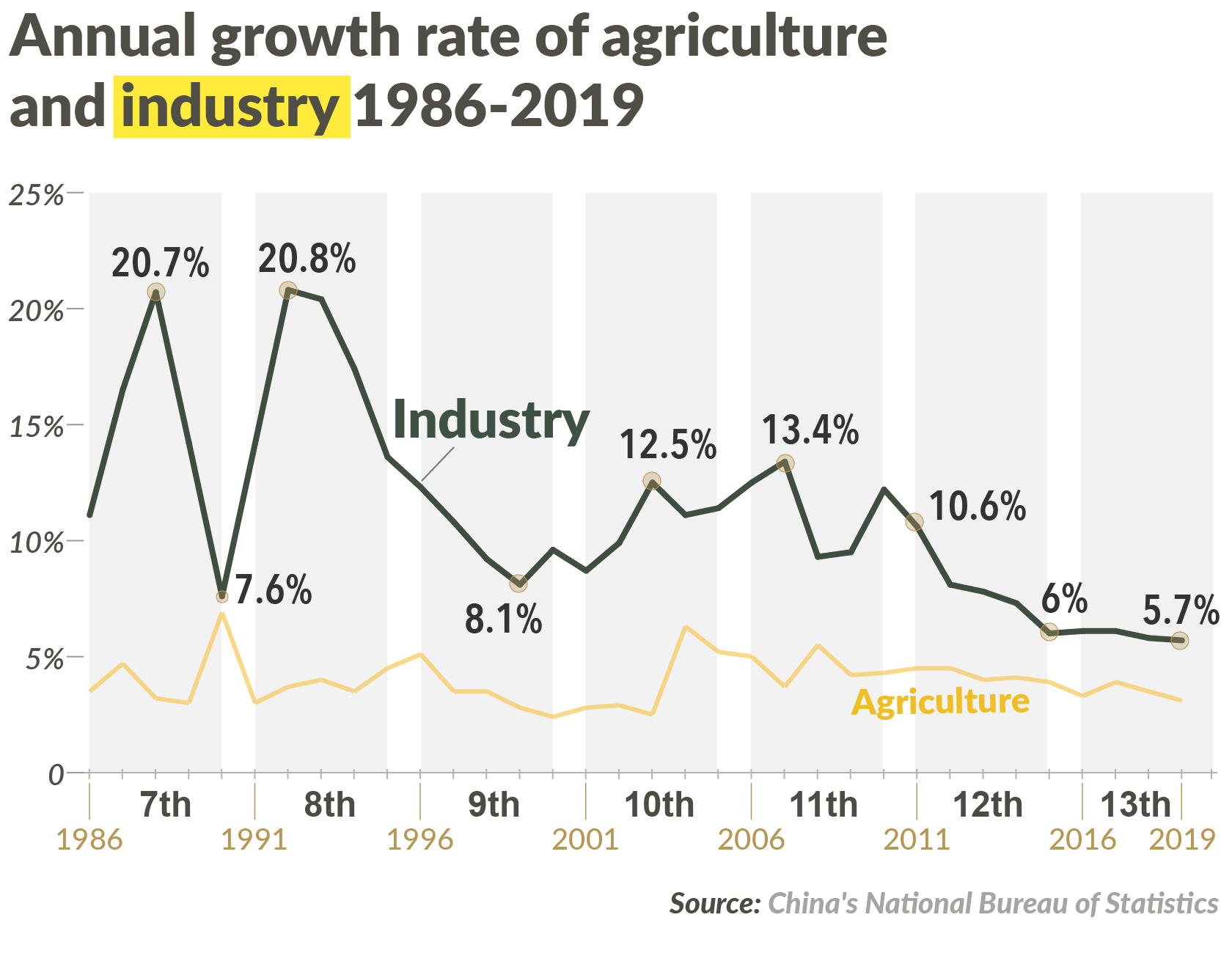
China's industry growth rate was in a downward trend when the government unveiled "Made in China 2025," a 10-year national strategy put in the 13th FYP (2016–2020) to upgrade the country's manufacturing sector.
China is the world's largest agricultural producer, producing a fourth of the world's grains.
Content related to agriculture is highlighted. Most FYPs make fewer references to agriculture than industry.
Industry Agriculture
Here are the titles of the chapters or sections
Agriculture remains a vital sector in the national economy, though its average growth rate has typically been lower than that of industry.

Plans for rural development appear in the second part of the 11th FYP (2006–2010), called "Construction of New Socialist Villages." In the subsequent FYPs, rural development plans make up a whole chapter listed at the top of the document.

For more information on public health and foreign trade, please view on a larger screen.

China's Five-Year Plans (The second to sixth FYPs are excluded, as they are not available.)
*Please note: The analysis in this project is based on the Chinese version of the Five-Year Plans.
Editors: Zhao Hong, Le Tian
Copy Editor: Claudine Housen
Chief Editor: Chen Ran
Data Editors: Zhou Rui, Shi Tao
Visual & Interactive Designers: Qin Zhaoying, Li Yixiao
Interactive Developers: Qin Zhaoying, Duan Huiran(Intern)
Testing Engineers: Zhang Sheng, Zhang Yupeng, Zhang Dongbo
Technology Support: Li Jian
Multimedia Producer: Xu Jiye
Senior Consultant: Dr. Xia Jixuan
Managing Director: Zhang Shilei
Supervisor: Fan Yun

Copyright © 2020 CGTN. Beijing ICP prepared NO. 16065310-3











"We take the capital construction of heavy industry as the focus of the 1st FYP for the development of the national economy and start with the 156 industrial projects the Soviet Union designed to help China."
"We will fully implement the 'Made in China 2025' action plan… to foster a new competitive edge in manufacturing."
"We will continue to give top priority to resolving the 'three rural issues,'… promote the construction of a new socialist countryside, and promote the sound development of urbanization."