
 []
[]
Share







Copied
China's consumer market has a huge potential for consumer goods upgrades, as people nowadays care more about quality and energy saving.
The country has introduced measures to consolidate the momentum of industrial upgrades and enhance the vitality of the consumer market.
Earlier this month, for example, the National Development and Reform Commission (NDRC) joined with two other departments to issue the Plan for Promoting the Recycling of Key Consumer Goods and Resources (2019-2020), aiming to upgrade automobiles, home appliances and consumer electronic products with the supply-side structural reform as the main line.
The plan said there will be no driving or purchasing restrictions on new energy vehicles (NEV), and those that have been implemented should be removed.

A WM Motor new energy vehicle in Shanghai, June 11, 2019. /VCG Photo
Meanwhile, households without cars are encouraged to make their first car a new energy vehicle. The local government should also speed up the elimination of old cars and the renewal of vehicles in the urban public sector, as well as promote the upgrade of rural vehicle consumption, the plan said.
With the increase in people's disposable income and the improvement consumer's quality of life, home appliances like refrigerators, air conditioners, washing machines and water heaters have already become part of people's lives in China and are great need of renewal, said Xu Dongsheng, vice president of the China Household Electrical Appliance Association.
The plan also provides conditions to support energy-saving and intelligent home appliances, which will effectively boost the transformation and upgrade the household appliance industry and further optimize the market supply, according to Xu.
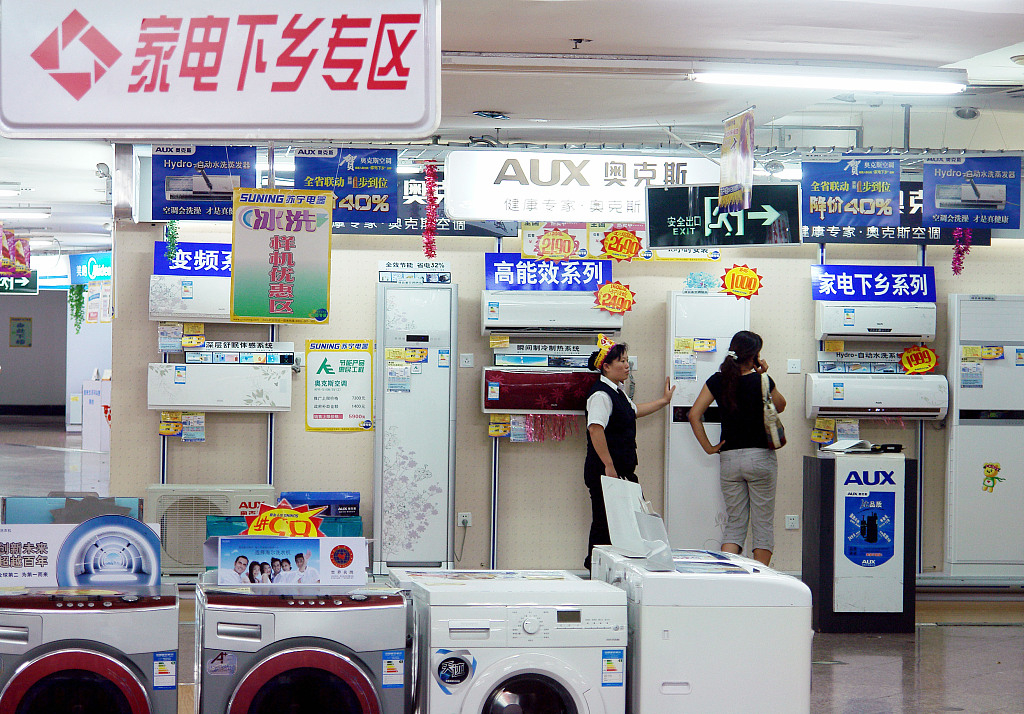
Discounted home appliances at a mall in Zhengzhou, China, July 21, 2019. /VCG Photo
The country has also paid great attention to consumption in rural areas. In 2008, China rolled out the "Home appliances going to the countryside" policy in a bid to encourage domestic consumption and improve the living standards of rural residents.
From 2008 to 2012, the investment subsidy was nearly 90 billion yuan (about 13 billion U.S. dollars). The country sold 298 million units of home appliances to the countryside with 720.4 billion yuan in sales.
Last year, the per capita consumption expenditure of rural residents reached 12,124 yuan, an increase of 10.7 percent.
Company's role in boosting consumer goods upgrades
Last year, the market size of China's home appliances industry reached 810.4 billion yuan (117 billion U.S. dollars), up 1.9 percent year on year, according to an official report.
Trading in or returning old items for new ones have become a new trend in the home appliance industry, which helps boost the home appliance market.
For example, China's e-commerce company Suning.com recently launched the "old-for-new" subsidy worth about one billion yuan.
Suning's latest data shows that 440,000 orders to trade in old home appliance have been received, both online and offline, and the number of participants has exceeded 282,000 since the launch of the campaign in March.
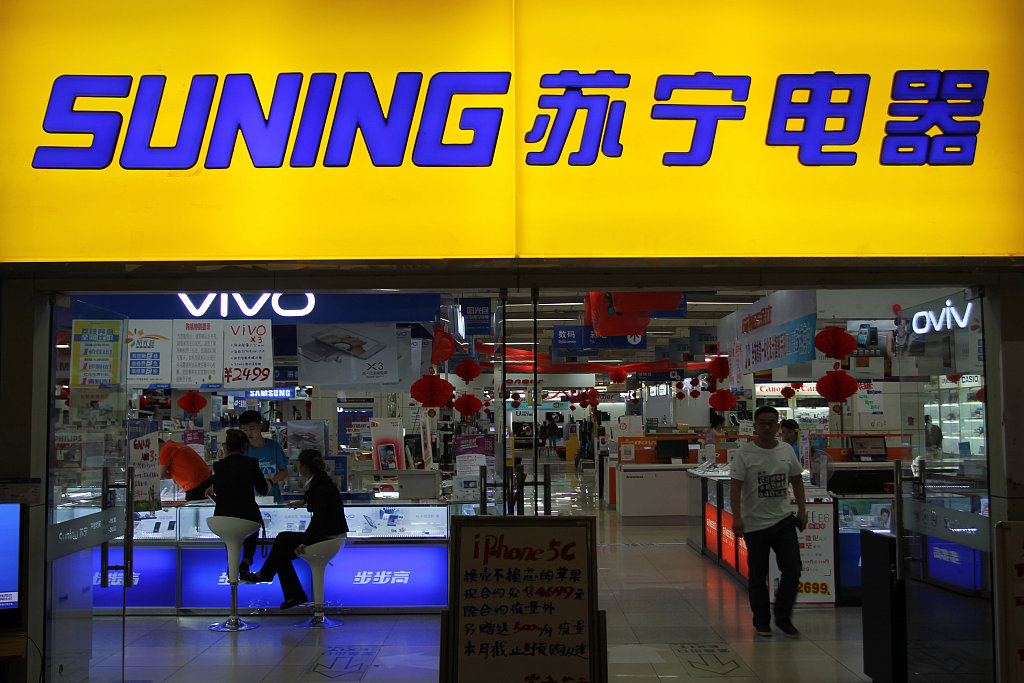
A Suning outlet in Wuhan, Hubei Province. /VCG Photo
Tapping used goods market
The used goods market offers new opportunities for optimizing the effective use of resources to develop the shared economy.
The size of used goods transactions in the first quarter of this year increased by 5.5 percent over the previous quarter, according to a report by BigData-Research.
E-commerce platforms, together with cutting-edge technology like big data and cloud computing, help facilitate the trading process. With new consumption concepts, consumers are more accepting of and familiar with secondhand trading e-commerce platforms.
China's e-commerce retailer JD.com on June 3 announced a merger between its secondhand trading platform Paipai, an online electronics recycling platform Aihuishou, investing 500 million U.S dollars.
The secondhand concept has seen results. An Aihuishou salesperson told Chinese financial markets website eastmoney.com he received 40 customers who completed both direct delivery and online secondhand transactions in May.
The trading volume in May almost equals the total number of transactions of the past three months, the salesperson said.