
 []
[]
Share







Copied

The new travel restrictions imposed by the U.S. pose another setback for Cuba’s fragile economy.
The U.S. Treasury Department announced the U.S. will no longer allow educational trips known as “people-to-people” exchanges and is banning private air travel and cruise ships. The Cruise Line International Association said the move immediately impacts 800,000 bookings.
The Cuban government reacted with an official statement saying that Cuba will not be intimidated by the U.S. blockade and blasted attempts to force political concessions by hurting the country’s economy and living conditions for its people.
Cristina Escobar, a Cuban journalist and commentator, points out the biggest impact of the restrictions is around the ecosystem of private business. These people are living off of thousands of American tourists who arrive each week through the Havana port.
In 2018, Cuba received over 4 million tourists, with only 800,000 through recreation vessels. Thus, the impact of the restrictions is not that significant. She also observed that the tourists who came by cruise ships didn’t spend much and always stayed on the ship. But private enterprises, like small restaurants, tourist coaches and taxis will be severely affected.
“The measure won’t affect the Cuban government directly, but the first people who will feel the heat of this is the private workers near the ports,” she contended. She encourages Americans to go to Cuba by themselves and talk with Cubans on the street. “Even if they (Cubans) are against the government and disagree with lots of the policies in Cuba today, they don’t like Trump’s policies on Cuba,” she argued.
In Escobar’s view, there are a large number of tourists coming from Canada, Europe and Russia. The American tourists are interested in the culture and history of Cuba. “It is very hard to substitute an American tourist who tends to spend money and deal with private business,” she added, “This provides and helps local economy which is going to be affected in central urban port areas.”
Escobar suggests that this strategy will affect the interests of European and Canadian companies in Cuba. For example, there are lots of hotels in Cuba owned by Spanish companies.
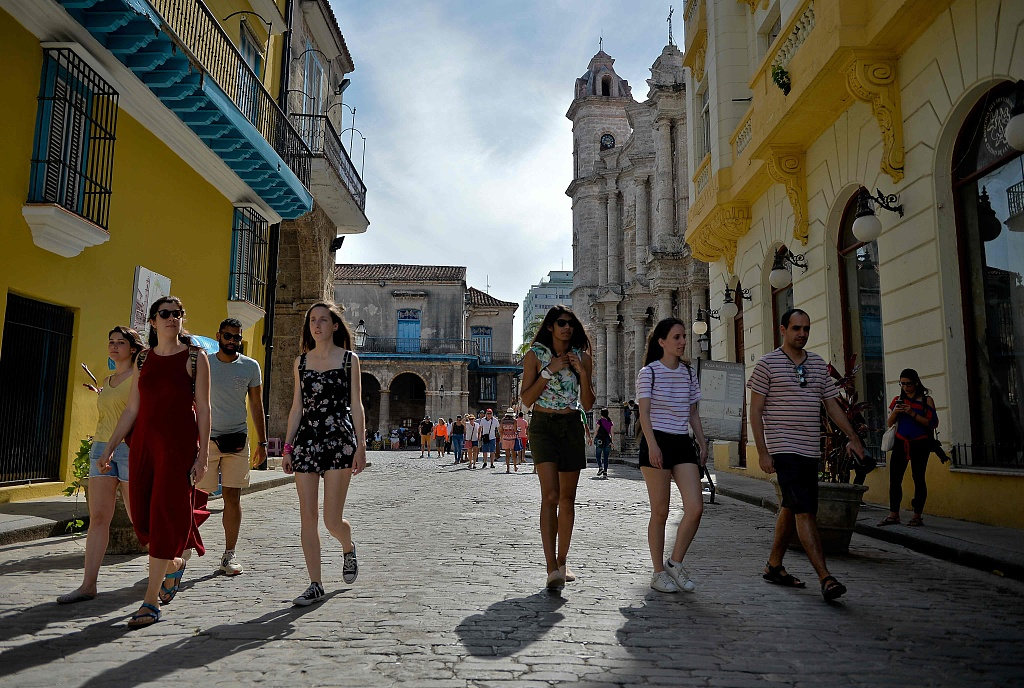
Tourists walk along a street of Old Havana, May 7, 2019. /VCG Photo
Collin Laverty is the president of Cuba Educational Travel, an organization that connects American people and Cubans through travel. He thinks the Trump administration eliminated the “people to people” category which was the most common way that American traveled to Cuba.
But there still remain 11 other categories for travel to Cuba and some of them are quite broad, such as professional research or meetings in Cuba. He believes if Americans could figure that out, lots of them will travel to Cuba under these categories. Unfortunately, these restrictions cause a lot of confusion and fear.
“But I think a lot of work will be done and there is a huge demand amongst Americans to travel,” said Laverty. “So we will not see a complete stop. We’ll just see a slowdown temporarily.”
Lester Munson, a principal of International at BGR Group (Barbour, Griffith & Rogers), contends the U.S. economic sanctions on Cuba haven’t been as effective as advocates would like them to be.
He thinks the Cuban government is responsible for limitations on the free market and entrepreneurship and they are the ones who generally benefit from increasing capital flows to the island. So Munson is not in favor of tightening economic sanctions unless it is for a very specific U.S. foreign policy purpose.
Munson also indicates that the economic embargo on Cuba is a result of the Helms–Burton Act, which punishes foreign companies in Cuba for using “confiscated” property that is thought to belong to Americans. The U.S. is always going to be upset by the government in Cuba. “The U.S. doesn’t want to bully the Cuban people and may want to bully the Cuban government,” he concluded.
The Heat with Anand Naidoo is a 30-minute political talk show on CGTN. It airs weekdays at 7:00 a.m. BJT and 6:00 p.m. Eastern in the U.S.
(If you want to contribute and have specific expertise, please contact us at opinions@cgtn.com.)