
 []
[]
Share







Copied
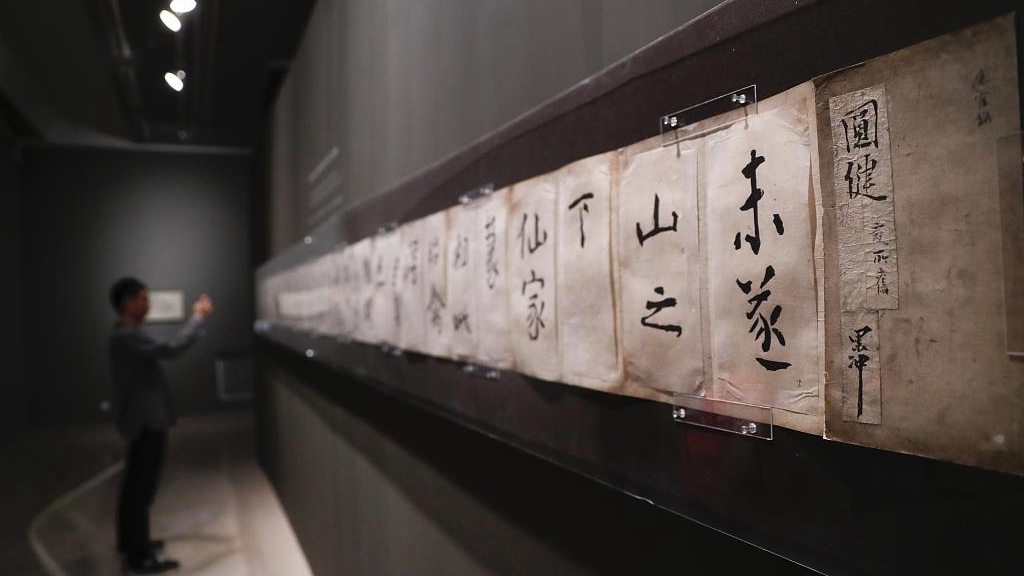
The term "dialogue" is now widely used in political, economic and cultural fields and is an important component to all aspects of exchanges.
At first sight, artworks on display at the National Art Museum of China in Beijing appear to be part of a Chinese calligraphy exhibition. But the artist is Kim Jeong-hui, who played a leading role in developing the Chusa style of calligraphy on the Korean Peninsula over 200 years ago.
Wedged between his cross-disciplinary works, one can understand why "dialogue" between Kim and his Chinese mentors is meaningful.
"From calligraphy to poetry, as well as the ideas expressed in his calligraphy and poetry, and those stories between Kim and his Chinese mentors, all these are valuable literature in the history of Chinese and Korean cultural exchanges," Wu Weishan, curator of the National Art Museum of China said.
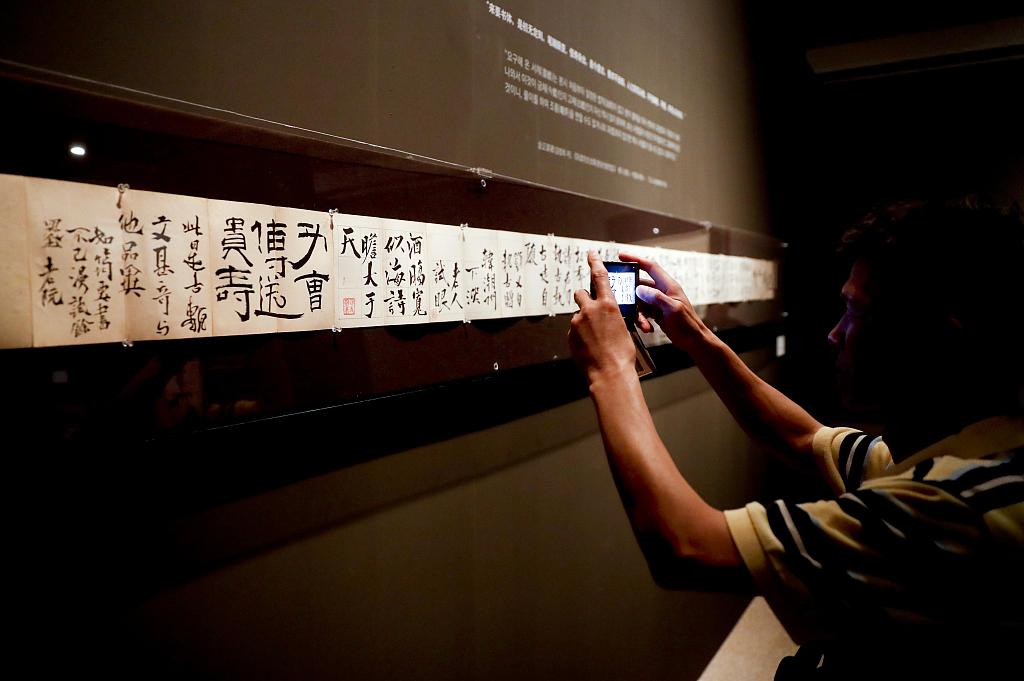
Calligraphic works by Korean artist Kim Jeong-hui are seen at the art exhibition, June 18, 2019. /VCG Photo
Born in 1786 into a powerful family, Kim had access to a cohort of artists and scholars in Beijing when he first came to China in 1809. Ruan Yuan was Kim's lifelong mentor, a realist with the critical spirit of "seeking truth from facts." His other mentor was Weng Fanggang.
The spirit and artistic attainment Kim learned from his Chinese mentors greatly influenced his spiritual world.
"When Kim Jeong-hui came to China 200 years ago, he was only a 24-year-old young man. He contributed to the cultural exchanges in East Asia and introduced modern art to the Korean Peninsula," Yoo Intaek, director of the Seoul Arts Center said.
"Young people are creative. Their exchanges inspire new creations and bring more vitality to the world. Through dialogues, young people can combine the unique cultural elements from all different countries and form a dynamic driving force for the mutual development and prosperity of the entire human race," Wu said.
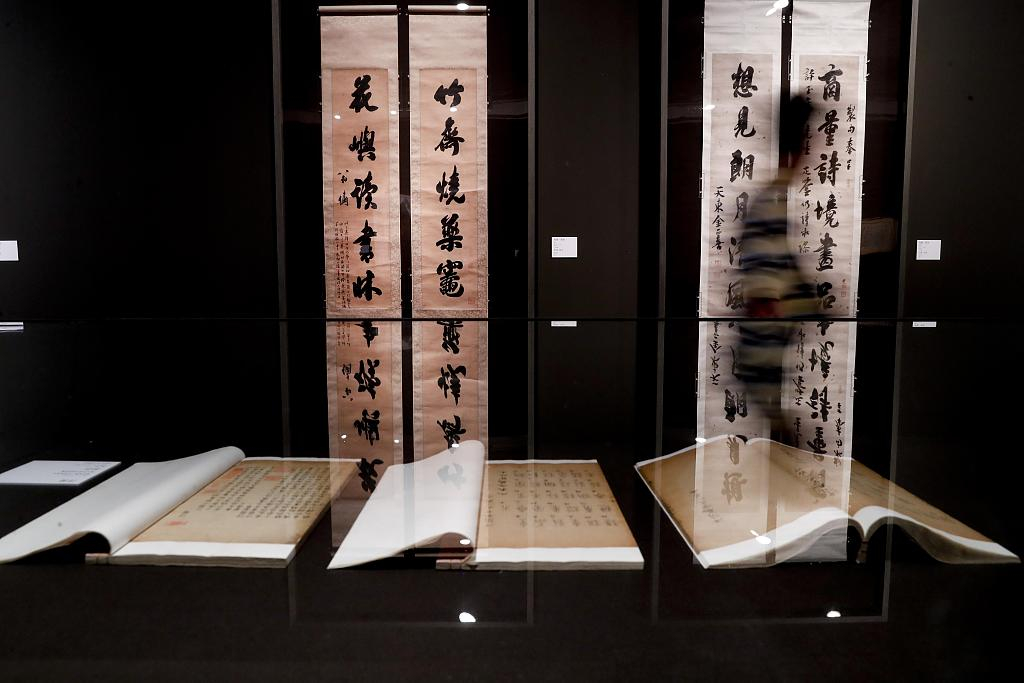
Calligraphic works by Korean artist Kim Jeong-hui on display, June 18, 2019. /VCG Photo
China and South Korea are close neighbors. The cultural exchanges between the two countries have a long history. The two peoples continue to learn from each other and jointly contribute to the East Asian civilization. "Dialogue between Kim Jeong-hui and the Literati of (the) Qing Dynasty (1644-1911)" is another cultural blending between Chinese and Korean art. And the two-month-long exhibition has drawn visitors from near and far.
"I don’t feel foreign at all, especially when I see the portrait of Korean pre-cultural elites. There are also portraits of our Chinese masters, Ruan Yuan and even Su Dongpo. All of a sudden, there’s no gap at all between the two cultures. The Chinese and Korean cultures have a lot in common, so young people should be encouraged to exchange a lot and cooperate more," a Chinese visitor said.