
 []
[]
Share







Copied
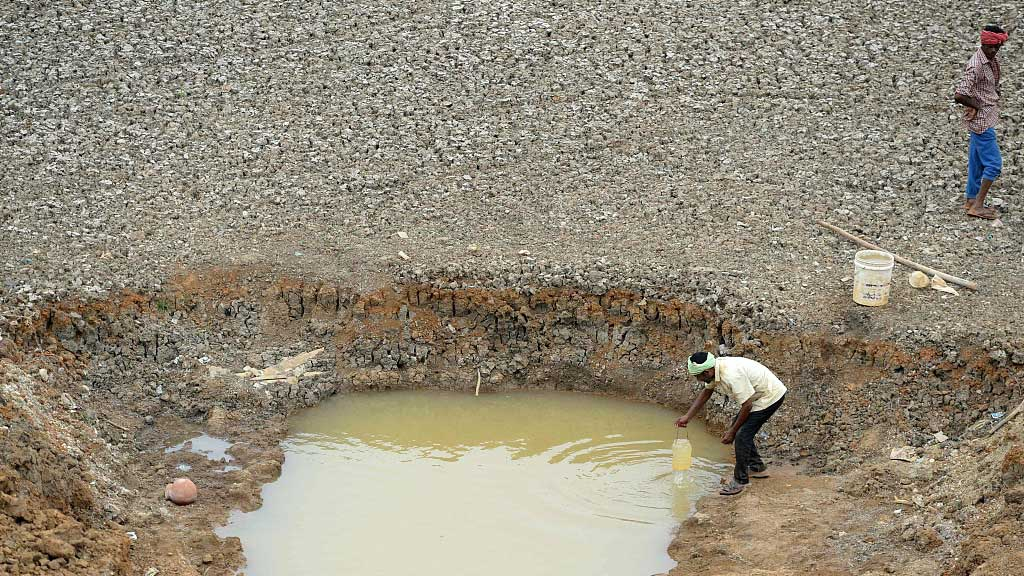
Collecting water from the Puzhal reservoir on the outskirts of Chennai, June 20, 2019. /VCG Photo
The thought of how we as humans will survive without water sends a shudder down the spine. But this is almost reality for people in cities like south India's Chennai.
Schools have closed, restaurants shut, and businesses are hit, especially the IT industry, which has asked employees to work from home as water is scarce. The government is supplying only 525 million liters of water although the demand is about 1.2 billion liters a day. The whole city is surviving on water tankers – both private and government.
If you drive around Chennai early in the morning, at every nook and corner, you can find people filling their pots from tankers. The poor are the worst hit by this water crisis.
Anthony Amma, 50, is a daily wage laborer. She comes to the water distribution center to collect water every morning. Living close to a slum in Mylapore, each trip costs someone like her 300 Indian rupees, or about 4.50 U.S. dollars.
She complains, “We have to hire an auto which costs us a lot of money per day. We both have to shell out a lot of money just to transport water from here to home. The tanker comes on alternate days. How will our children and grandchildren manage without water? So, we have to come to collect from here. Daily, we have a problem with getting water on time. If we had water, we would be able to do our jobs and send our children to school.”
M. Prakash, a tailor, opens his shop four hours later than usual. “I open my shop at twelve. I can’t meet my deadlines as I start late. Every month I am earning about 4,000 rupees (about 60 U.S. dollars) less than what I used to before this water crisis started,” he laments.
There are many who are relying on private water tankers and are ready to pay. The cost of a water tanker has skyrocketed.
T. Ganesh, who buys from water tankers regularly, explains, “Earlier if we would book a government tanker we would get it in a week but now the wait has increased to 21-25 days. The government tanker is cheaper, but the private tankers are asking exorbitant prices for a 9,000-liter tanker.”
But who is to blame for this situation in Chennai?
According to the water activist Jayaram Venkatesan, “The four reservoirs were the main source of our water requirement. These four reservoirs are completely dry today. These reservoirs have not been desilted. As a result the groundwater has not been recharged. It is because of the non-proper planning of the government almost 2 tmc of silt has been in these four reservoirs. So, if they had cleared the city would not have been flooded as we saw in 2015. And today we would not have been facing this severe situation of water crisis. So, the primary responsibility of the situation lies on the government which failed to manage the water bodies.”
Tamil Nadu Fisheries Minister D. Jayakumar said that the government was doing its best to fight the water crisis in one of India's largest cities. The government maintains that they can supply adequate water to the residents till November.
The water crisis is not a new phenomenon in India. The country is "suffering from the worst water crisis in its history," according to a recent government think tank report. It warned that 21 cities, including Delhi, Bangalore, Hyderabad and Chennai, are likely to run out of groundwater by 2020. Across the country, the report estimates that by 2030, 40 percent of Indians could be without supplies of fresh drinking water.
(Gong Zhe also contributed to the story.)