
 []
[]
Share







Copied
Editor's note: Andrew Korybko is a Moscow-based American political analyst. The article reflects the author's opinion, and not necessarily the views of CGTN.
It's been widely reported in Indian media that the U.S. sent its Ministry of External Affairs a letter late last month threatening to take what is being described as "punitive action" against any Indian companies that sell American supplies or equipment to Huawei.
This revelation comes amidst the Indian government's deliberations over whether or not to allow the Chinese telecommunications giant to build the country's planned 5G network, thus making the American move an obvious means of pressuring New Delhi to choose a different strategic partner instead. The U.S. doesn't want India and China growing closer as a result of their possible 5G collaboration and has a few other tricks up its sleeve that it could employ in its attempt to prevent this from happening.
Official data earlier this week revealed that the U.S. just overtook China to become India's top trading partner, which sounds unusual on the surface because of their latest tit-for-tat tariffs. The U.S. recently removed India from the Generalized System of Preferences (GSP) that had previously allowed many of its partner's goods to enter the country tariff-free, with the South Asian state retaliating by imposing tariffs on a little fewer than 30 American products.
These trade tensions are occurring while the two countries are negotiating a free trade deal and have spiked just before Secretary of State Pompeo's visit to India next week as part of his larger Asian tour ahead of the upcoming G20 Summit in Japan. Nevertheless, the U.S. and India's economic disagreements haven't had any negative impact on their excellent military-strategic cooperation.
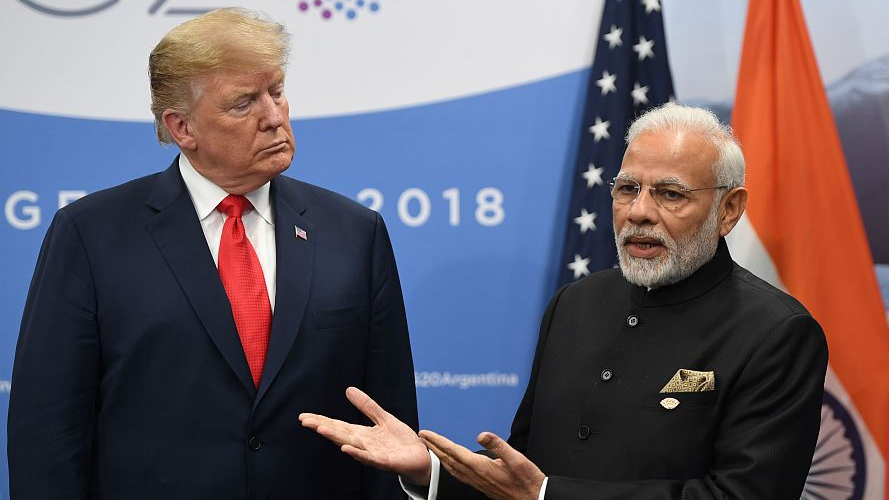
U.S. President Donald Trump (L) listens to Indian Prime Minister Narendra Modi during a meeting on the sidelines of the G20 Leaders' Summit in Buenos Aires, November 30, 2018. /VCG Photo
In fact, the U.S.' increased export of arms and energy to India might account for why it surprisingly became the country's top trading partner, though there are concerns that this is might have been at Russia and Iran's relative expense.
Moscow is still New Delhi's main military partner but its share of Indian supplies has consistently decreased over the past decade as Washington's has grown, as proven by the "Trends In International Arms Transfers, 2018" report released by the Stockholm International Peace Research Institute back in March.
As for energy, India agreed to abide by the U.S.' unilateral sanctions against Iran despite previously promising last year to only respect multilateral ones legitimized by the UN Security Council. Although India insists that it's "multi-aligning" (as its experts call it in their parlance) and not pivoting towards the U.S., it's hard not to wonder whether it could have done so more "gracefully" than it has.
One possible reason why it hadn't might be because the U.S. is politicizing its growing economic influence over India in respect to the aforementioned issues of arms and energy purchases, which would mean that the pressure that it's putting on its partner in the technological domain over Huawei is merely the continuation of this trend.
Just as military cooperation forms the basis for India's strategic partnership with Russia, so too does its energy cooperation with Iran. With that in mind, technological cooperation could play a similar role in the Indian-Chinese Strategic Partnership too, which is why the U.S. is against all three and putting pressure on New Delhi to weaken these relationships and replace each respective partner with itself. In view of this, the U.S.' reported letter to India's Ministry of External Affairs threatening "punitive action" against Indian companies that sell American parts to Huawei is part of a larger strategic game.
Having said that, India's national interests are best served if its leaders make their decisions independently of American pressure. Objectively speaking, Huawei's construction of the South Asian state's planned 5G network would greatly contribute to the strengthening of the Indian-Chinese Strategic Partnership, which in turn would increase the importance of the BRICS and SCO multipolar structures that they both form such crucial components of.
Prime Minister Modi and President Xi had a friendly meeting at the second-mentioned institution's summit last week in the Kyrgyz capital of Bishkek and they both plan to hold a trilateral meeting with President Putin during the upcoming G20, so it's important for India to keep up the positive momentum that it's achieved in furthering Eurasia's multipolar integration. Complying with America's dictates against Huawei would endanger all of that, so India should stay strong and resist its new partner's pressure.
(If you want to contribute and have specific expertise, please contact us at opinions@cgtn.com.)