
 []
[]
Share







Copied

Editor's note: This article is an edited translation of a Chinese story published on the WeChat accounts of Yuyuantantian on June 24, 2019. The article reflects the authors' opinions, and not necessarily the views of CGTN.
The past two weeks witnessed China's mid-year shopping spree.
Among the Chinese e-commerce entities, Alibaba's online retailer Tmall has received 150 million orders placed by shoppers. Statistics show that one out of every eight orders was for electronic devices, pushing the sales of more than 40 related brands beyond 100 million Chinese yuan; nearly 200 emerging Chinese brands registered a growth of over 1,000 percent.
On Suning.com, another Chinese online retailer, order placements during the first hour of the "June 18" online shopping festival increased by a stunning 215 percent year over year, contributing to a 133 percent year-on-year growth of orders placed through all channels.
On Pinduoduo, a Chinese group buying site, the number of orders placed during the festival topped 1.08 billion by 19:40 on June 18, of which nearly 70 percent were from lower-tier cities.
An unexpected group of shoppers
The shoppers belong to what is called the "grassroots market" that includes all but tier-one and tier-two cities.

Major Chinese online shopping platforms have posted strong sales growth in the June 18 shopping festival. /VCG Photo
As China's economy grows at a relatively fast speed, this part of the market has become a new battlefield for competition among unicorn start-ups and well-established e-commerce retailers alike.
The grassroots market- A newly awakened force
The potential of the grassroots market has long been in the shadows of the tier-one cities. Over the past few years, however, both the per capita disposable income and consumption expenditure of rural residents have exceeded those of their urban counterparts.
Canny business owners, poised to take a share of the grassroots market, have all started to take concrete actions during the past week.
For Pinduoduo, one of the earliest explorers in the grassroots market, nearly 70 percent of all its orders placed during the festival came from lower-tier cities. Also extremely popular among consumers in tier-three and tier-four cities were Chery cars, Midea air conditioners, electric shavers and toothbrushes.
3156 Suning offline county- and township-level stores partook in the mid-year shopping promotion, driving up the retailer's sales revenue and sales volume by 222 percent and 556 percent respectively year over year.
It has therefore resulted in a heated competition.
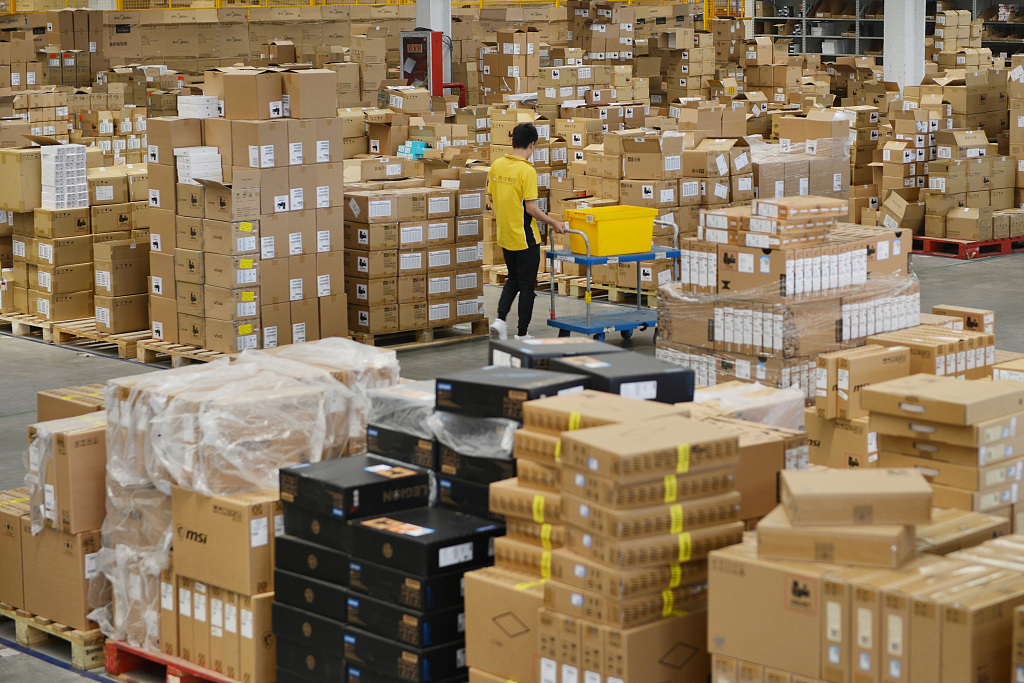
A warehouse filled with packed products that worth 800 million Chinese yuan. /VCG Photo
On Pinduoduo, over 700,000 Chinese yuan was spent within 8 hours as deposits for the Chery automobile released online on June 18. Considering that the deposite was set at only 999 yuan, which means on average for each hour of the sale, there were 90 users, mostly from tier-four, tier-five, and tier-six cities, placing deposits.
On Tmall, the number of shoppers from tier-three, tier-four, and tier-five cities who purchased goods on the platform and their total spending both increased by over 100 percent year over year.
Revenues of the most popular brands such as Apple jumped 170 percent year over year in tier-three, tier-four, and tier-five and tier-six cities, twice the figure in tier-one and tier-two cities. On Taobao's group shopping website Juhuasuan, the sales revenue of iPhone XR topped 50 million yuan within just one minute.
Among the 100 million new members of Taobao registered last year, about 80 percent are from the grassroots market in lower-tier cities.
Therefore, the grassroots market bolstered the growth of domestic brands.
Heading towards a promising future
But, the grassroots market rises for a reason.
According to E-commerce in China 2018 recently released by the Ministry of Commerce, rural e-commerce trade volume hit 1.37 trillion yuan in 2018, registering a year-on-year increase of 30.4 percent.
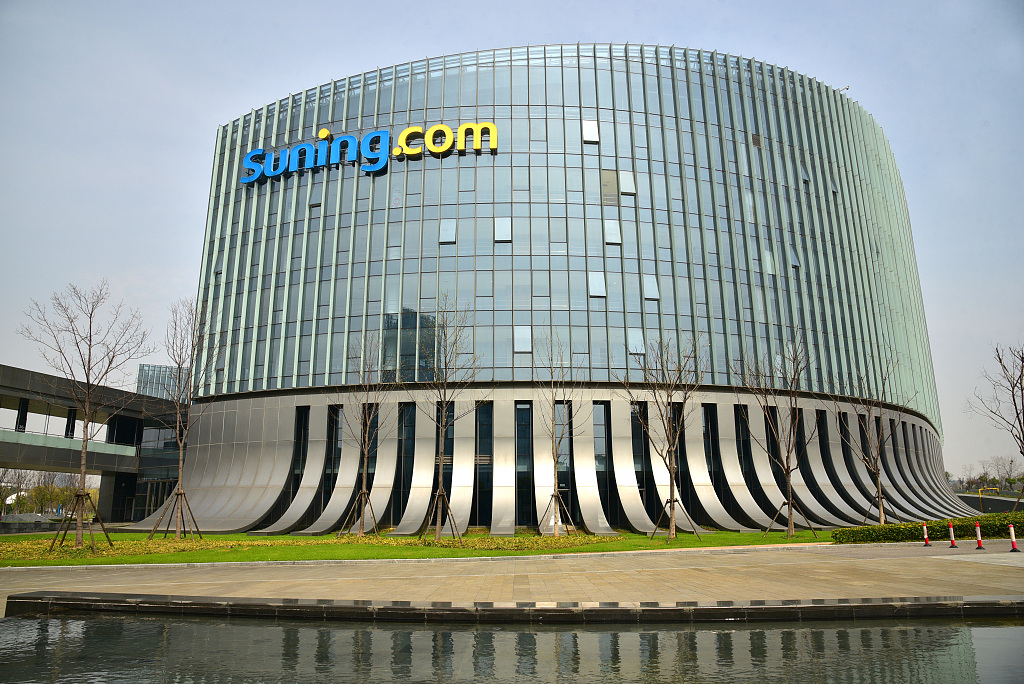
The headquarters of Suning.com Co., Ltd., one of the largest non-government retailers in China. /VCG Photo
Although accounting for only 4.3 percent of the total e-commerce revenue (31.36 trillion yuan), the growth rate exceeds the overall number (8.5 percent) by nearly 22 percentage points.
To occupy the market of lower-tier cities and build differentiated advantages to compete with e-commerce giants, some retailers have established their presence in tier-three, tier-four, and tier-five cities by tailoring their products to the needs of consumers in the grassroots market, and have thus become a market force to be reckoned with.
Now, an increasing number of urban residents have chosen to engage in entrepreneurial and innovative endeavors in rural areas. This number, according to statistics from the Ministry of Agriculture and Rural Affairs, has hit seven million and is still on the rise.
Besides, during the past six years, the population that lives below the national poverty line in rural areas has decreased from 98.99 million in late 2012 to 16.6 million in late 2018.
The goal for 2019 is to lift at least another 10 million people out of poverty, and rid around 300 counties of the status of "impoverished counties". By the end of last year, 832 state-level impoverished counties, 88 percent of the national total, had been made demonstration counties for the introduction of e-commerce in rural areas.
Moreover, by the end of December 2018, the total number of broadband network users in China's rural areas increased by 23.64 million to 117 million. As signal towers and optical fibre become new pillars for agricultural development in more villages, new business models such as e-commerce start to flourish in rural areas.
While tier-one and two cities lead the medium- and high-end consumer markets, the grassroots market is harboring enormous potential that is yet to be unleashed. However, China's consumer market as a whole, boasting a population of 1.4 billion, is the essential foundation and driving force for China's future economic development.
(If you want to contribute and have specific expertise, please contact us at opinions@cgtn.com.)