
 []
[]
Share







Copied
Editor's note: Tracy Chen is an assistant research fellow from The School of International Development at UEA.The article reflects the author's opinion, and not necessarily the views of CGTN.
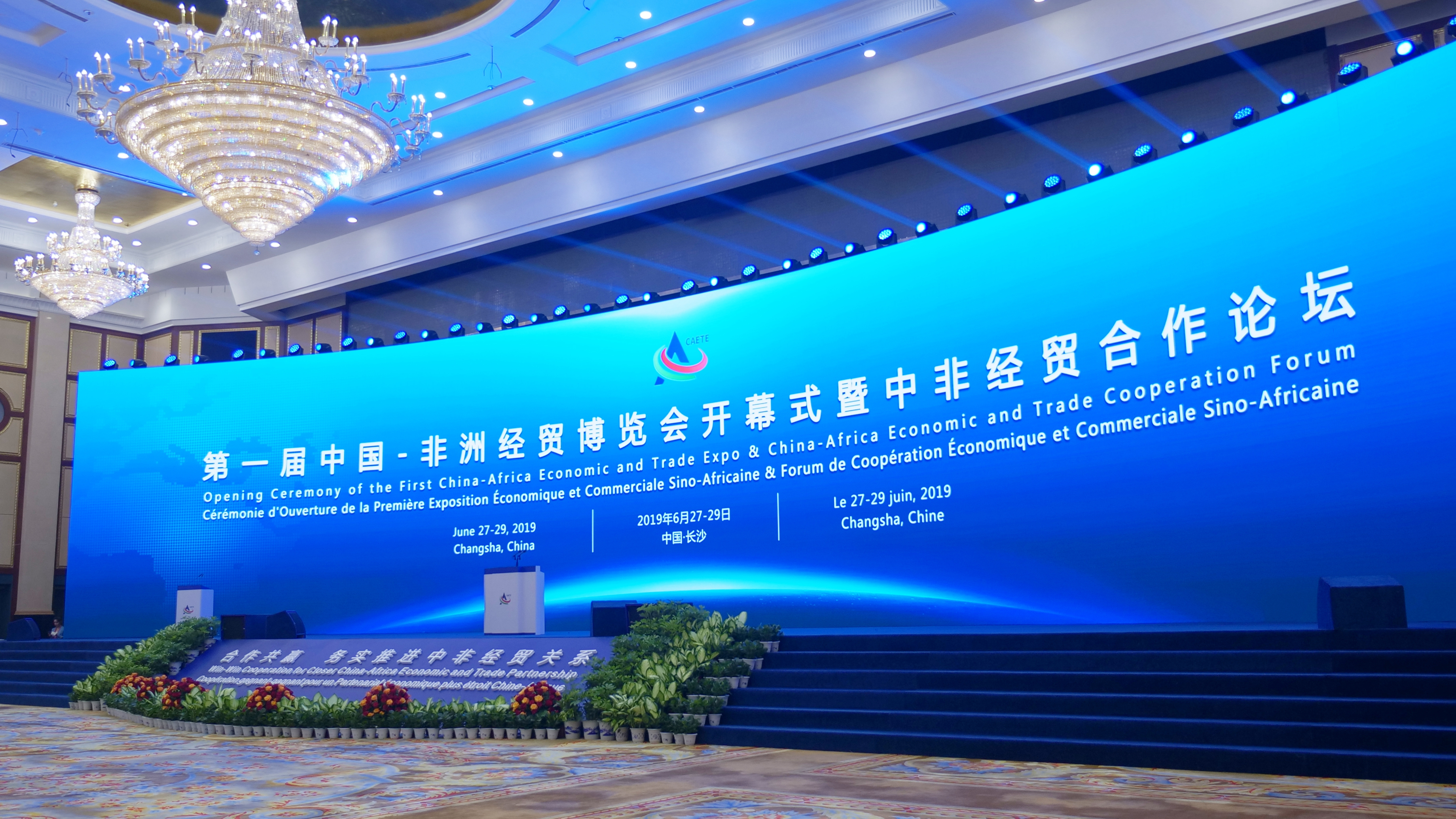
As the first concrete measure of the eight major initiatives announced by President Xi Jinping at the 2018 Beijing Summit and the 7th Ministerial Conference of Forum on China-Africa Cooperation (FOCAC), the China-Africa Economic and Trade Expo will be held in Changsha, Hunan Province, on June 27-29.
It is the first economic and trade expo specifically organized for African countries in China. A total of 53 African countries, 31 Chinese provinces and municipalities, the United Nations Industrial Development Organization (UNIDO), World Food Program (WFP), WTO, the African Union and other international organizations have registered to participate in the exhibition.
In 2018, the China-Africa trade volume reached 204.2 billion U.S.dollars, an increase of 19.7 percent over the previous year. China has become Africa's largest trading partner for 10 consecutive years. According to statistics from the General Administration of Customs of China, China's exports to Africa in 2018 were 104.91 billion U.S. dollars, up 10.8 percent and China's imports from Africa were 99.28 billion U.S. dollars, up 30.8 percent. Though in 2018, the surplus was 5.63 billion U.S. dollars, down 70 percent year on year, the trade imbalance will continue to be a hot topic when talking about China-Africa trade relations.
It is true that most African countries run large deficits with China, but this is the current trade pattern that Africa has with many other countries.
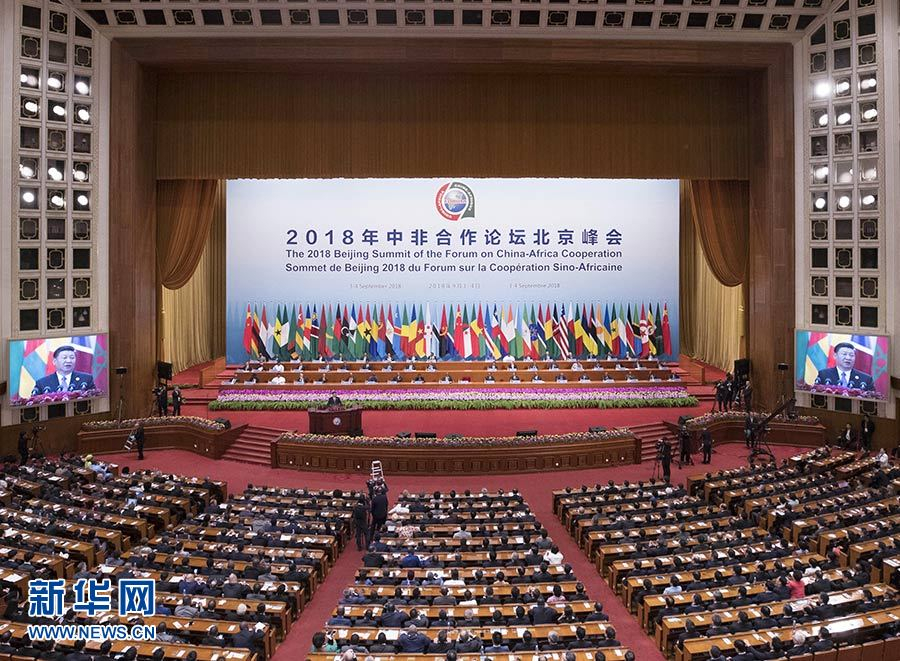
Opening ceremony of the 2018 Beijing Summit of the FOCAC, Sept. 3, 2018. /Xinhua
Take the example of South Africa. South Africa had trade deficits with China, but it also has trade deficits with Saudi Arabia, Germany, Thailand, France, Nigeria, Italy and Brazil. Likewise, Nigeria and Botswana have heavy trade deficits with just about anyone.
With economic development and structural transformation, the self-circulation system of production, investment and financing in African countries are constantly taking shape. However, for quite a long time to come, Africa's endogenous factors are not enough to support its rapid development and huge demand. For now, it is unrealistic for Africa to be separated from the external market. It needs technology and especially financial support.
Both China and Africa want to promote economic and trade cooperation from the past blood transfusion to hematopoiesis and to accomplish such a transformation, concrete measures should be taken.
With the theme of "Win-Win Cooperation for Closer China-Africa Economic and Trade Partnership," China and African countries will explore new ways and measures for China-African economic and trade cooperation with a series of forums concerning agriculture, trade, infrastructure and financing, as well as investment promotions and business negotiation activities.
Take agricultural industry, for example. There are many agricultural products in Africa, but its processing and export-orientation degree is very low. The development of the agricultural industry needs not only the participation of big enterprises but also many small and medium-sized ones. The host city Changsha is the provincial capital of Hunan, which is a major agricultural province in China and its agricultural products processing industry now enjoys a scale of more than one trillion yuan.
As the first platform for local cooperation between China and Africa, this expo will be a good chance for companies from both sides to take opportunities to cooperate. Meanwhile, to further promote Africa's non-resource products to come into the Chinese market, the expo has set up a long-term African commodity exhibition hall in the Gaoqiao market in Changsha.
At the Beijing Summit of the Forum on China-Africa Cooperation in September last year, President Xi Jinping announced that China would upgrade and build a number of overseas economic and trade cooperation zones in Africa.

Fireworks performance in Changsha, Hunan Province, June 26,2019. /VCG Photo
During the past 40 years, industrial parks and economic development zones have played a very important role. They attracted a large number of domestic and foreign enterprises, funds and technology with favorable preferential policies and high-quality resources. China has now built up 25 economic and trade cooperation zones in Africa, which have made positive contributions to Africa's industrialization, job creation and export growth.
China will upgrade and renovate the existing 25 trade and economic cooperation zones in Africa, promoting infrastructure construction, investment environment, sewage treatment, vocational training and environmental protection. At the same time, a number of new economic and trade cooperation zones will be built responding to the wishes and needs of different African countries.
Since the establishment of the FOCAC in 2000, China and Africa have been looking for ways to advance common growth and development. But in the process of economic and trade cooperation, the volumes of trade between the two parties would not necessarily exactly balance. The most important thing for China and Africa is mutual benefit and a concentration of resources in industry in a manner that is complementary.
(If you want to contribute and have specific expertise, please contact us at opinions@cgtn.com)