
 []
[]
Share







Copied
Editor's Note: The article is based on an interview with Wang Yong, a professor at the School of International Studies at Peking University. The article reflects the expert's opinion, and not necessarily the views of CGTN.
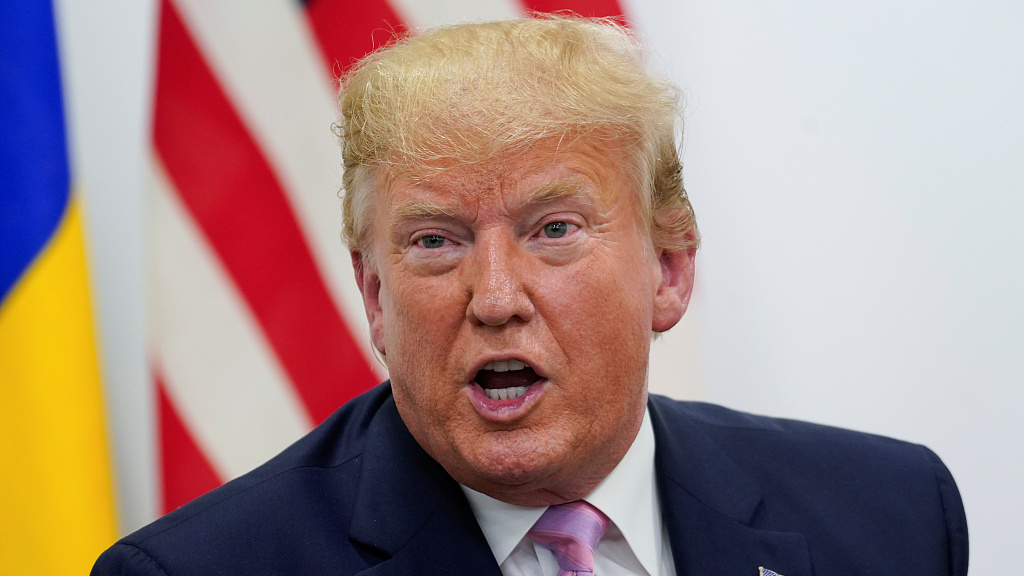
The world's two largest economies agreed to resume stalled trade negotiations on the sidelines of the G20 summit in Japan on Friday. In his first face-to-face conversation with Chinese President Xi Jinping in seven months, U.S. President Donald Trump agreed not to impose new tariffs on Chinese exports and allowed American companies to continue selling products to Chinese telecommunications giant Huawei.
The result is within expectation, according to Wang Yong, a professor at the School of International Studies at Peking University. Despite previous exchanges of tariff threats, both leaders are eager to clinch a fundamental trade deal at the earliest date.
From the U.S. side, the clock is ticking for the 2020 presidential election and it is not the first time that Democrats pulled the trigger on Trump’s multi-lose trade war. "Tariffs are taxes. And Americans are going to pay on average 800 U.S. dollars more because of these tariffs," said Pete Buttigieg, mayor of South Bend, Indiana, lashing out at Trump in a debate.
Resuming trade talks with the world's second largest economy is the easiest way for Trump to refute his Democratic rivals and woo more voters in the campaign, Wang told CGTN. It is worth noting that the American farmers and blue-collar workers who made Trump a president in 2016 are the biggest victims of the trade tensions.
While China purchased 60 percent of American soy exports in 2017, the price of American soybeans is hovering at the lowest level in more than a decade because of the trade friction. Trump cannot afford to lose the votes from his previous supporters and resuming trade negotiations, a prerequisite to persuading Beijing to buy more crops, would be Trump's special gift for them.
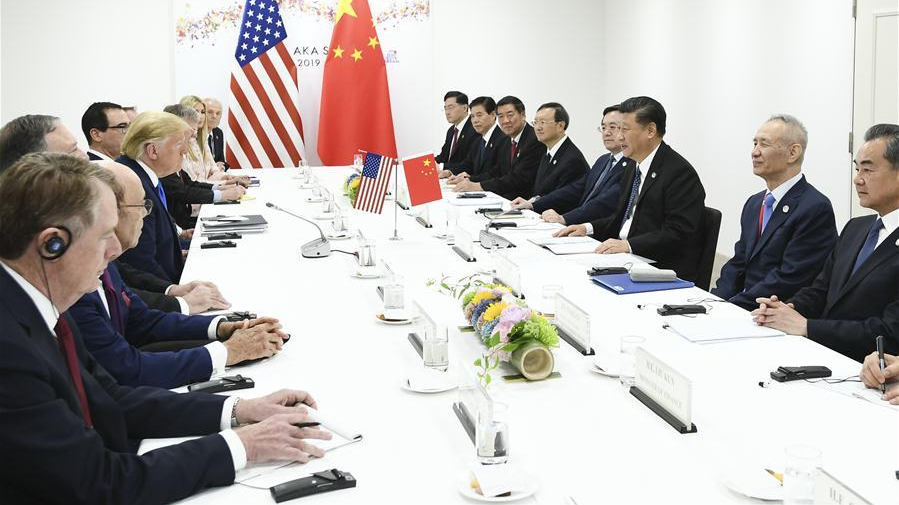
Chinese President Xi Jinping meets with U.S. President Donald Trump in Osaka, Japan, June 29, 2019. /Xinhua Photo
Apart from political motivations, the U.S. economy can no longer withstand the deteriorated ties with the Asian giant, Wang noted. The tit-for-tat tariffs have already cost both countries billions of dollars, disrupted the global industrial chain and dragged the global economy into uncertainty. Trump's aggressive trade approach on China was to close trade gap, but, ironically, have widened trade deficits with China.
A slew of American companies that are relying heavily on the Chinese market and China-made products have filed repeated complaints against Trump's tariff threats. The ban on Huawei is also imposed at the sacrifice of American high-tech competitiveness.
In the era of globalization, the U.S. is shooting itself in the foot if it decouples from the Asian country. The nature of global supply chains and the law of economics always prevail over politicians' wayward decisions. Stopping the exchange of tariff threats and returning to the negotiating table will prevent the U.S. economy from a further slide.

American farmer John Boyd checks the condition of his soybean field in Baskerville, Virginia, the U.S., January 8, 2019. /VCG Photo
For China, a stable relationship with the United States will win it a peaceful external environment for domestic development. Although the Chinese economy is resilient enough to withstand the trade friction, tariff hikes have already harmed the interests of many export-oriented Chinese enterprises.
Confrontation is not the way out. China is sincere to re-negotiate with the U.S. and clinch a deal that is in the interests of both countries, just as President Xi said at the summit that "cooperation and dialogue are better than friction and confrontation."
Whether the resumption of talks would breed a fundamental trade deal still faces uncertainties, Wang said. Differences on some fundamental issues remain unsettled. Moreover, some hawks in the Trump's camps including Secretary of State Mike Pompeo and National Security Advisor John Bolton are obstinate in their anti-China stance and are seeing rising influences on Trump's Beijing policy.
The on-again-off-again trade talks, according to Wang, may be a new normal in China-U.S. relations. In the era of global integration, China and the U.S. should focus more on their common interests than differences. For both countries, cooperation is the only way out.
(If you want to contribute and have specific expertise, please contact us at opinions@cgtn.com)