
 []
[]
Share







Copied

Editor's note: The following article was first published by China Plus on July 1, 2019. The article does not necessarily reflect the views of CGTN.
The National Development and Reform Commission and the Ministry of Commerce have released two updated negative lists for this year, allowing foreign investors to take control or sole proprietorship in more fields in China.
The unveiling of the new shortened lists took place less than 48 hours after Chinese President Xi Jinping spoke at the Osaka G20 summit, stating that China would further expand its opening-up process in five respects. The momentum and speed of opening-up clearly demonstrates the country's determination to take action.
China's new version of the negative lists for foreign investment has three characteristics: First, the number of items off-limits to foreign investment has been cut from 48 down to 40 for nationwide implementation, representing a reduction ratio of 16.7 percent.
A separate list governing foreign investment in China's pilot free trade zones, which enjoy a higher degree of openness, has slashed restricted areas from 45 to 37, a reduction of 17.8 percent.
Second, China is open to foreign investment in a wide range of sectors, involving agriculture, mining, manufacturing, transportation, value-added telecommunications, infrastructure and cultural services.
Third, the government continues to give free trade zones the ability to develop policy initiatives as early adopters in expanding opening-up, including the removal of restrictions on foreign investment in free trade zones in aquatic products, fishing and publications.
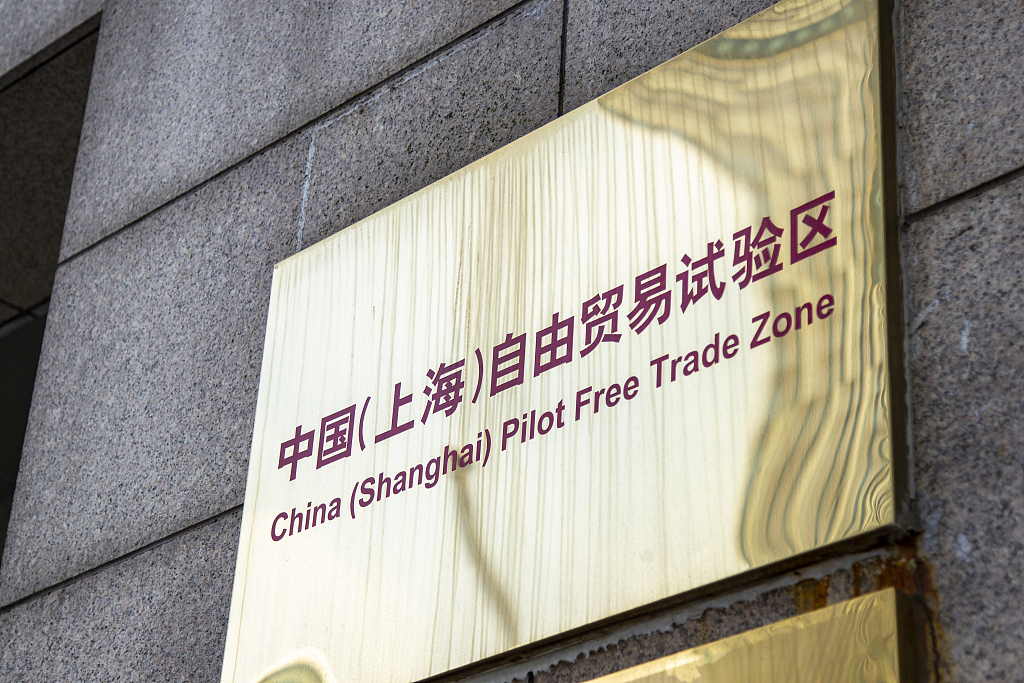
VCG Photo
China has once again provided reassurance to foreign companies in China through a firm commitment to continually expanding its opening-up and has made new contributions to promoting cooperation in the global industrial value chain.
In recent years, China has been pursuing a policy of “subtraction” in terms of the negative lists for foreign investment access and has promised to completely remove restrictions on foreign investment access outside the negative lists. For example, the negative list of the Shanghai Pilot Free Trade Zone has been shortened from the initial 190 restrictions to 37.
As a key step in institutional openness, China passed the Foreign Investment Law in March this year, clearly defining intellectual property rights and technology protection for foreign-invested enterprises, their pre-entry national treatment plus a negative list management system, and their investment, revenues and other legal rights in China.
The further expansion of the opening-up process is an inevitability as China seeks high-quality economic development and to increase public benefit. In recent years, China's manufacturing industry has essentially liberalized foreign investment, and the opening-up of the service industry is also accelerating.
In the first quarter this year, the added value of China's service industry accounted for 57.3 percent of its GDP, which still lags behind that of developed countries whose service sectors usually make up 70 percent of their GDPs. Under the new negative lists, service sectors including shipping agencies, gas and heat pipelines in cities, cinemas, performance brokerage institutions, and value-added telecoms will see ownership restrictions relaxed or removed soon.
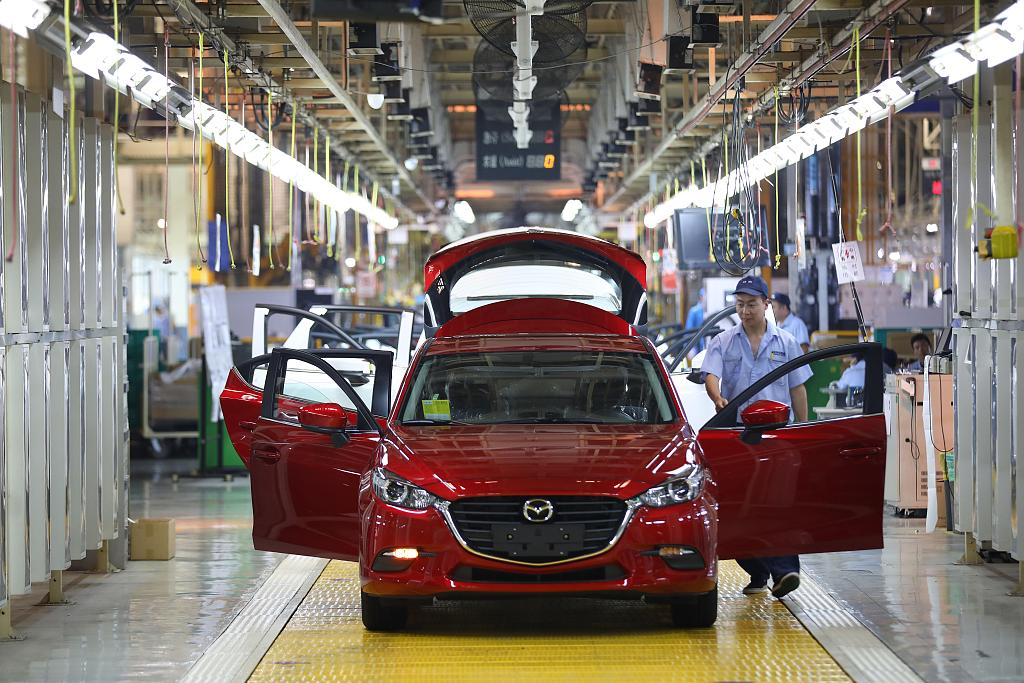
A vehicle manufacturing workshop in Nanjing, east China's Jiangsu Province, June 5, 2019. /VCG Photo
This will help speed up China's related industries, encourage domestic companies to grow stronger in the face of tougher competition, and enhance the sense of well-being and gain among the people.
The new negative lists will clear the way for major new foreign investment in China. At present, foreign companies are responsible for half of China's foreign trade and account for about a quarter of the industrial enterprises above a designated size (those with annual main business revenue of 20 million yuan or more).
Take the cancellation of restrictions on foreign ownership of cinemas and performance brokerage institutions. The massive potential offered by China’s market of 1.4 billion people, which has already seen annual box office sales worth nearly 60 billion yuan, will be noticed by external investors.
Since the beginning of this year, the escalation in trade friction has frequently impacted the global industrial value and supply chains. It is crucial for China, as the world's largest trader of goods and the second largest in terms of service trade, to become a steady influence amid instability and uncertainty.
The Japanese Chamber of Commerce and Industry in China recently published a white paper on the Chinese economy and Japanese enterprises in 2019, stating that Japanese companies in China are expecting further opening-up of the Chinese market.
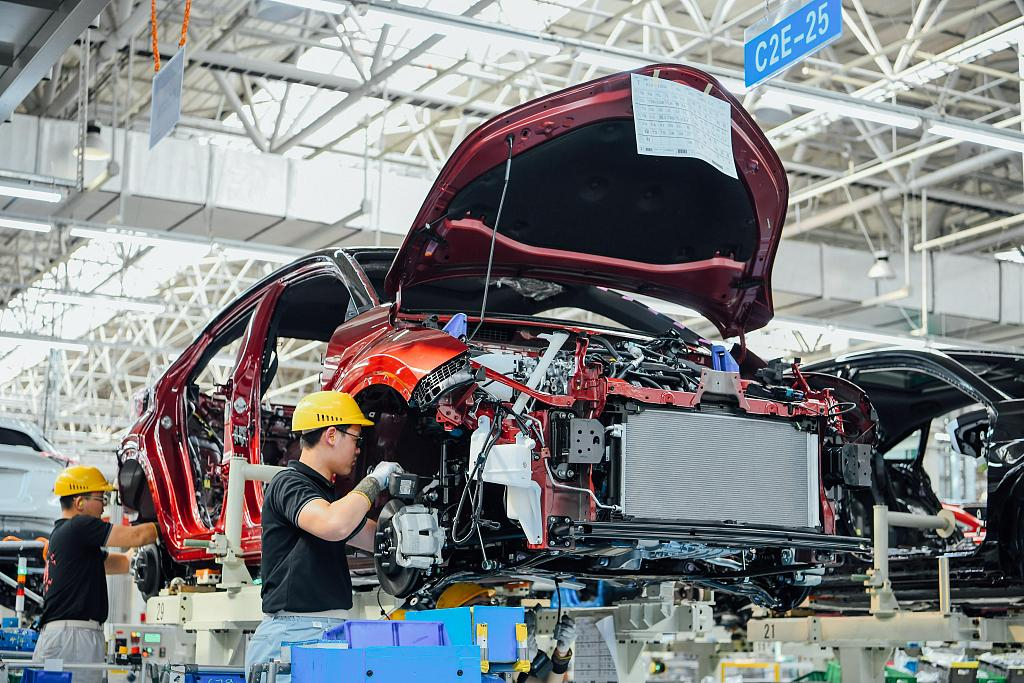
Japan's Toyota manufacturing workshop in China, March 22, 2019. /VCG Photo
It's not only Japanese companies that regard the Chinese market as an important support for their global development strategy, with many foreign firms increasing their investment and foothold in China.
In addition to the construction this year of Tesla's Shanghai Gigafactory, British Telecom has become the first international telecommunications company to obtain a license to operate in China, and UBS AG has achieved absolute control over its Chinese affiliate UBS Securities Co. Ltd.
Meanwhile, Allianz (China) Insurance Holding Co. Ltd. has been given the go-ahead to establish China's first foreign insurance holding company, and Standard & Poor's has been cleared to enter the Chinese credit rating market.
The "slimming" of the negative lists for foreign investment access not only demonstrates the increasing momentum of China’s opening-up process but also provides certainty and policy guarantees for foreign businesses wishing to invest in China, share in the country’s development opportunities, and achieve mutually beneficial and win-win outcomes.
Facts prove that no matter how the world changes, China's economy has always remained broad, stable and bright. It is ready to embrace every partner based on the principle of achieving shared growth through consultation and collaboration.
(If you want to contribute and have specific expertise, please contact us at opinions@cgtn.com.)