
 []
[]
Share







Copied
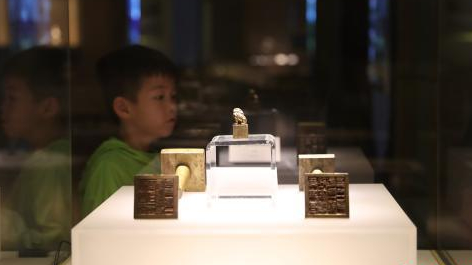
Over 200 cultural relics showcasing the prosperity of the Tang-Bo Ancient Road are on display in Yin Chuan, northwest China's Ningxia Hui Autonomous Region.
The exhibition shows the genesis of the Tang-Bo Ancient Road, going as far back as the Song Dynasty (960-1279), and its evolution into a route connecting South Asia.
Cultural relics, images and texts display the influence of political relations, and economic and cultural exchanges between the Tang Dynasty (618-907) and Tibetan Tubo Kingdom (about 618-842) on the road.
The Tang-Bo Ancient Road is one of famous ancient roads in China. It started from Chang'an, the capital of the Tang Dynasty, and ended in Lhasa, the capital of the Tibetan Tubo Kingdom.
The 3,000 km-long road connected such regions as Shannxi, Gansu, Qinghai, Sichuan and Tibet. For the longest time, it was the only way linking central China to Qinghai Province, Tibet Autonomous Region and beyond, including countries like Nepal and India.
It was also an important part of the Silk Road network, and enabled ethnic and cultural exchanges, trade contacts, religious communication, and regional ties.
"This joint exhibition embodies the advantages of cultural relics resources along the Tang–Bo Ancient Road, and is the result of research cooperation among museums of various provinces and regions," said Li Zengjin, the curator of Ningxia Museum.