
 []
[]
Share







Copied
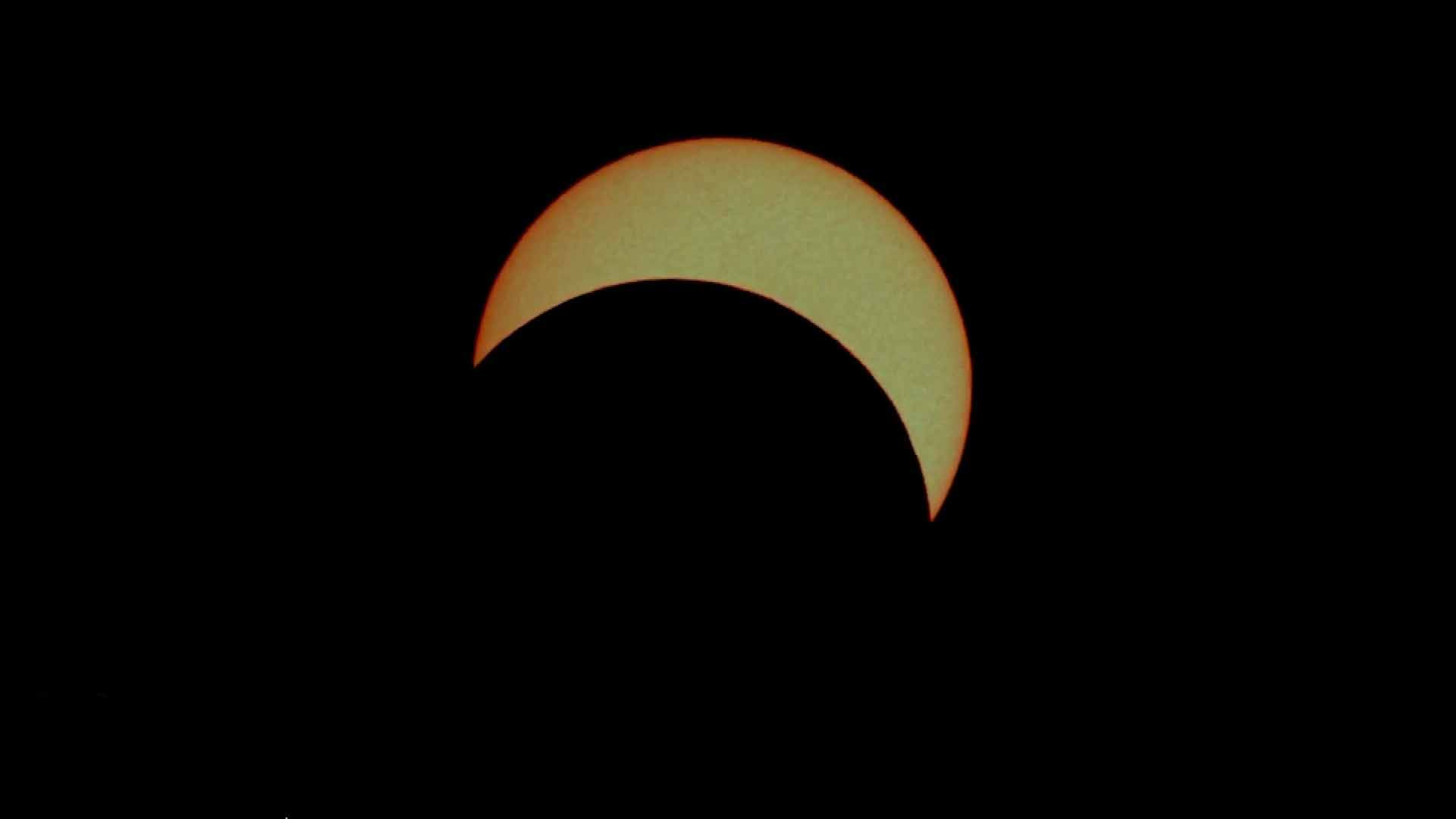
Hundreds of thousands of South Americans were enthralled by the biggest sky-watching event of 2019 on Tuesday – a rare total solar eclipse plunging a vast swath of Latin America's southern cone into darkness, and briefly turning day into night.
The solar eclipse this time began at 13:01 (17:01 GMT) in the Pacific Ocean and a 95-mile (150 kilometers)-wide band of total darkness reached Chile's coast at 4:38 pm (20:38 GMT), before crossing into southeastern Argentina and the wastes of the South Atlantic.
People in Argentina and Chile, a country that hosts some of the world's most powerful astronomical telescopes, looked to the skies captivated by the breathtaking spectacle.
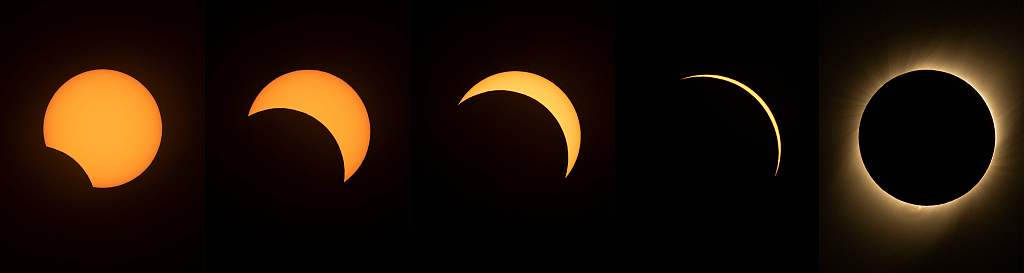
Different stages of the solar eclipse as seen from the La Silla European Southern Observatory (ESO) in La Higuera, Coquimbo Region, Chile, July 2, 2019. /VCG Photo
Why is this eclipse so rare?
Total solar eclipses are rare, but what is even rarer about Tuesday's event is that it occurred directly over an area of the Earth most prepared to witness the heavenly bodies.
Both Argentina and Chile are situated under the narrow long band of Earth that are best places to experience the eclipse, where dryness, crystal-clear air, and little light pollution have created a stargazers' paradise.
Chile's Coquimbo region near the Atacama Desert – festooned with some of the planet's most powerful telescopes – was situated directly on the eclipse's 100-mile-wide "path of totality."
"Very seldom has it happened that the whole of an eclipse is seen over an observatory, the last time this happened was in '91," said Matias Jones, an astronomer at the landmark La Silla Observatory operated by the European Southern Observatory.
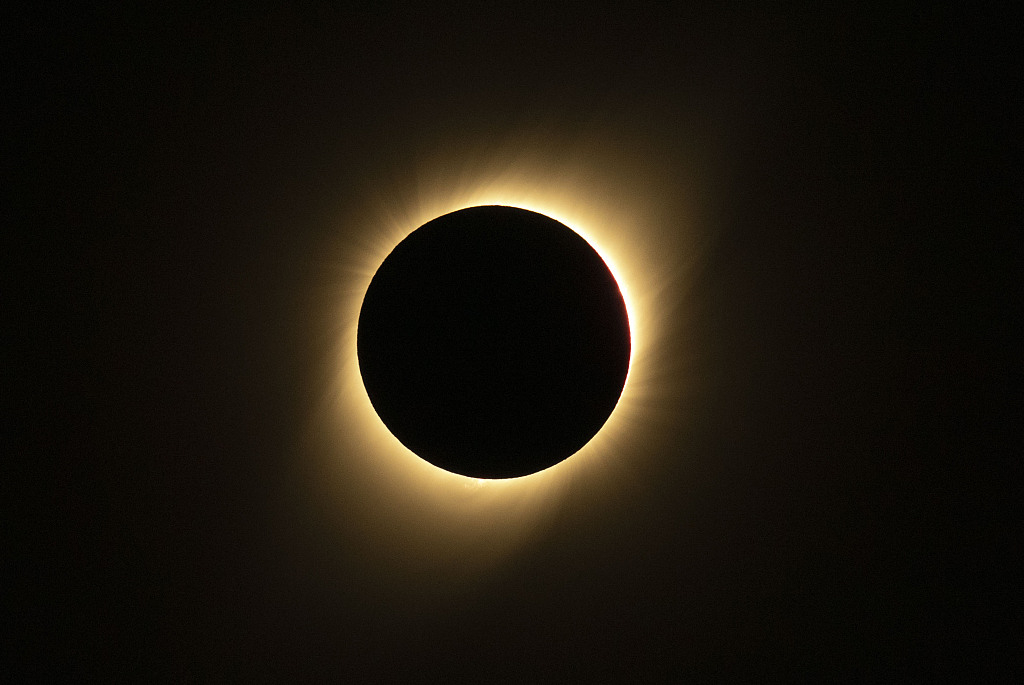
Solar eclipse as seen from the La Silla European Southern Observatory (ESO) in La Higuera, Coquimbo Region, Chile, July 2, 2019. /VCG Photo
How do solar eclipses happen?
Solar eclipses happen when the Sun, the Moon and Earth line up, allowing the Moon to cast its shadow on Earth.
There are four types of eclipses: total, partial, hybrid and annual. They distinguish from each other by the proportion of the shadowed area.
Take the total solar eclipses as an example, when the orbital planes intersect, and the distance aligns favorably, the Moon can appear to blot out the disk of the Sun completely. The total eclipse occurs somewhere on Earth about every 18 months.
In recent years, the longest duration in which the Moon completely covered the Sun was during the solar eclipse of July 22, 2009, with a maximum duration of 6 minutes and 39 seconds.
There will be 224 solar eclipses, including 68 totals during the 21st century, according to a scientific report by NASA.
The next total eclipse will be visible in southern Chile on December 14, 2020.
(With input from AFP)