
 []
[]
Share







Copied
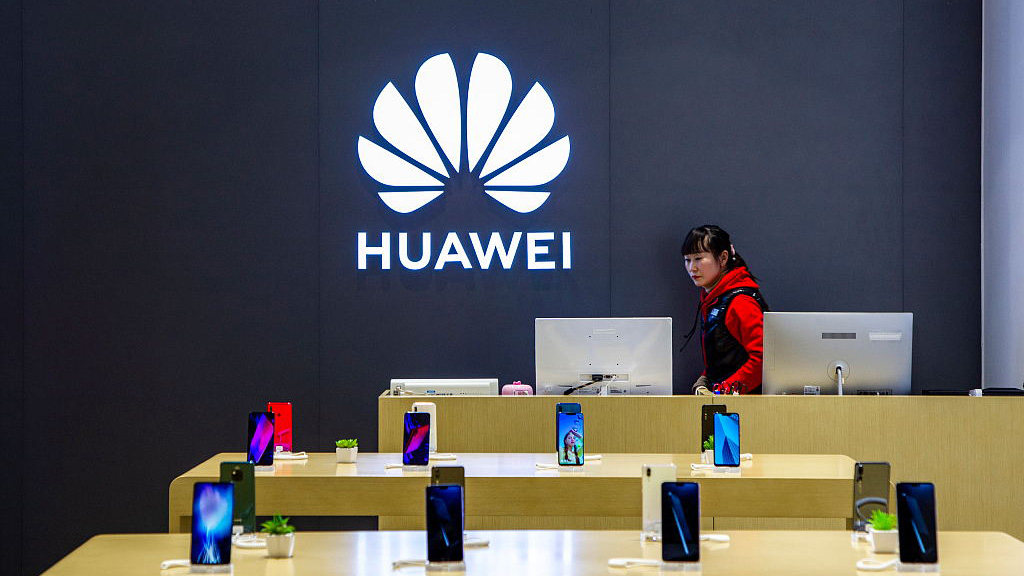
Huawei, one of the world’s biggest telecommunications companies and service providers, is leading the way in 5G wireless technology.
The company is also caught in the middle of the U.S.-China trade war. The U.S. Commerce Department put the company on its “entity list” in May, banning all U.S. companies from selling products to Huawei. U.S. President Donald Trump also signed an executive order stopping U.S. firms from purchasing or using Huawei telecom gear.
Washington claims Huawei could use its technology to spy on behalf of the Chinese government, something the company has repeatedly denied. After talks with Chinese President Xi Jinping on the sidelines of the G20 Summit, President Trump changed his position.
Andy Purdy served as a top cybersecurity official for the U.S. government and is now the chief security officer for Huawei Technologies USA. “I think the best scenario for us would be if the United States government would engage in serious discussion with Huawei because the Chinese government doesn’t speak for us, and we don’t speak through the Chinese government,” said Purdy.
Purdy hopes that Huawei would not only be able to buy from American companies but also continue to support its rural wireless and wireline customers in America.
He thinks the “entity list” means heightened scrutiny to make sure Huawei abides by trade rules in the U.S. And it’s not clear to what extent Huawei is able to buy the core products that American companies have been selling to it. “I don’t think it serves anybody’s interest if Huawei finds other means of buying all these products and decides to do it for the long term,” he asserted.
In Purdy’s view, there is a geopolitical context with the rise of China's economy and military. And China has influence around the world with various influential industrial projects. The U.S. is looking at a world where it was once the strongest power, but now China is becoming a competitor. The U.S. is trying to make sure that it is prepared if China turns hostile toward the U.S.
Regarding the accusation against Huawei, Purdy pointed out that the real concern of the U.S. is China, not the Huawei company. Also, cyberspace is an unsafe world. There are at least five nations in the world that can virtually implant hidden functionally to do bad things.
“The fact is, we [Huawei] can’t turn over data that we don’t have. And the only access we get the customer data is specially configured laptops that every keystroke is logged and recorded. So, you can see exactly what we did to the data,” Purdy argued, “That’s not the way it’s pictured in public media.
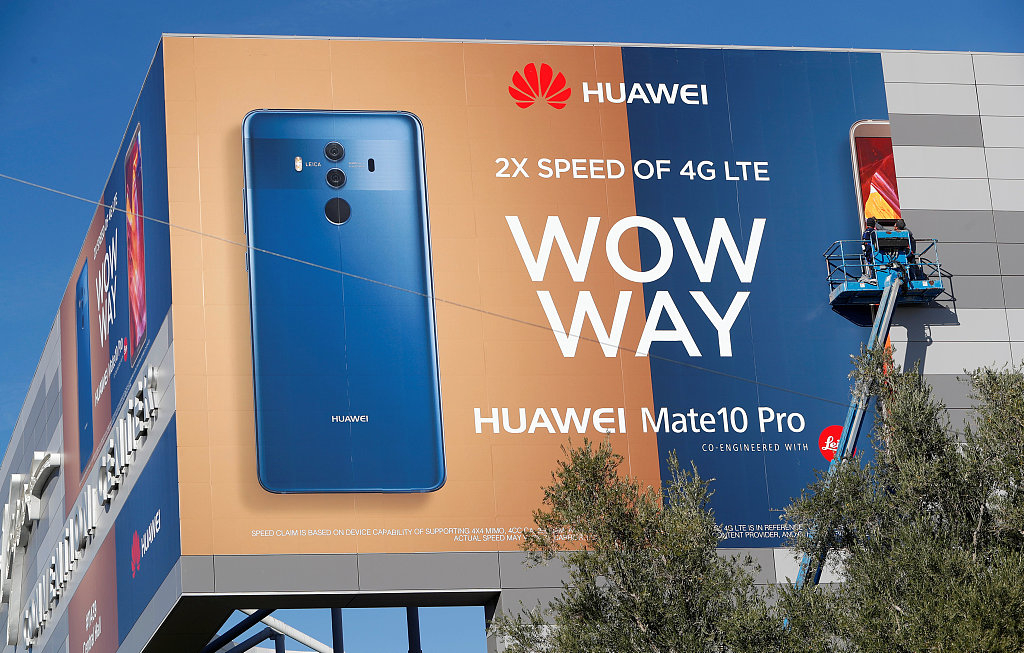
A crew hangs a Huawei advertisement on the side of the Las Vegas Convention Center as workers prepare for the 2018 CES in Las Vegas, Nevada, USA, January 5, 2018. /VCG Photo
Purdy hopes that the U.S. and China could work together. “We will have discussions about real cybersecurity risk and we have to understand the implications to our country. We need to be able to grow and improve with the best innovation, and we need to plan what technologies we care about,” he added.
Some U.S. lawmakers are upset that President Trump will allow U.S. companies to sell components to the Chinese telecommunications company, Huawei. Trump made the announcement at the G20 Summit in Osaka, Japan. In tweets, Senator Marco Rubio called the move a “catastrophic mistake,” and Senator Chuck Schumer said it “undercuts our ability to change China’s unfair trade practices.”
Matthew Bey, a senior global analyst at the intelligence firm Stratfor, thinks Huawei is trying to fight a hypothetical.
He also thinks a big concern of President Trump moving forward is what his election campaign strategy with respect to China is. Trump can be the first to create new deals with China, or he can say he put more tariffs on China. “If he does sign some strike in a card that he can’t sell to the American public and U.S. Congress, it could undermine his hands,” Bey said.
Einar Tangen, a political and economic affairs commentator with CGTN America, thinks the U.S. will not believe Huawei’s reassurance that there are no backdoors in its equipment. “When you are willing to do something, you think everyone else is willing to do the same,” he argued.
Tangen indicates that the real issue here is the U.S. lost two years behind Huawei. The U.S. believes that because Huawei has superiority in a leading technology that American ignored for too long, Huawei might use it the way that American would use it.
The Heat with Anand Naidoo is a 30-minute political talk show on CGTN. It airs weekdays at 7:00 a.m. BJT and 6:00 p.m. Eastern in the United States
(If you want to contribute and have specific expertise, please contact us at opinions@cgtn.com.)