
 []
[]
Share







Copied
Editor's note: Liu Jianxi is an opinion editor at CGTN Digital. The article reflects the author's opinion, and not necessarily the views of CGTN.
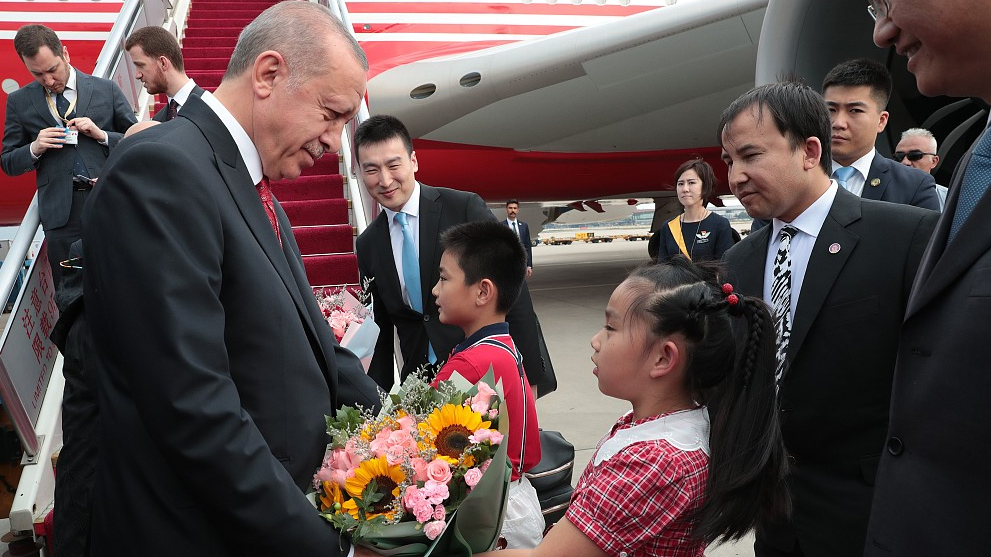
During his China trip on Tuesday, Turkish President Recep Tayyip Erdogan reiterated the importance of Beijing-Ankara bilateral ties and reached consensus with his Chinese counterpart Xi Jinping on a wide range of issues including the Belt and Road Initiative (BRI) and anti-terrorism cooperation.
But the blossoming China-Turkey relationship is not what some Westerners are ready to see. They harshly criticized Erdogan's silence on the Xinjiang Uygur Autonomous Region issue and argued that Ankara might be "rebalancing its strategic relations away from the West to the East."
Admittedly, Ankara is intensifying its economic ties with Beijing. But this is more about diversifying relations and cannot be equated with a "strategic shift" to the East, Li Weijian, a research fellow at Shanghai Institute for International Studies and vice president of the Chinese Association of Middle East Studies, told CGTN.
Today's world is no longer tied to the Western bloc. In an era of transformation, major economies are struggling to write the rules for the future global order. In this context, Ankara's diversification of relations with all countries conforms to the current tendencies.
As a NATO member, Turkey has been actively improving ties with its Western partners. But its efforts were only met with estrangements. The EU bloc has never opened its door to Ankara. Turkey-EU divergences on Ankara's planned purchase of Russia's S-400 air defense systems and the Syria crisis have further strained their relations.
This, combined with domestic economic difficulties, has prompted Erdogan to look east. China's BRI advocates multi-win cooperation. Extending from Asia and Europe to Africa, the Americas and Oceania, the BRI has opened a gateway to opportunities for shared prosperity. This is what Ankara needs.
"There is natural harmony between our Middle Corridor Initiative and China's Belt and Road Initiative," Erdogan said, adding that "this harmony allows us to cooperate with China in large geographies such as Central Asia and Africa."
For Ankara, cooperation in the BRI could not only bring instant infrastructural benefits. The rail and road network, if established, would make the country a future trade center at the crossroads of Europe, the Caucasus, the Middle East and the Mediterranean. This would be a considerable boost to Turkey's economy.
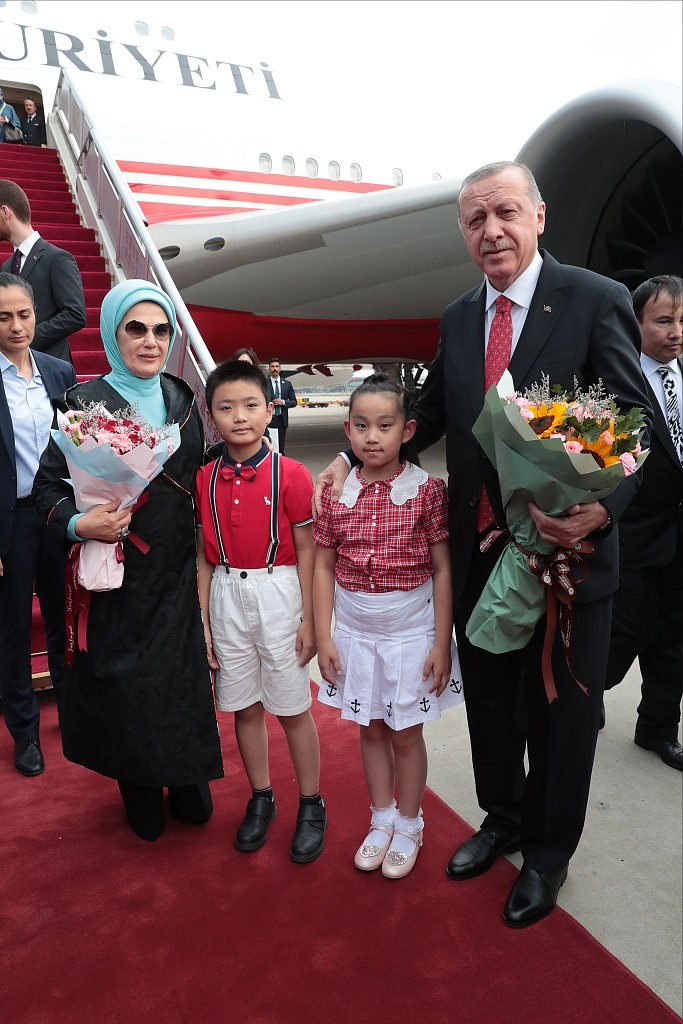
Turkish President Recep Tayyip Erdogan (R) and his wife Emine Erdogan arrive in Beijing, China, July 2, 2019. /VCG Photo
Apart from the economy, Ankara and Beijing share common interests in anti-terrorism security cooperation. Terrorist activists in China's Xinjiang, if not eliminated, would pose severe security threats to Turkey and even the whole world. Given the above, building friendly ties with Beijing conforms to Ankara's core interests and has nothing to do with picking sides between the West and the East.
But some Western observers stay obstinately in a Cold War mentality. They are using every possible means to drive a wedge between China and Turkey, for instance, pouring dirty water on Xinjiang's vocational training centers. Beijing has, for several times, invited foreign scholars and media outlets to Xinjiang, but these Westerners still turned a blind eye on local people's happy life and kept tainting the training centers as "concentration camps."
During his China trip, Erdogan emphasized that it is a fact that the residents in Xinjiang lead happy lives. Still, Western forces with ulterior motives lashed out at Erdogan's remarks, accusing him of sacrificing the Xinjiang issue to court Beijing.
Such allegations are nonsense. Erdogan is recognized by many as a leader of the Muslim world, standing up for the Muslim populations. He has no reason to sacrifice the interests of Xinjiang's Uygur people. Moreover, Turkey, with unique ties with the Uygur people in China, has a better recognition than other countries on the Xinjiang issue.
Admittedly, Turkey had misunderstandings about China's Xinjiang policy in the past, but it has gradually realized the importance of the Chinese government's anti-terrorism endeavors. Erdogan has, several times, voiced his opposition to anti-China separatists' activities in Xinjiang.
In the era of global integration, Turkey is making the right decision to tighten ties with China. It is high time that Westerners harboring Cold War mentality view the blossoming Beijing-Ankara relations with objectivity.
(If you want to contribute and have specific expertise, please contact us at opinions@cgtn.com.)