
 []
[]
Share







Copied

Less than 24 hours before polls open in Greece, opinion polls suggest that the result of Sunday's election is a foregone conclusion. Kyriakos Mitsotakis, the leader of the conservative New Democracy party is on course to become Greece’s next prime minister.
In fact, most opinion polls further suggest that his party is on course to also win an outright majority in Parliament, which will give Mitsotakis, whose family has dominated Greek politics for years, the freedom to enjoy almost absolute hegemony. Should this happen, it would be a significant shift in a country that has been governed by fragile, even awkward, coalitions during its turbulent bailout years. None of those coalitions survived a full, four-year term.
This is the first general election held in Greece since the country exited its third consecutive bailout program in August 2018. Prime Minister Alexis Tsipras, seeing his leftist Syriza party lagging behind in opinion polls, has been trying to capitalize on the fact that it has been his government that led Greece to the end of the bailout era. So far it has not been enough to make voters' anger subside.
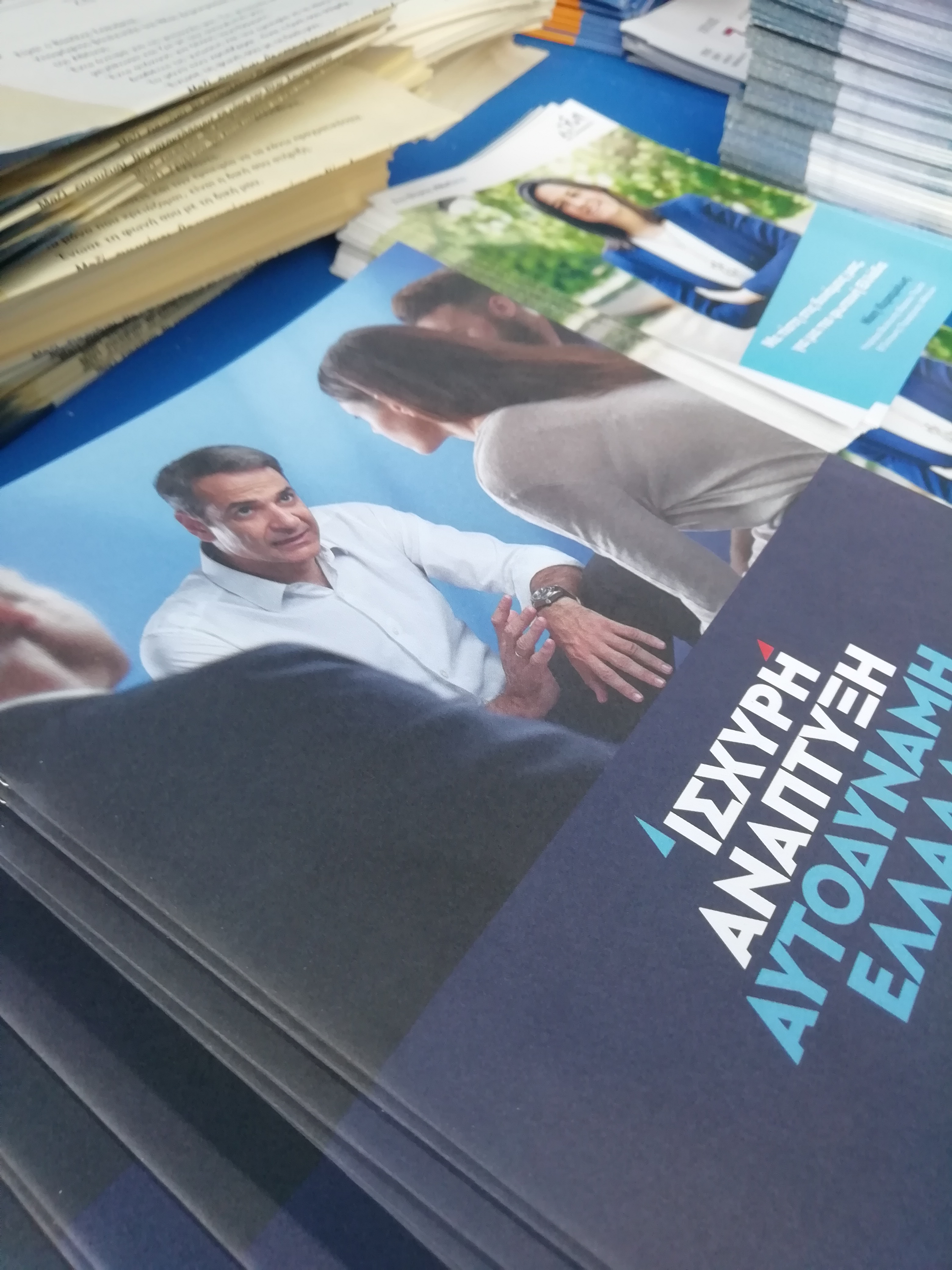
New Democracy party leader Kyriakos Mitsotakis has focused his campaign on economic rejuvenation, promising lower taxes and more foreign investment. /CGTN Photo
Alexandros Klossas, chief editor at Greece’s public television says Tsipras came to power because Greeks were angry at the politicians who, until Tsipras was first elected in January 2015, were implementing the harsh austerity measures demanded by Greece’s international lenders in exchange for bailout money. Tsipras appeared as a savior who promised to end austerity and confront the EU and the IMF. He didn’t.
"Now voters are angry for the things that didn’t happen," says Klossas. "But they are still looking for a Messiah."
While Greece’s lenders have stopped scrutinizing every action of the Greek government in order for them to ensure that the country stays on track with the targets strictly stipulated in the bailout agreements, they still have a big say in how Greece handles its finances.
The Greek economy remains fragile, its massive public debt keeps growing and the GDP growth rate is anemic at 1.9 percent for 2018 (down to 1.3 percent in the first quarter of 2019, according to Eurostat). Meanwhile, nine years of brutal austerity, including budget and pension cuts, over-taxation, lay-offs and salary cuts have brought the country, especially the young and middle class population, to its knees. Greece has become the third poorest country in the EU, behind Bulgaria and Romania, according to Eurostat. Moreover, about one in three Greeks runs the risk of poverty or social exclusion, according to ELSTAT, the Greek statistics agency, and almost one in four cannot afford satisfactory heating in winter.
"Look around you, Greece has been destroyed," said Eleni, an elderly New Democracy voter as she pointed to a row of closed stores across the street in downtown Athens. "We are old, not much will change for us, but I hope it will for you, the young ones."
Yet, that’s exactly what most Greeks still hope for — change. The crisis may have subsided, yet its devastating effects are still here and will probably still be felt for years to come.