
 []
[]
Share







Copied
Editor's note: Nuño Rodríguez is a political scientist and analyst and director of the political consultancy Quixote Communications. The article reflects the author's opinions, and not necessarily those of CGTN.
Twenty years have passed since negotiations on trade agreements between Mercosur and the European Union began. In these years, the conversations have been stop-start. Everything indicated that there was not a willingness by both parties to open their commercial space to the companies and products of the other party.
For that reason, the announcement of an agreement between the two largest commercial areas in the world has been an international surprise. The creation of a free trade area between the two blocks would mean that the companies in both areas would have access to a market of almost 800 million consumers.
Since 2017, Argentina and Brazil had been increasing their efforts to reach an agreement with the EU. Both the president of Argentina Mauricio Macri and the president of Brazil at that time Michel Temer knew that agricultural products were going to be a difficult barrier to overcome, so since that year, they began to make concessions on products such as olive oil and whiskey.
Both countries were looking for an economic boost through investments in the region and through tariffs withdrawal for industrial and technological products that would allow them to modernize production processes. The international political conjuncture was propitious for reaching an agreement; On one hand, the governments of the Mercosur countries had a free market profile, and on the other hand, the EU needed to find new outlets for its products due to the trade war started by the U.S.
The agreement reached by the two free trade areas does not seem to be a balanced agreement. The document published by the European Commission shows how both parties agreed to reduce tariffs in a stipulated period between 5 and 15 years. In the same way, they set quotas for products, among other points, within the complex trade agreement.
The significant point is that Mercosur exports are mainly food products with little added value, compared to European industrial and technological exports with a higher added value.
There have been voices of alarm from both sides of the Atlantic; in Europe, the agricultural sectors are concerned about the volume of agricultural imports, and the Mercosur countries are concerned because their small industry sector may disappear due to the low competitiveness against European goods, mainly in the automotive sector.

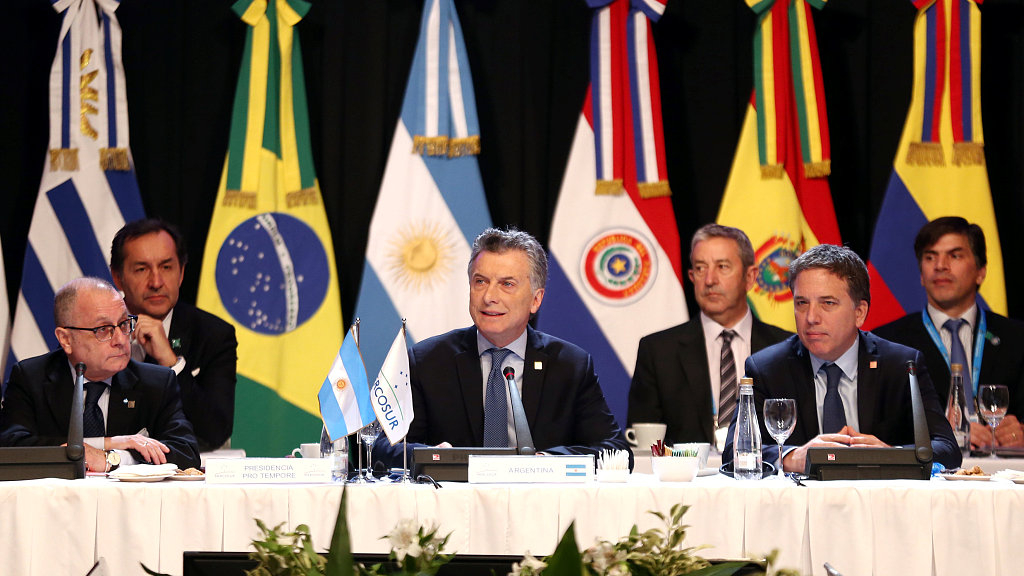
Argentine Foreign Minister Jorge Faurie speaks during a working session at the Mercosur trade bloc summit in Mendoza, Argentina, July 21, 2017. /VCG Photo
In Europe, solutions are already being considered, such as subsidizing agricultural sectors or protecting various designations of origin. The agreement reached states that subsidies may be negative to the market flow but allows it to the signatory countries. One thing is clear; European countries have more capabilities and are in a better position to protect their agricultural sectors than the Mercosur countries to protect their industrial sectors.
At the moment, the European agro-food sector has a higher production capacity than Mercosur because it is a high technological sector. The bet of Mercosur in this scenario would be to obtain European production technology to exponentially increase agricultural and livestock capacities. Once again, it seems that South American countries are betting on an economy with little added value.
The different nature of the products exported by each economic area is not the only variable that unbalances the agreement. The document presented by the European Commission stipulates that the signatories have to observe production measures that are sustainable with the environment and that comply with strict sanitary measures.
Compliance with these measures is already observed in European production but applying them to the production of Mercosur can again increase the price of their products, so these measures can behave like an undercover tariff system.
Another point of the document is also significant since it allows European companies to compete for public bidding in Mercosur countries. This point is of great importance because European companies will have a competitive advantage over Mercosur companies to get contracts with their own governments.
In the case of Brazil, this can be a multimillion-dollar bet for energy, civil engineering and telecommunications companies, which will have the opportunity to join a market that was previously difficult for them. The promptness that the Brazilian and Argentine governments have had to reach this agreement may be due to the upcoming elections that will take place in two Mercosur countries. And that same promptness may have caused excessive surrenders that may mean that the agreement will not be ratified in the Mercosur Parliament if there are government changes in Argentina or Uruguay.
(If you want to contribute and have specific expertise, please contact us at opinions@cgtn.com.)