
 []
[]
Share







Copied
Editor's note: Peter M. Tase, a strategist on the geopolitics of Southeast Europe, former Soviet Union and Latin America, has authored ten books on Paraguayan Foreign Policy and Azerbaijan Contemporary Studies. The article reflects the author's opinions, and not necessarily the views of CGTN.
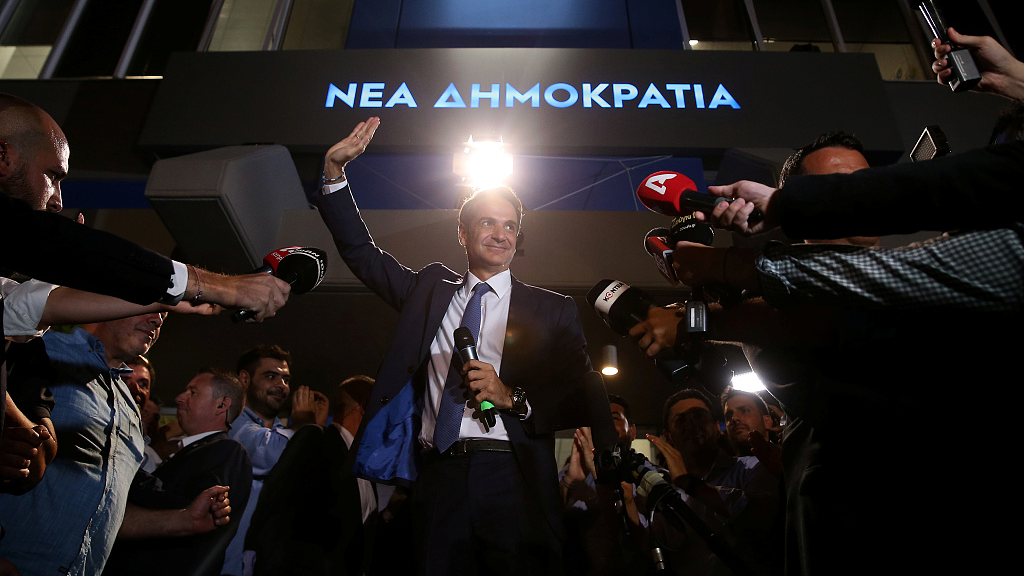
On Sunday, Greek Prime Minister Alexis Tsipras conceded defeat to his rival, New Democracy's Kyriakos Mitsotakis in the general election, meaning the center-right New Democracy (ND) will regain the power.
Tsipras’s SYRIZA reached the helm of government in January 2015, and established a coalition government with the far-right "Independent Greeks" party (ANEL), a deal centered on an ambitious anti-austerity program and economic growth rhetoric. In July 2015, six months after intense negotiations with Greece’s lenders and a referendum, Athens signed the third bailout program and a few months later, the nation expressed once again in the ballot boxes its confidence on whether SYRIZA or ND were best suited to implement the memorandum and ongoing austerity measures.
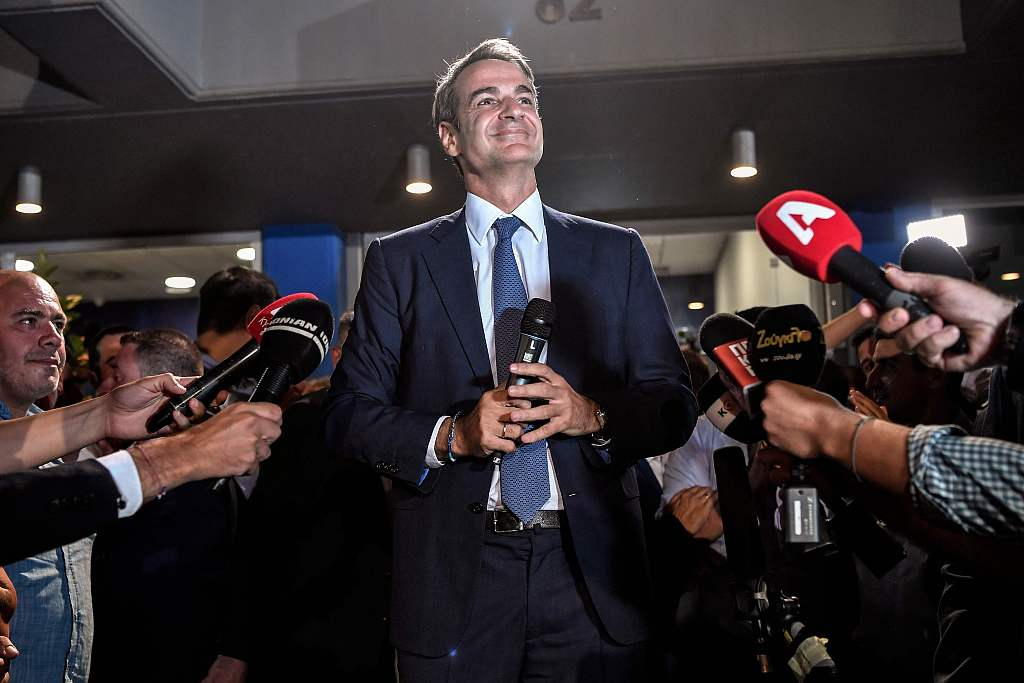
Greece's newly elected Prime Minister and leader of conservative New Democracy party Kyriakos Mitsotakis, speaks to the press outside the party's headquarters after the official results of the elections, in Athens, Greece, July 7, 2019. /VCG Photo
SYRIZA won and established a government coalition with ANEL, an alliance that lasted until January 2019, when the latter abandoned the government due to its divergence with the Prespa Agreement signed between Greece and North Macedonia (then the Former Yugoslav Republic of Macedonia or FYROM). Furthermore, ND Party, under Kyriakos Mitsotakis, strongly opposed the Prespa agreement and demonstrations were led by some of ND Members of Parliament.
With Mitsotakis as Greece's newly elected prime minister, Athens in the next few years will begin a new chapter of economic cooperation with the People's Republic of China and reap the fruits from Belt and Road Initiative (BRI) proposed by China in 2013. As the most developed Balkan Nation, and EU member country, located in the southernmost shores of Southeast Europe, the future Hellenic government will intensify its dialogue with Beijing so that the Belt and Road Initiative could deliver a greater infrastructural and economic impact on the country, increase the leverage of Greece’s food industry and consolidate its financial sector.

Supporters of the New Democracy party gesture as they watch the exit polls displayed at the party's main electoral kiosk, in Athens, Greece, July 7, 2019. /VCG Photo
Mitsotakis' new government is expected to establish close economic cooperation with the BRICS countries and the Shanghai Cooperation Organization, therefore increasing the country’s exports, reshaping its foreign policy and economic diplomacy strategies, and bolstering Athens’s presence in some of the world’s largest markets. Furthermore, Mitsotakis is expected to organize a nationwide referendum on the status of a bilateral agreement with North Macedonia, or Prespa Agreement, signed between the governments of Alexis Tsipras and Zoran Zaev on June 17, 2018.
Under Mitsotakis’s leadership, Greece will play a greater role in strengthening the waves of globalization by signing bilateral trade agreements with the country’s non–traditional partners, including Argentina, Paraguay and Chile, and work with Central Asia's largest economies. The Hellenic emblematic products will earn a greater presence in the world’s top notch markets. Greece’s economy will prosper and its annual contributions towards regional defense requirements will finally be met, including fulfillment of its membership obligations in the NATO.
In the next years, strategic economic cooperation between Greece and the Organization of the Black Sea Economic Cooperation is expected to rise, while regional defense cooperation with nations such as Ukraine, Romania and Hungary will receive a greater priority. With Kyriakos Mitsotakis as prime minister, the Hellenic nation will have greater economic growth, smaller and highly effective government tailored with swift restructuring that will lead to lower unemployment rates and effective economic reforms.
(If you want to contribute and have specific expertise, please contact us at opinions@cgtn.com)