
 []
[]
Share







Copied
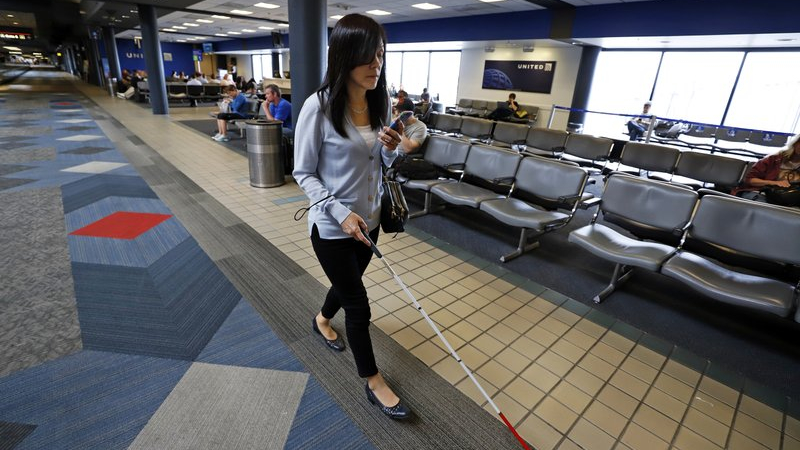
Navigating airports can be tricky. They’re loud, crowded and not always laid out intuitively. They’re even more challenging for visually impaired people.
Chieko Asakawa knows those challenges firsthand and she has also devised a solution. Blind since she was 14, Asakawa is now an IBM Fellow and a professor in Carnegie Mellon University’s Robotics Institute. This spring, she and other researchers at Carnegie Mellon launched a navigation app for Pittsburgh International Airport that provides turn-by-turn audio instructions to users on how to get to their destination, be it a departure gate, restaurant or restroom.
Pittsburgh is one of a growing number of airports around the globe providing Wayfinding apps. The Pittsburgh app, called NavCog, was first used at the Carnegie Mellon campus and works almost like an indoor GPS.
“Independence is very important,” she said. “Technology has been helping us to be more independent and this is one of the examples. We still face a lot of challenges, but we will keep working to make it easier.”
Typically, visually impaired travelers arrive at the Pittsburgh airport and request an escort, Asakawa explained, but escorts aren’t available until passengers check in. So they must reach the counter on their own.
The escort takes the passengers to their gates and then leaves, she added, noting that if she wanted a coffee, or if the flight was delayed, it was very difficult to manage, and very often she’d just be stranded at the gate.
With NavCog, she can get up and find the gift shop, coffee shop or just wander around a bit, she said. The app is up and running and free to download.
It works with the help of hundreds of Bluetooth beacons installed inside the airport to wirelessly communicate to the user’s location.
Users put in where they are going, for example, Gate A3. The app gives users audio instructions like “walk 20 feet and turn left” and gets them to their destination. The app lets users know what stores they might be passing, giving them a better sense of their surroundings and shopping options.
It relies on a map of the terminal which includes all the restrooms, restaurants, gates, entrances and ticketing counters locations.
Ten legally blind people tested the app using an iPhone 8, traversing the terminal’s large open spaces, escalators and moving walkways with few errors. Most users were able to reach the ticketing counter in three minutes, traverse the terminal in about six minutes, go from the gate to a restroom in a minute and go from the gate to a restaurant in about four minutes, researchers said.
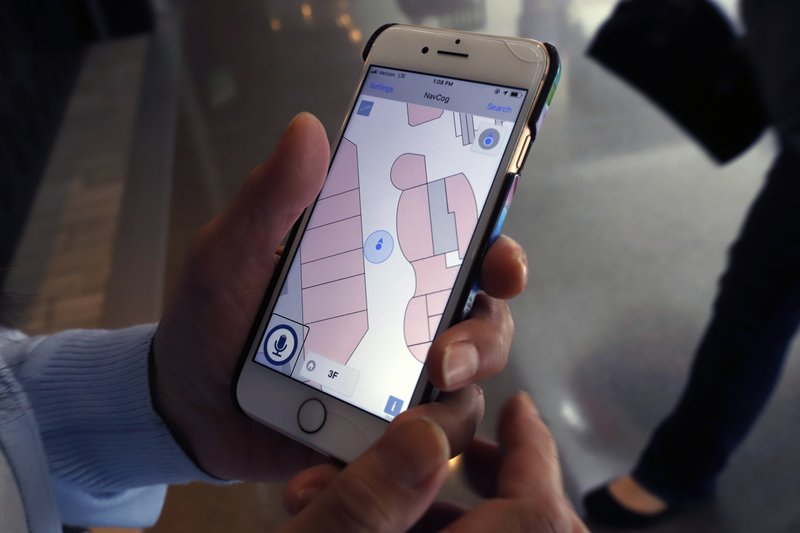
Chieko Asakawa using the airport wayfinding app that she and her team at Carnegie Mellon University to navigate through Pittsburgh International Airside terminal in Imperial, Pa. before boarding a flight to Japan. /AP Photo
Carnegie Mellon and the airport have partnered in developing new systems and technologies for enhancing traveler experience and airport operations. The technology is tested at the university’s on-site lab at the airport.
“Part of our commitment to the public includes making sure our airport works for everyone, particularly as we modernize our facilities for the future,” said airport CEO, Christina Cassotis.
The city is building a new airport terminal, slated to open in 2023, and incorporating the latest technology is a top priority, she said.
Dozens of airports, including Philadelphia International, offer free use of a service called Aira, where users connect with an “agent” either by using glasses equipped with a camera or through a smartphone app that accesses user’s camera.
Agents look at the footage and help relay what they see to the user, getting them where they need to go. The service is typically subscription-based and can be used at home or at work, but participating airports pay the fees for users on site.
Louisville International in Kentucky installed an app similar to NavCog in 2017, created by the American Printing House for the Blind, a company that develops products for the visually impaired.
Brian Charlson, with the American Council of the Blind, has been involved in wayfinding for over 30 years and has seen a number of airports and train stations try different technological approaches to make their spaces easier to navigate for the visually impaired. The NavCog app, he said, is a useful mashup of systems he’s seen over the years.
He cautions, though, that the blind population is older and has a high unemployment rate, so many don’t have access to smartphones, meaning such apps might be inaccessible.
Having options is always beneficial for the visually impaired, emphasized John McInerney, interim CEO of the Pennsylvania Association for the Blind.
“The apps can be very helpful,” McInerney said. “The whole idea is that you would not have to depend on a person to help you. But even today, that’s still a pretty good option.”