
 []
[]
Share






Copied
Editor's note: Liu Mingli is deputy director of the Institute of European Studies, China Institutes of Contemporary International Relations. The article reflects the author's opinions, and not necessarily the views of CGTN.
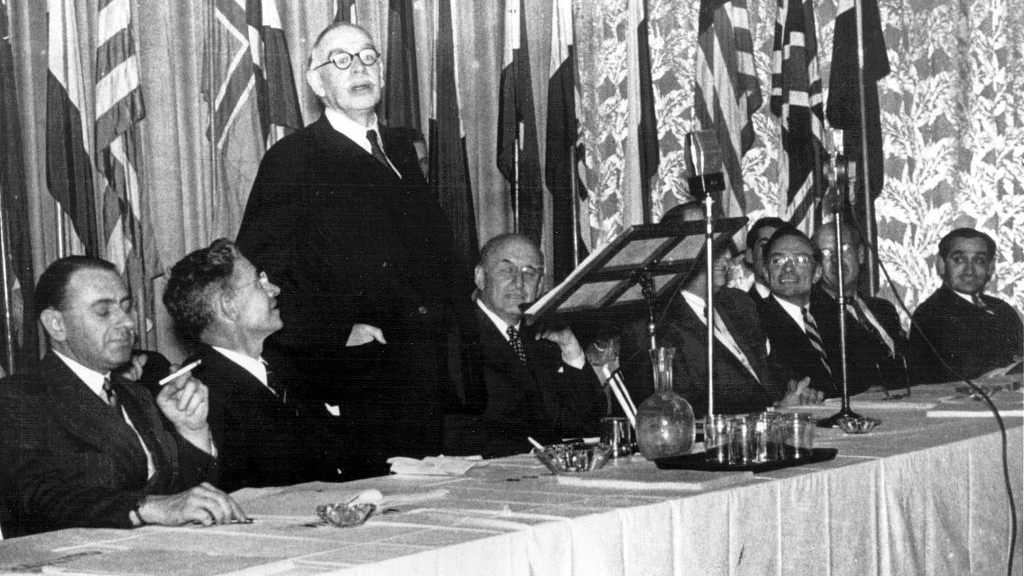
This year marks the 75th anniversary of the Bretton Woods Conference, officially known as the United Nations Monetary and Financial Conference, a gathering of delegates from 44 nations that met from July 1 to 22, 1944, in Bretton Woods, New Hampshire, to agree upon a series of new rules for the post-WWII international monetary system.
The dollar's position as a dominant currency was established from then on. Although the system broke down in the 1970s and was replaced by the Jamaican system, the dollar's position remained. The current international monetary system is still based on the Bretton Woods system, which shows the far-reaching impact of this meeting.
Looking back at history, we may be able to get some enlightenment on the current uncertainties within the global economy.
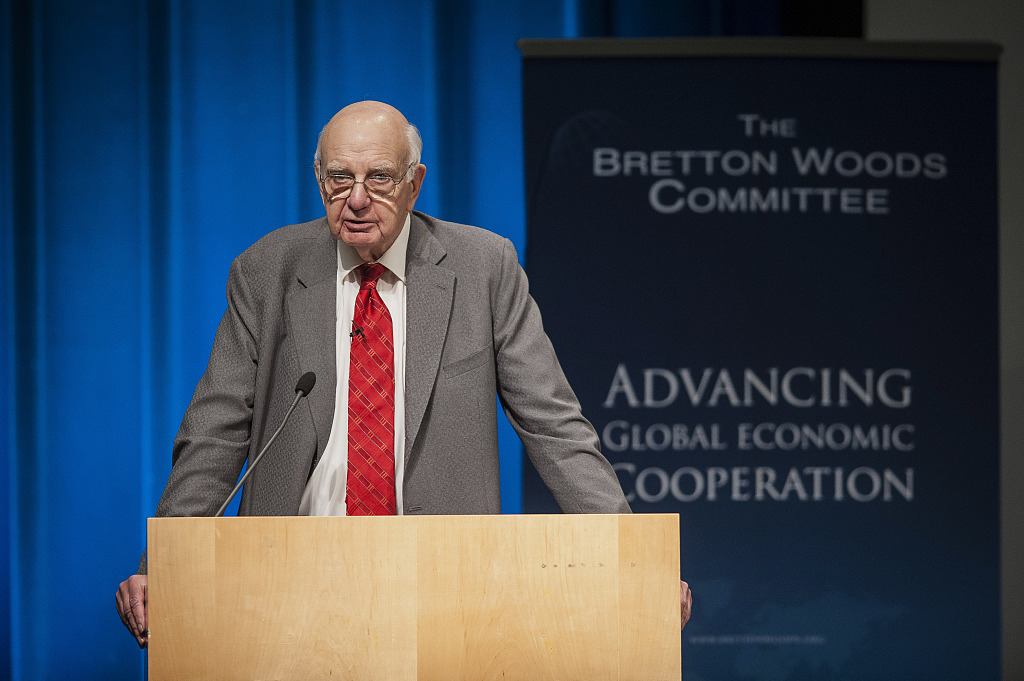
Paul Volcker, former chairman of the U.S. Federal Reserve, speaks during the 31st Annual Meeting of the Bretton Woods Committee, Washington, D.C., U.S.,May 21, 2014. /VCG Photo
First, the dominant country in the international monetary system must ensure the health of its own economy.
The dollar's status was established by its superpower after war. That's why the White Plan defeated the Keynes Plan at the Bretton Woods Conference. However, since the relative advantage of the United States was formed in a very special historical period after war, it is very difficult to maintain for a long time, which has become an unstable factor in the international monetary system.
With deterioration of its economy, in 1971, the United States unilaterally announced that the dollar could no longer be freely convertible into gold. This policy shocked the world and became well-known as the "Nixon shock," which eventually led to the collapse of the Bretton Woods system.
After the Wall Street financial crisis in 2008, the deterioration of the fiscal and debt situation of the United States also attracted attention globally, and the international status of the dollar also caused a lot of concerns and discussions.

New York Stock Exchange, Nov. 6, 2008, New York City, U.S. /VCG Photo
Second, the dominant power should exercise their exorbitant privilege carefully.
The status of the dollar gives the United States powers to impose seigniorage on the world and to influence policies of other countries, including financial sanctions against other countries.
Barry Eichengreen, a famous American economist, calls it "exorbitant privilege." But if the United States abuses this privilege, it will undermine other countries' trust in the U.S., and affect the stability of the system, and even lead to a search for alternatives. After 2008, the United States began quantitative easing in response to the financial crisis, which left global holders of dollars at risk of dollar depreciation.
Third, the dominant country needs to maintain their commitment to multilateralism.
A system is stable only when it is supported in a multilateral way. Although the Bretton Woods Conference was held in and led by the United States 75 years ago, it was a product of multilateral cooperation and supported by other participating countries.
In the early 1970s, after the United States was unable to keep the dollar freely convertible into gold, the United States and other countries still conducted close consultations and coordination on how to maintain the stability of the exchange rate between the dollar and other currencies, which finally led to the Jamaican system.
When we look at the current international monetary system, we find some new developments worth watching. In Europe, the push to further the international use of the euro has received official backing from EU institutions, with European Commission President Jean-Claude Juncker even calling the excessive use of the dollar in Europe absurd.
In Asia, RMB internationalization has been a clear strategic direction. In Africa, the Economic Community of West African States (ECOWAS) decided to adopt a single currency by 2020. In the Middle East, a new transaction system for trade with Iran, known as INSTEX, short for Instrument in Support of Trade Exchanges, is already in operation, which is independent of the Society for Worldwide Interbank Financial Telecommunication (SWIFT).
Around the world, digital cryptocurrencies have attracted a lot of attention, and their prices have skyrocketed. Unilateralism and the tendency of using the dollar as a geopolitical weapon appear to be eroding global trust in the dollar and the United States. Looking back, we can see that to maintain the stability of the international monetary system, the dominant country needs to develop its economy very well and take the necessary responsibilities.
So far, we are unable to find a system to replace the current one in the short term. Systemic change will take a long time. But when it does, it will be painful and turbulent. Lessons should be drawn from history.
(If you want to contribute and have specific expertise, please contact us at opinions@cgtn.com.)