
 []
[]
Share







Copied
Editor's Note: The article is based on an interview with Liu Chunsheng, an associate professor of the Central University of Finance and Economics in China and the deputy dean of Blue Source Capital Research Institute. The article reflects the expert's opinions, and not necessarily the views of CGTN.
China's GDP expanded by 6.3 percent year-on-year in the first half of 2019, the National Bureau of Statistics announced on Monday. The figure in the second quarter is 6.2 percent, lower than 6.4 percent in the first three months.
The performance immediately invited pessimistic voices from the West on the Chinese economy. U.S. President Donald Trump even claimed that his tough action on Beijing is working and China's slowing economy is forcing it back to the negotiating table. "United States tariffs are having a major effect on companies wanting to leave China for non-tariffed countries," Trump said on Twitter.
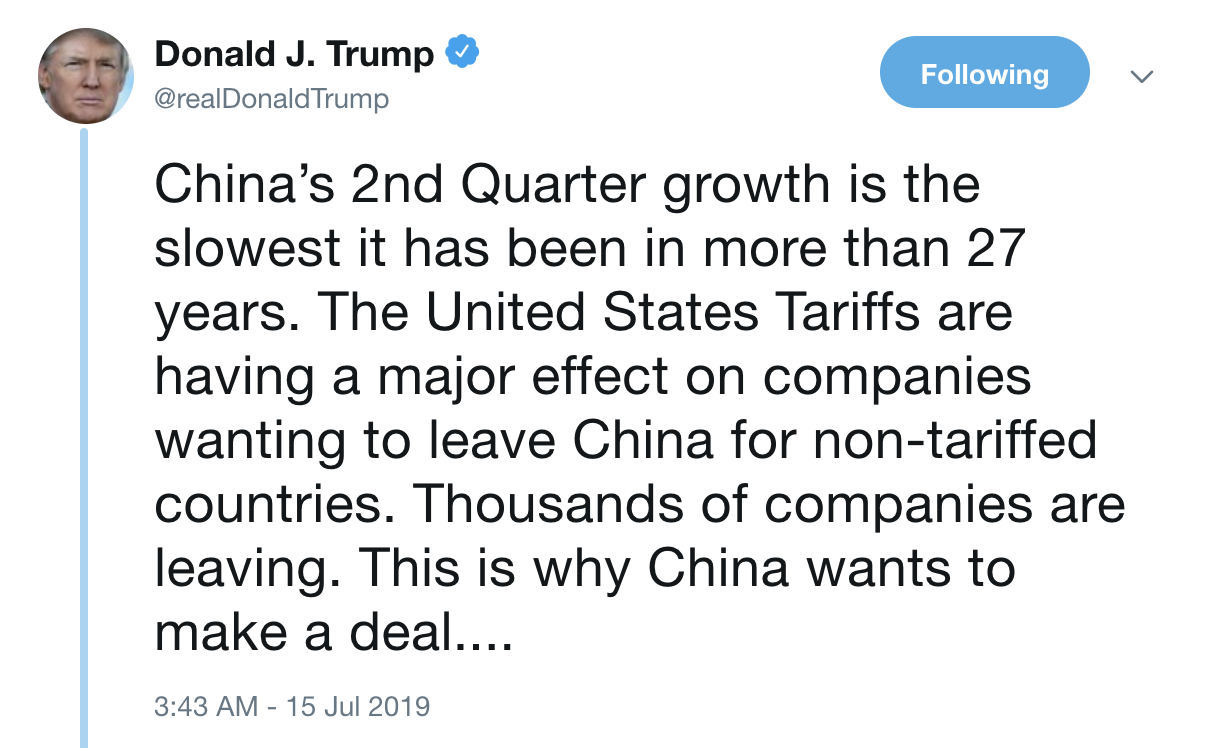
Screenshot via Twitter
This is nonsense. To begin with, although China's 6.2 percent growth in the second quarter is the slowest in the past 27 years, it is within Beijing's stated goal of between six percent and 6.5 percent for 2019, and still outperforms other major economies – four times that of the United States'. Considering China's huge economic scale, the 6.3 percent growth in the first half of the year deserves applause.
Moreover, the challenges that China has undergone to keep its economy on track can never be underestimated, Liu Chunsheng, an associate professor of the Central University of Finance and Economics in China and the deputy dean of Blue Source Capital Research Institute, told CGTN.
Externally, economic uncertainties are increasing. At the domestic level, downward pressure still loomed large. Against this backdrop, the Chinese government has put loads of efforts including the adjustments in macroeconomic policies to ensure the stable economic growth. The country's capability to deliver the 6.3 percent growth against the headwinds should be recognized and applauded, Liu said.
It is also worth noting that by growing at 6.3 percent, China's GDP expanded to about 45.09 trillion yuan (around 6.6 trillion U.S. dollars). What does it mean? In 2018, China's GDP reached 90 trillion yuan. Not surprisingly, China will see better economic performance this year than in 2018. With more holidays in the second half of the year, China's GDP in the next six months, according to Liu, is highly likely to exceed 45 trillion yuan.
It is true that the trade tensions between the world's largest two economies are exerting negative effects on the Chinese economy. But considering China's huge developmental potential, growing domestic demands and the flexible fiscal and monetary policies, the Chinese economy has never been defeated by Trump's tariffs.
VCG Photo
It is the U.S. economy, not China's, is suffering more from the trade friction. "Sorry to break it to you but tariffs are paid by the importer – U.S. taxpayers in this instance," The Guardian quoted Trevor Greetham at Royal London Asset Management as saying.
Beijing's return to the negotiating table is a result of the joint efforts by the two parties. Beijing has reiterated that "it does not want a trade war, but it is not afraid of one and it will fight one if necessary." China will never sacrifice its core interests in exchange for a deal. The slowing economy will not change the country's stance on the trade friction, Liu stressed.
For years, the West has been biased on China. Despite Western hype, China will maintain its strategic composure and further open up its economy to the outside world. The resilience in the Chinese economy determines that the country will continue to be a mainstay for the world's sustained growth, Liu emphasized.
(If you want to contribute and have specific expertise, please contact us at opinions@cgtn.com)