
 []
[]
Share







Copied

Editor's note: The article was first published by China Plus on July 18, 2019. The article does not necessarily reflect the views of CGTN.
China's State Council said on Wednesday that the government will further strengthen the protection of intellectual property rights with comprehensive measures to defend the lawful interests of all market entities. The new measures are expected to help improve the country's business climate and encourage technological innovation.
According to the decision made at the State Council's executive meeting, the government will focus on four key areas.
First, enforcement of IPR-related laws will be intensified, and all kinds of market players will be treated as equals. This will help to create a business environment in which all market players compete on an equal footing, which will in turn stimulate their enthusiasm for innovation.
Second, the government will revise the Patent Law, the Copyright Law, and the Trademark Law, and the cost of breaching these laws will be significantly increased. Currently, damages are largely based on the principle of compensating for the losses.
But when it comes to intellectual property rights violations, this isn't enough to deter malicious and repeated infringements. In amendments to the Patent Law and the Trademark Law, the government will allow for a maximum penalty of five times the punitive damages for malicious infringement, a high penalty by international standards.
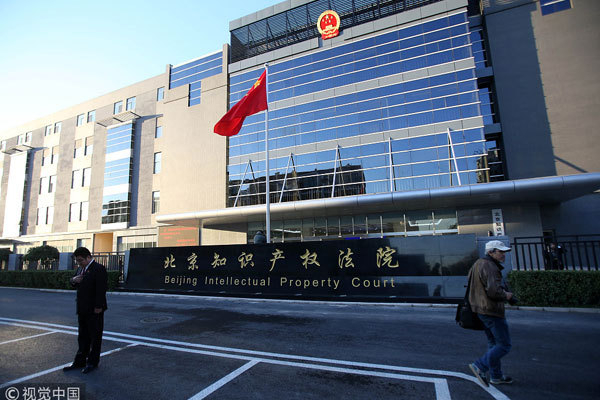
A photo of the Beijing Intellectual Property Court. /VCG Photo
Third, the quality and efficiency of IPR examinations will continue to be improved. By the end of the year, the time taken to review high-value patent applications will be shortened to 17.5 months, and the average review period for trademark registration will be no more than five months. This is expected to help improve the quality and quantity of high-value IPR registrations.
And fourth, the government will enhance its international cooperation so that it's easier for companies to seek IPR protection overseas. According to the American patent service company IFI Claims, companies in China obtained more than 12,500 patents in the United States last year, an increase of 12 percent from the previous year.
According to the World Intellectual Property Organization, Huawei alone submitted more than 5,400 international patent applications during the year, the largest number of applications made by any company in the world.
The world is in the midst of a new round of technological revolution and industrial transformation, and protecting intellectual property rights means protecting innovation. China is one of the world's leading innovators: it is one of the top 20 countries on the 2018 Global Innovation Index compiled by the World Intellectual Property Organization.
China has a strong incentive to strengthen its IPR protection, because comprehensive protection is essential for promoting innovation-driven development and a further opening of its market. More stringent IPR protection will stimulate innovation, and provide new momentum for the country's high-quality development.
(If you want to contribute and have specific expertise, please contact us at opinions@cgtn.com.)