
 []
[]
Share







Copied
Several business and economic advisers shared their concerns about the global trade environment and weak economic outlook during the Third APEC Business Advisory Council (ABAC) Meeting on Tuesday.
The meeting is being held in Hangzhou, China, from July 22-25, paving way for this year's APEC Economic Leaders' Meeting in Chile.
Hafimi Abdul Haadii, ABAC Brunei member, acknowledged the influence of trade tensions on the weak economic outlook but said, "We probably don't feel as much as some of the other bigger economies."
"We are definitely seeing... willingness or unwillingness or hesitation to want to invest because it's a wait-and-see (attitude). Sometimes in certain scenarios, you have to take the plunge — it's sort of make-or-break," she added.
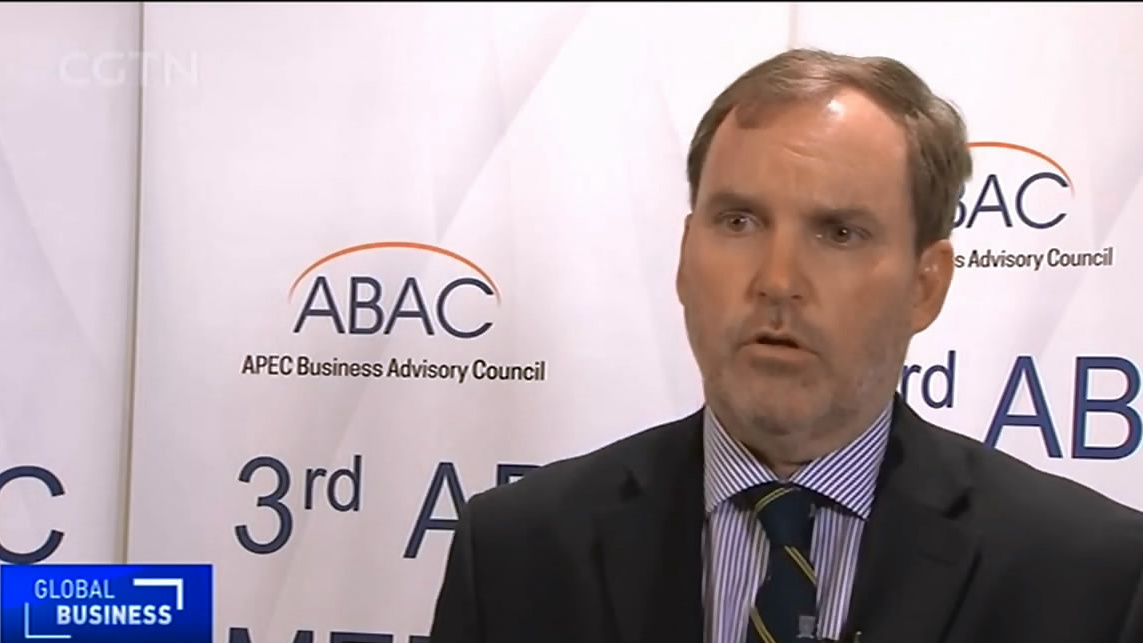
Richard von Appen, chair of the APEC Business Advisory Council 2019. /CGTN Photo
Meanwhile, ABAC 2019 Chair Richard von Appen is worried that trade tensions and weak global economy will affect "a lot of humble people, who live from trade."
"Our main concern is to try to bring up the issue that we need a solution as soon as possible because this will have social consequences. And it goes against what we are all here for: to help especially entrepreneurs, rural areas, women participate in the economy," he said.
"Some of the issues in the current global tensions are driven by certain views and philosophies of the way in which trade balance should be handled," commented by Robert Milliner, ABAC Australia member.
He thinks those issues don't necessarily fit with the views of businesses which "have seen the opportunities to be able to trade across borders, drive opportunities, not only for large businesses but also for small business, the opportunities to bring other people to supply chains, the opportunities to advance economies and to develop education and growth in those economies."