
 []
[]
Share







Copied

A plan for peace between Israel and the Palestinians cannot rely on global consensus, inconclusive international law and "unclear" United Nations resolutions, U.S. President Donald Trump's Middle East envoy told the U.N. Security Council on Tuesday, sparking pushback from several countries.
Jason Greenblatt and senior Trump adviser Jared Kushner have spent two years developing the plan - made up of political and economic components - which they hope will provide a framework for renewed talks between Israel and the Palestinians.
Read More:
Palestinians reject U.S. 'economy first' peace plan
Kushner insists economic plan key to Israeli-Palestinian peace
Opinion: Why U.S. economic plan for the Palestinians won't make a difference
Greenblatt said Trump hoped to make a decision "soon" on whether to release the closely held plan before or after an Israeli election in September. Kushner and Greenblatt have not said if it calls for a two-state solution, a goal of past peace efforts.
The two-state solution, supported by the United Nations, envisages that Israel and an independent state of Palestine, with East Jerusalem as its capital, live side-by-side in peace and security.
"If that were achievable, I think we'd already have peace. It's not achievable," Greenblatt told reporters, adding the "60-or-so"-page plan "does not contain a one-state solution."
Greenblatt told the 15-member Security Council that peace could not be achieved "by fiat of international law or by these heavily wordsmithed, unclear resolutions," triggering strong rebuttals from several members, including Germany, Russia, Britain, France and Indonesia.
"For us, international law is not menu a la carte," Germany's U.N. ambassador, Christoph Heusgen, told the council.
"There are other instances where U.S. representatives here insist on international law, insist on the implementation of U.N. Security Council resolutions, for instance on North Korea," Heusgen said.
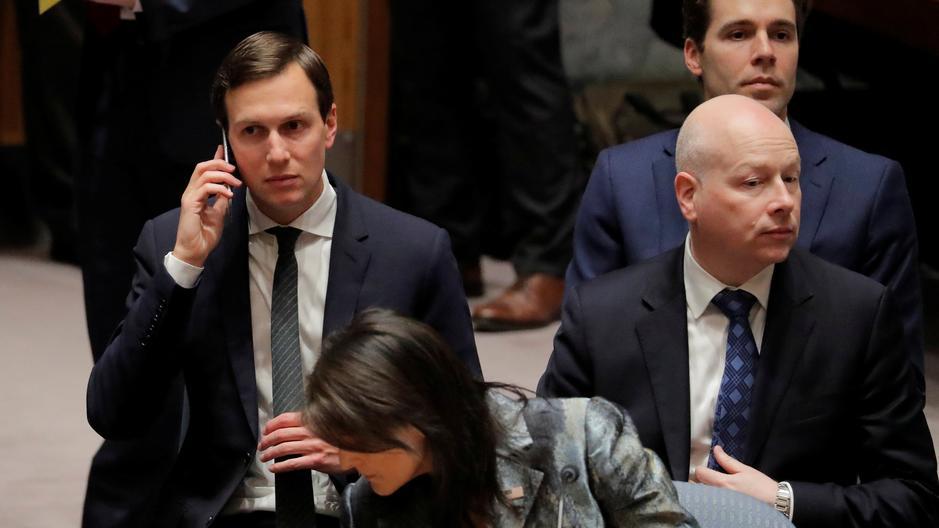
U.S. White House senior adviser Jared Kushner (L) and Jason Greenblatt (R), U.S. President Donald Trump's Middle East envoy wait for a meeting of the UN Security Council at UN headquarters in New York, U.S., February 20, 2018. /Reuters Photo
'Put aside blanket rejections'
"We must champion multilateralism and uphold fairness and justice in promoting a comprehensive, just and durable solution," Wu Haitao, China's deputy permanent representative to the United Nations, said in the Security Council meeting on Tuesday.
He reiterated that the two-state solution is the only correct way forward to resolve the conflict between Palestine and Israel.
France would support any peace effort "so long as this aligns with the approach that we have set out together, so long as this adheres to international law, specifically all resolutions of the Security Council," French U.N. Ambassador Nicolas de Riviere said.
"Security Council resolutions are international law, they merely need to be complied with," said Russian U.N. Ambassador Vassily Nebenzia.
Greenblatt, Kushner and U.S. Iran envoy Brian Hook will travel to the Middle East later this month to promote a proposed $50 billion economic development plan for the Palestinians, Jordan, Egypt and Lebanon.
"We are trying to view this holistically," Greenblatt said of Hook being part of the delegation. "Even if I had a great peace plan, if we don't figure out how to make sure that Iran doesn't spoil it, how much success are we really going to have?"
In the Security Council, Greenblatt called on the Palestinians "to put aside blanket rejections of a plan they have not even seen" and show a willingness to engage in talks with Israel. He also urged the Security Council to encourage the parties back to the negotiating table.
Nebenzia suggested a visit by the Security Council to the region was overdue and could be helpful. The United States has long objected to a council visit, which has to be agreed by consensus, diplomats said.
(With input from Reuters, Xinhua)