
 []
[]
Share







Copied
Editor's Note: Aamna Khan is an international relations PhD student at Jilin University. The article reflects the author's opinions and not necessarily the views of CGTN.
The relationship between Pakistan and the United States has experienced many ups and downs. Pakistan has been a staunch non-NATO ally for the U.S. during the Cold War and War on Terror. However, the relationship has deteriorated starkly in the last few years, especially after Donald Trump became U.S. president. But, with Imran Khan becoming the prime minister of Pakistan in 2018, people have expected to see key changes in Pakistani foreign policy. As a result, the first meeting between the two leaders has been long-awaited and everyone is curious to know the direction in which the relationship will go.
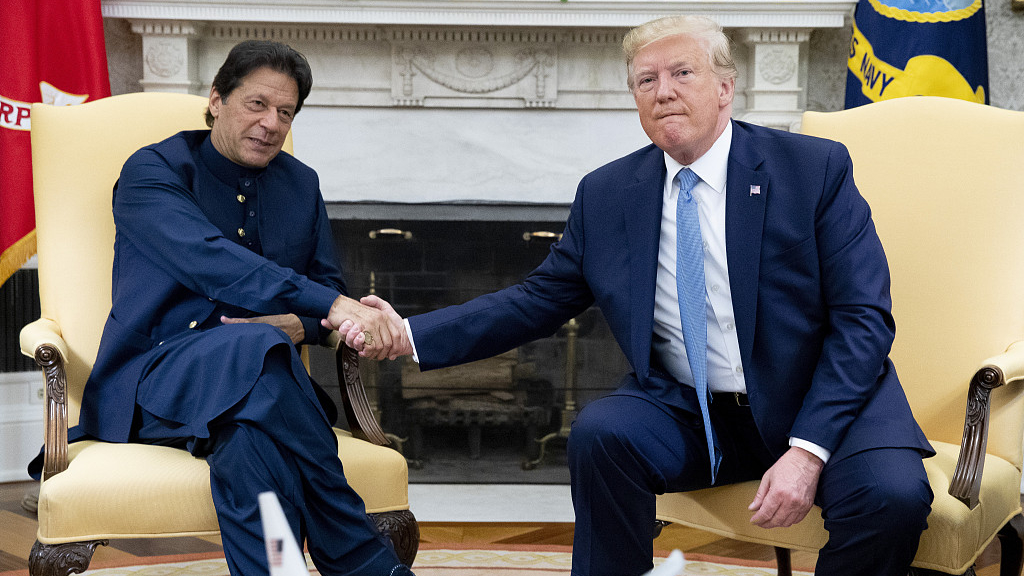
Prime Minister Khan met President Trump in the White House on Monday, July 22. The meeting attracted much attention internationally as well as in Pakistani media. The main agenda of the meeting covered peace in Afghanistan, terrorism and trade. In Pakistan, Khan's trip was viewed as successful, mainly because, after a long time, people got to see a confident leader who spoke with dignity and conveyed his message clearly to the U.S. President Trump also looked calm and happy. During the press conference, he introduced PM Khan as a very popular leader and said that the relationship with Pakistan is improving and he is very much satisfied.
It was a major shift in President Trump’s attitude towards Pakistan, as he has always been a harsh critic of the country. In his tweets earlier this year, Trump said: "The United States has foolishly given Pakistan more than 33 billion dollars in aid over the last 15 years and they have given us nothing but lies and deceit, thinking of our leaders as fools. They give safe haven to the terrorists we hunt in Afghanistan, with little help. No more!" And as a response, PM Khan tweeted: "Trump's false assertions add insult to the injury Pak has suffered in US WoT (war on terror) in terms of lives lost and destabilized and economic costs. He needs to be informed about historical facts. Pak has suffered enough fighting U.S.'s war. Now we will do what is best for our people and our interests."
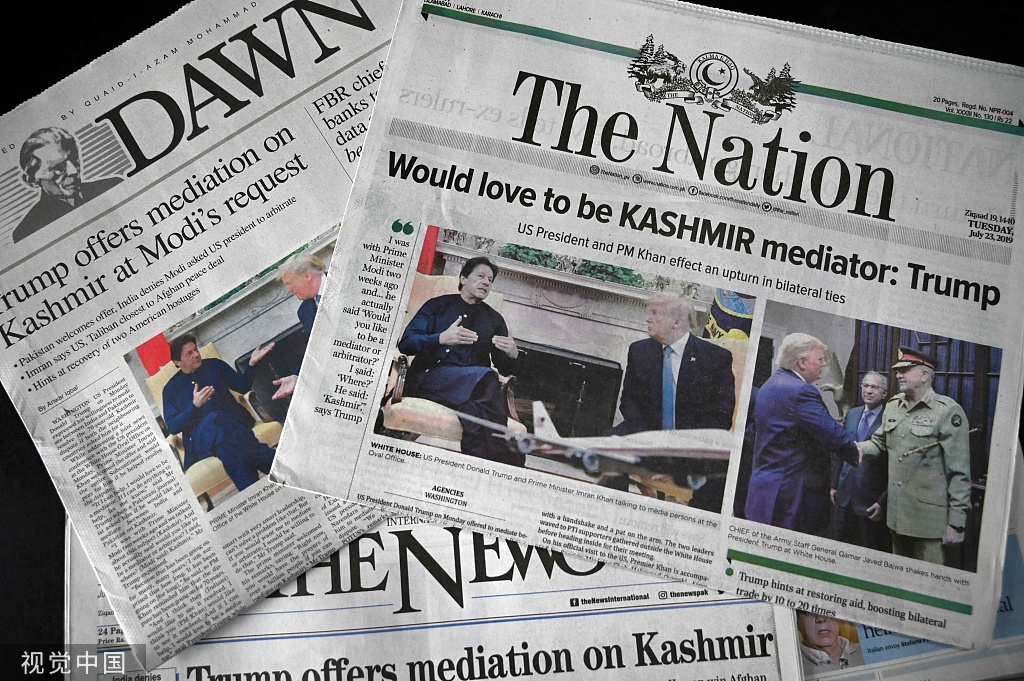
Pakistani newspapers covering PM Khan's visit to the U.S. on July 23, 2019. /VCG Photo
Based on Trump's attitude coming out of the recent meeting, it was clear that the U.S. has changed its approach towards Pakistan and realized its significance for the region, especially Afghanistan. They recognized that without involving Pakistan, peace in Afghanistan is unattainable, as no other country understands Afghanistan better than Pakistan.
The importance given to Pakistan is not surprising. Instead, it was very much expected. While the world is moving towards multipolarity, the U.S. is trying to make new alliances as well as making efforts to rejuvenate old ones. Therefore, it doesn't want to lose Pakistan, once a strong ally which has been shifting towards regional counterparts like China and Russia. Pakistan is participating more in regional affairs, especially after becoming a part of the Shanghai Cooperation Organization (SCO). At last month's SCO summit in Bishkek, much attention was given to PM Khan by Russia and China. To salvage the relationship, President Trump, during the press conference, even offered to mediate between India and Pakistan on the long-standing Kashmir dispute, which means offering Pakistan a helping hand to resolve one of its most contentious conflicts. The question here is how does Pakistan see this? And is Pakistan ready to go back to the western bloc and be a part of their politic again?
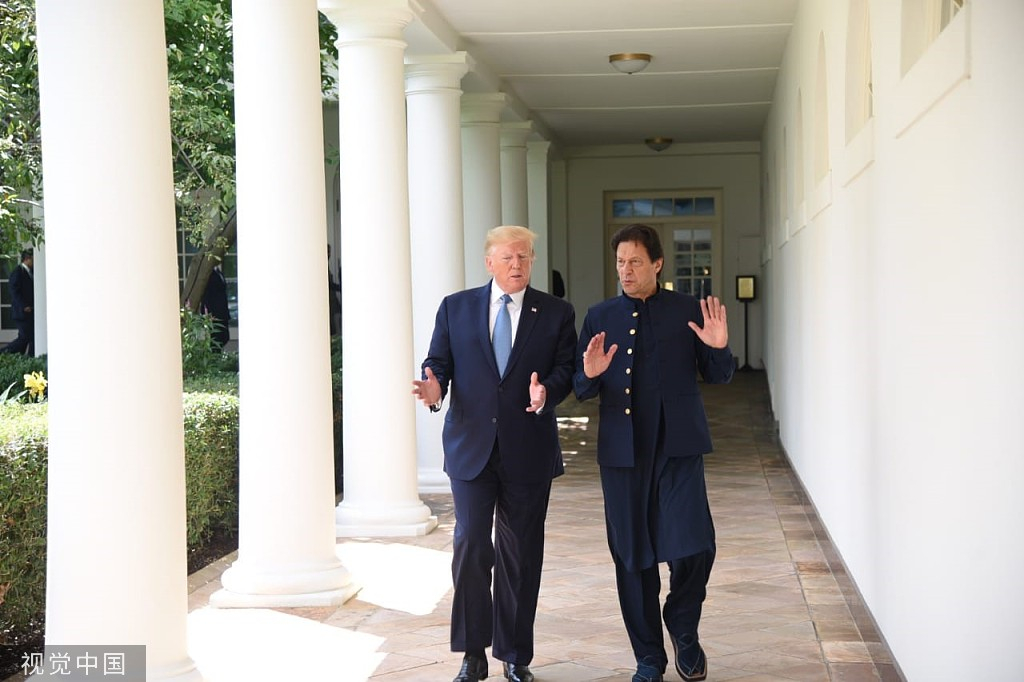
U.S. President Donald Trump and Pakistan Prime Minister Imran Khan at the White House, July 22, 2019. /VCG Photo
It is essential right now for Pakistan to make rational foreign policy decisions and prevent itself from falling prey to American policies and not allow itself to be made a scapegoat of America's wrong decisions again. The U.S. needs also to understand that they can't use Pakistan anymore for their interests as they had done in the past. Pakistan requires a balanced foreign policy and should learn from previous mistakes.
PM Khan must fulfill his own words as in his first address to the nation after winning 2018 elections during which he promised a balanced foreign policy. He said that Pakistan will not become part of any proxies in future. While addressing the United States Institute of Peace, PM Khan said that Pakistan wants a friendly and equal relationship based on mutual trust and respect. He said that aid has remained the biggest curse because of the conditions attached to it. It is humiliating for a country. Therefore, he doesn't want aid, but rather a dignified relationship between both the countries.
Pakistan is an important player of regional politics which can play a significant role in peace-building in the region. As tensions are escalating between the U.S. and Iran, Pakistan can facilitate mediation between them for peace. Similarly, it can play a role in the Afghan peace process. Pakistan should maintain good relations with the United States without jeopardizing its relations with its neighbors. One can hope that this meeting will bear some fruitful outcomes and become a milestone in achieving enduring peace and prosperity for the entire region.
(If you want to contribute and have specific expertise, please contact us at opinions@cgtn.com.)