
 []
[]
Share







Copied
Editor's note: Sultan Mehmood Hali is a veteran of the Pakistan Air Force and television host with PTV News. The article reflects the author's opinion, and not necessarily the views of CGTN.
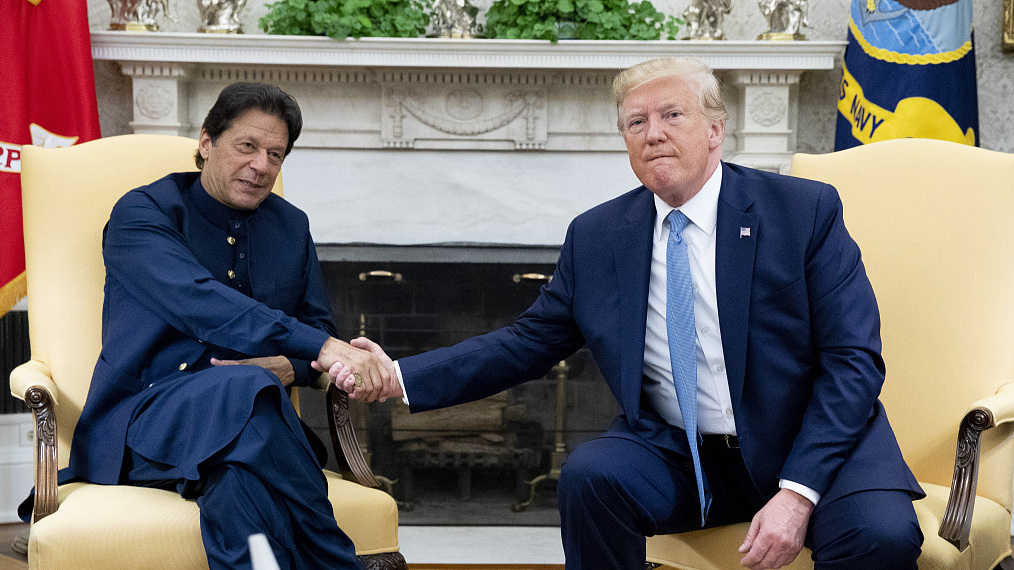
Pakistani Prime Minister Imran Khan's maiden sojourn to the U.S. capital, Washington, DC has ended in a high note. His friendly tête-à-tête with President Donald Trump, the camaraderie developed, and the bonhomie displayed was a far cry from the exchange of vitriolic accusations hurled at each other via tweets.
The journey from acrimony to geniality has been a tumultuous one. Imran Khan showed prudence by avoiding the topic of President Trump's ugly tryst with Muslim Congresswomen, after all he was representing Pakistan and not the Islamic Ummah. From being labeled as an unreliable ally in the war in Afghanistan, whose coalition support funds were embargoed, Imran Khan has transformed into a popular leader with a vision for peace and prosperity.
Traveling by a commercial airline, shunning protocol, avoiding high cost hotels and trimming down his entourage to save the national exchequer of funds that will have other uses, Imran Khan endeared himself to the masses at home and abroad.
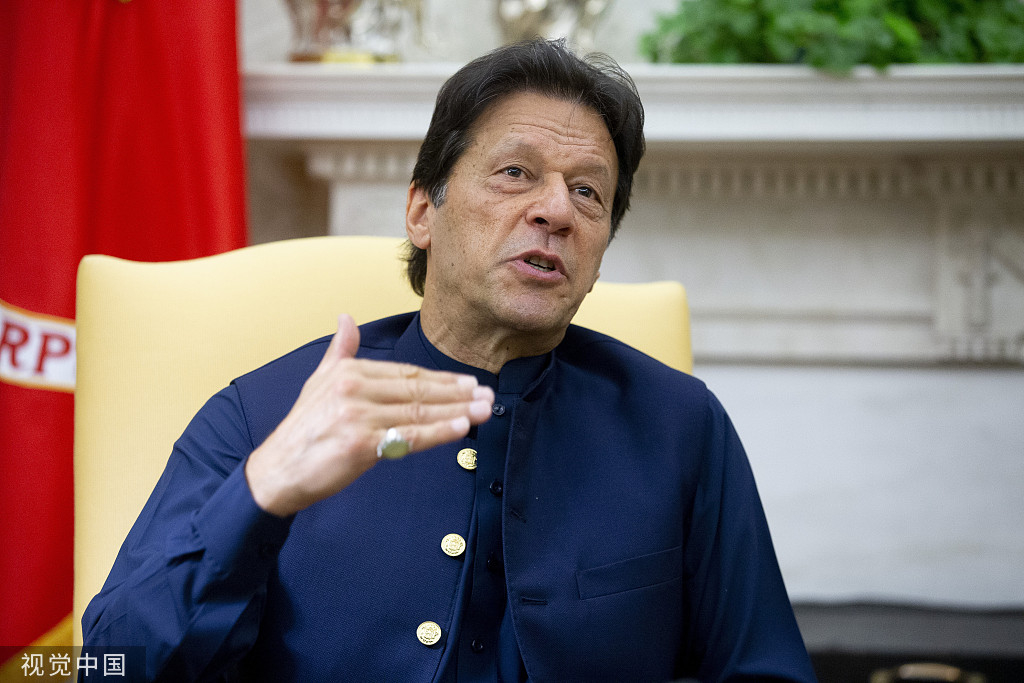
Prime Minister of Pakistan Imran Khan delivers remarks during the meeting with U.S. President Donald Trump, Washington, DC, U.S., July 22, 2019. /VCG Photo
The weekend address to the Pakistani Diaspora, comprising 28,000 members including doctors, engineers, educationists and artisans, who flocked to hear their beloved leader in the Capital One Arena of Washington, DC must have left indelible impressions on the U.S. president. In his various meetings with Pakistani business community, which has pledged millions of dollars of investment in Imran Khan, must have made a mark.
President Trump drew a proverbial rabbit out of the hat, when he volunteered to mediate between Pakistan and India over the contentious Kashmir issue. The U.S. president confided that when he met the Indian Prime Minister at Osaka three weeks earlier, Narendra Modi had asked Trump if he would mediate or arbitrate between Pakistan and India to resolve the long-standing Kashmir issue. Imran Khan jumped at the opportunity stating that the prayers of thanks of over a billion people will be for Donald Trump, if he can help resolve the flashpoint between the nuclear weapons armed neighbors. Albeit, the Indian Ministry of External Affairs denied that Mr. Modi had asked Donald Trump to mediate, one does not believe that the U.S. president fabricated the offer.
Imran Khan on his part has volunteered his services to help bring the Taliban to the peace talks as well as mediate between the U.S. and Iran. Imran Khan’s offer must have sounded like milk and honey to the U.S. president, who is keen on stopping further bloodshed in Afghanistan and withdraw U.S. troops from the embattled theater of war. Pakistan’s standing with the Taliban has been one of trust and respect, which can be used to bring about peace in the region, where Pakistan itself is a stakeholder for peace.
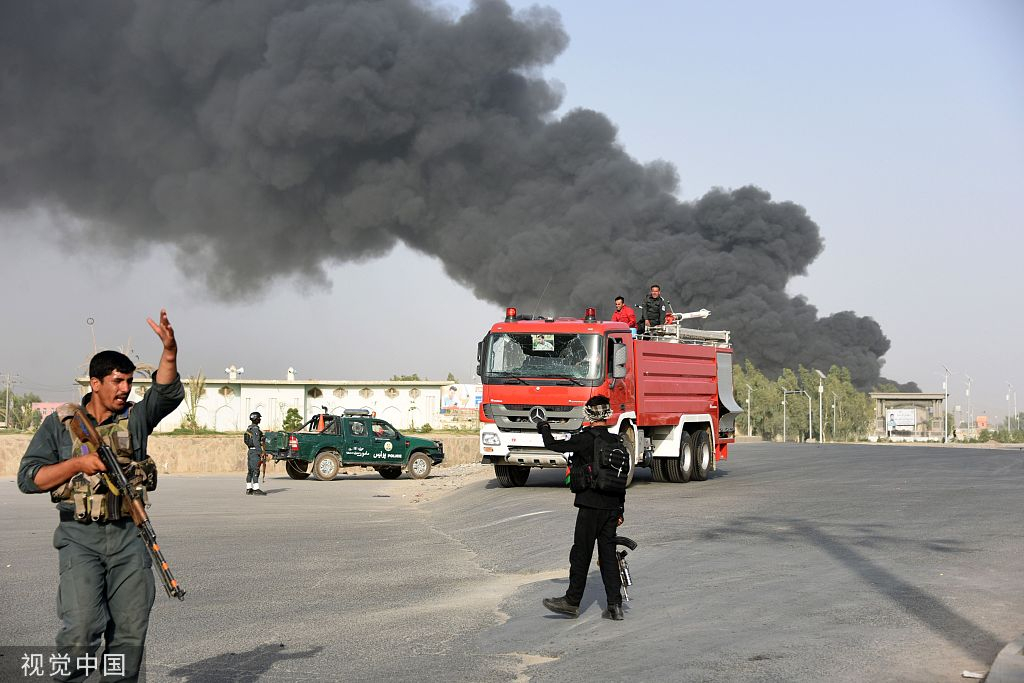
Afghan policemen arrive near a site of car bomb attack as smoke rises from the Police headquarters in Kandahar Province, Afghanistan, July 18, 2019. /VCG Photo
Iran too is a neighbor, with whose leadership, Imran Khan has developed an aura of confidence by not taking sides in the Saudi-Iranian rivalry or the U.S.-Iran showdown. Imran Khan spelt out the dangers of an armed US-Iran conflict, which will not only spillover into Pakistan but will be bloodier and more devastating than the U.S.-Iraq conflict.
The U.S. President saw in Imran Khan, a mature and popular leader, who does not seek power or pelf for himself but is striving for the betterment of the people and peace for the region. The visible amity between the two leaders can be gelled into a bond of friendship which will usher shared harmony for humankind and this must be welcomed.
Accompanied by the Army Chief and head of Pakistan's Inter-Services Intelligence Agency along with the Foreign Minister, Minister for Ports and Shipping as well as the Advisers on Finance and Commerce, the Pakistani Prime Minister managed to cover various areas of bilateral ties.
The Army Chief called on his counterparts at Pentagon and shared details of Pakistan’s success in the war on terror while the finance, commerce and other aspects were covered by respective specialists.
Over a decade of trust deficit between the U.S. and Pakistan cannot be bridged in one meeting alone but a good start has been made and the foundations of better understanding and cooperation have been laid. The convergence of interests has brought the two erstwhile estranged allies together again. Pakistan did not seek the resumption of aid as it wanted to maintain its dignity, but the U.S. president did hint towards it. More importantly, Pakistan's narrative has been accepted, its sacrifices in the war on terror acknowledged and it is being perceived as part of the solution in Afghanistan and not the problem.
Another positive outcome can be U.S. support in staving off the looming threat of being blacklisted by the Paris-based terror-financing watchdog Financial Action Task Force. In June 2018, Pakistan was placed on the "grey list" due to its "strategic deficiencies" in the anti-money-laundering and counter-terrorism-financing regimes. In October 2019, Pakistan’s case is coming up for review.
(If you want to contribute and have specific expertise, please contact us at opinions@cgtn.com.)