
 []
[]
Share







Copied
Editor’s note: Mike Cormack is a writer, editor and reviewer mostly focusing on China, where he lived from 2007-2014. He edited Agenda Beijing and is a regular book reviewer for South China Morning Post. The article reflects the author's opinions, and not necessarily the views of CGTN.
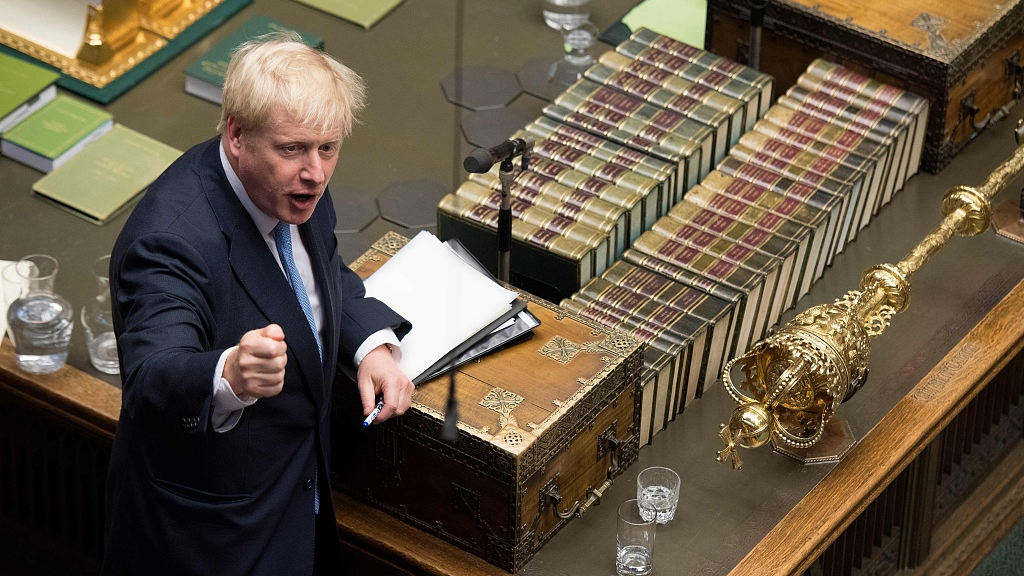
On July 23, Boris Johnson, former mayor of London, was elected as Conservative leader, and Queen Elizabeth II appointed him as British prime minister the next day. Johnson then officially became the new host of 10 Downing Street.
Few prime ministers have inherited such a bleak national outlook, with the UK's global reach set to be decisively reduced.
Yet even fewer, perhaps, have done so much to precipitate it. Boris Johnson, in truth, is the Brexit prime minister. Certainly, without it, he would not have reached No. 10. His leadership of the Better Out campaign helped him destroy the Cameron administration. His resignation from the post of foreign secretary likewise undermined Theresa May and ensured her withdrawal deal would be rejected in the House of Commons.
But there is another sense in which Johnson is the ideal Brexit prime minister. The problem about Brexit is that when it hits reality, its supporters flee from its consequences. It remains best as a concept, an ideal far from detail, legalities and specific legal clauses. This is because the UK sought several irreconcilable outcomes.
It wanted to leave the single market and customs union. It wanted the land border between Northern Ireland and the Republic of Ireland to remain "frictionless," without border checks. And it wanted Northern Ireland to be treated the same as the rest of the UK by the EU.
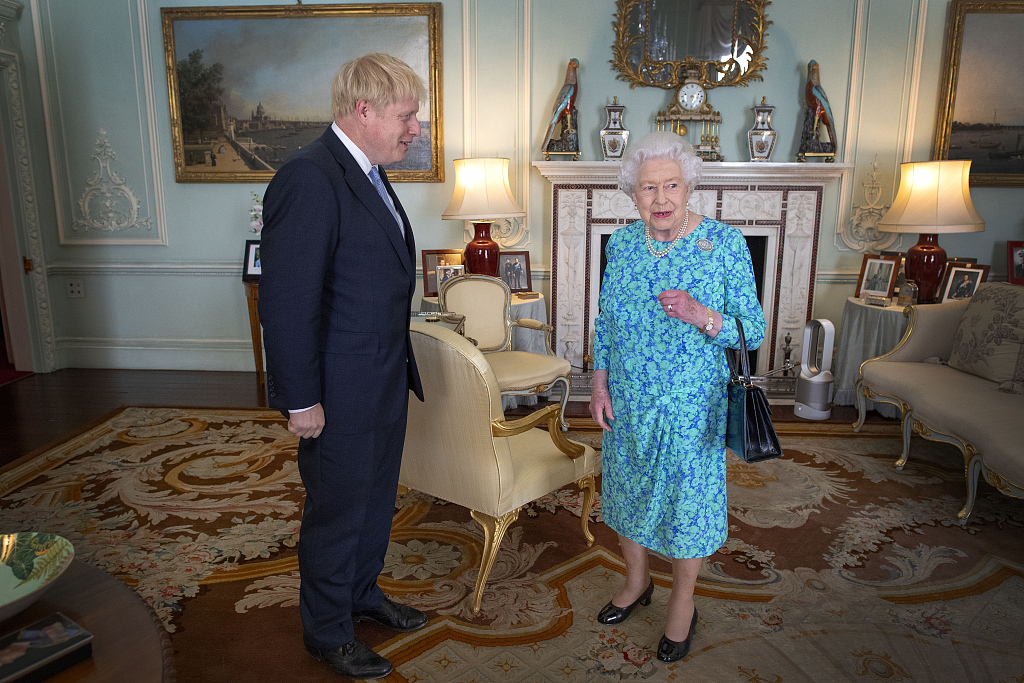
Queen Elizabeth II welcomes newly elected leader of the Conservative party Boris Johnson during an audience in Buckingham Palace, London, UK, July 24, 2019. /VCG Photo
But these are mutually inconsistent. If the UK leaves the single market and customs union that requires border checks, and if there are none between Northern Ireland and the Republic, that means Northern Ireland has a different status than the rest of the UK. And if Northern Ireland is treated differently from the rest of the UK, that means breaking up the United Kingdom, leaving the island of Ireland with a single trading identity and moving toward unification.
When a deal was hammered out with the EU, however, Johnson resigned as foreign secretary and decried it, calling it "servitude" to the EU and "colonial rule by foreign powers and courts" – because, to facilitate these irreconcilable goals, that necessitated a "backstop" – an insurance policy guaranteeing that there would be no hard border between Northern Ireland and the Republic, no matter what form of departure the UK takes from the EU.
Rather than admitting the logical absurdity of their goals, Johnson and the Brexiteers blamed Prime Minister Theresa May for not pursuing them with sufficient vigor. Detail, negotiated agreements – in a word, reality – were disdained. No serious alternatives were proposed, beyond scrapping the backstop. And so the appeal of "no deal Brexit" grew – a metaphorical slashing of the Gordian Knot, no matter what the situation might actually hold.
Boris Johnson likewise is better as a concept than as reality. His appeal is heavily based on his "positivity" and non-political charm. He “cuts through” to ordinary voters in a way that other politicians do not. But his track record in leadership roles is mixed to say the least.
As mayor of London, he caught the public eye through stunts like ziplining from the London Eye holding Union Jacks in each hand, and won re-election in 2012. He also left a trail of expensive gimmicky projects behind him, however, such as the 43-million–pound (around 53 million U.S. dollars) garden bridge (which had to be scrapped), and new red buses, which cost twice as much as normal double-deckers, and hundreds of thousands of pounds spent on water cannons which were illegal for use in the UK.
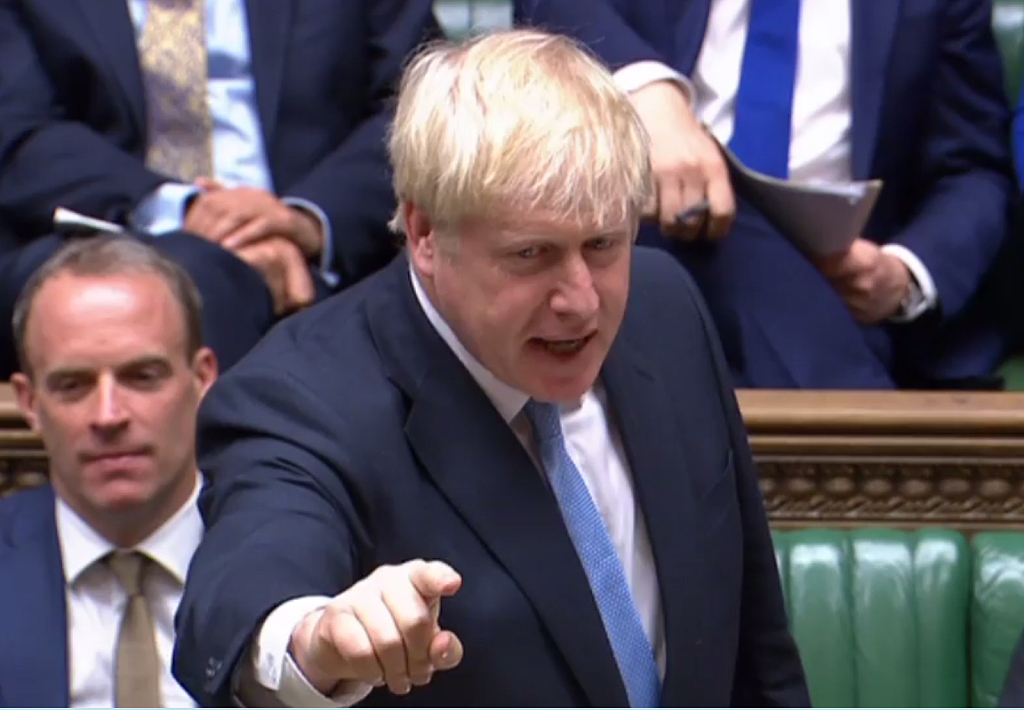
British Prime Minister Boris Johnson makes a statement in the House of Commons in London, UK, July 25, 2019. /VCG Photo
His time as foreign secretary, however, was more straightforward. He was catastrophic. Beyond glaring insensitivities, such as reciting Kipling's "The Road To Mandalay" (a poem that would be seen as grossly imperialistic) when in Myanmar, and making egregious remarks about foreign leaders (writing an insulting limerick about the Turkish president, comparing the French president to a Nazi guard), he also failed to handle the basic tasks of the office.
He got a British woman arrested in Iran for spying further into trouble by wrongly declaring she was employed there as a teacher, when she said she had only been there on holiday. He shocked people by declaring the Libyan city of Sirte had a bright future – as soon as they "clear the dead bodies away." And in the end he resigned rather than face the consequences of the EU Withdrawal Agreement.
Johnson is a strong campaigner, as was seen during the referendum. He attracts attention, even at the cost of his own dignity. He is skilled at finding the popular, and populist, line which gains broad attention. But he is also famously a no-detail politician, delegating such matters to those beneath him. He is indiscreet and insensitive. He enjoys making a spectacle, but regularly fails to do basic things such as establish his facts beforehand. He appears to have few goals beyond the gratification of his own ambition.
For a prime minister these are fatal flaws, meaning it is impossible to see how he can succeed in the role. And so, like Brexit, he will prove to be better in concept than in reality. Like Brexit, Johnson's appeal will be destroyed when the harsh reality comes into contact with grandiose rhetoric. But for him it will be even more personal, because the grandiloquence and the outlandish claims and the eye-catching slogans are all his.
(If you want to contribute and have specific expertise, please contact us at opinions@cgtn.com.)