- Home
- China
- World
- Europe
- Politics
- Business
- Opinions
- Tech & Sci
- Culture
- Sports
- Travel
- Nature
- Picture
- Video
- Live
- TV
- Specials


Share







Copied

Stargazers will have the opportunity to observe the last celestial event of the year – an annular solar eclipse – on Wednesday.
According to NASA's definition, an annular eclipse happens when the Moon is farthest from Earth. Because the moon is farther away from Earth, it seems smaller and does not block the entire view of the Sun.
Observers will be able to see a "ring of fire" if they are under the central region, or antumbra, of the shadow of the Moon. People under the penumbra of the Moon will be able to see a partial solar eclipse.
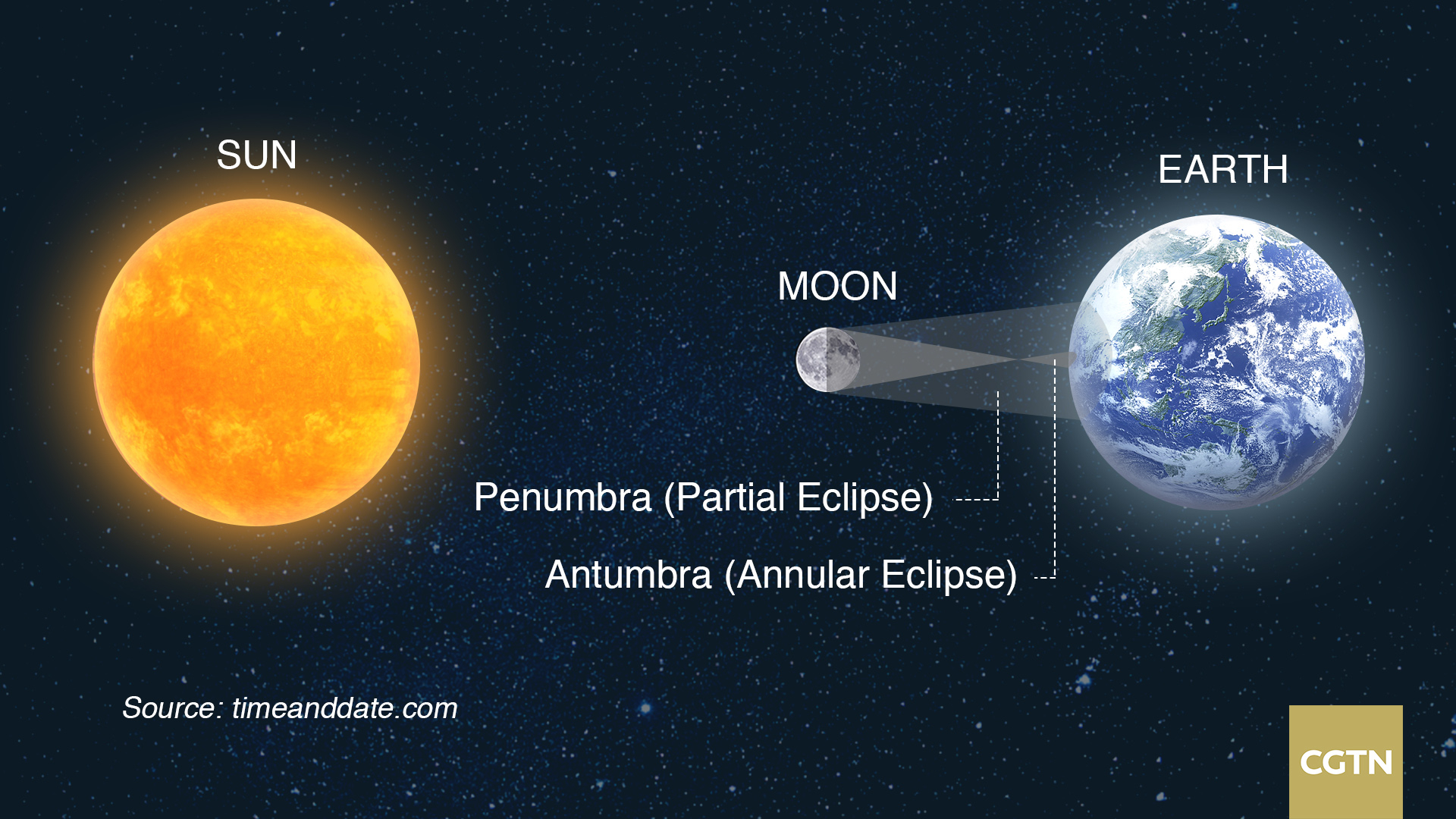
CGTN infographic by Du Chenxin
The solar eclipse will be visible from Asia, Africa and Australia. People in Saudi Arabia, Qatar, India, Sumatra, Borneo, Guam and the Philippines will be able to view the only annular solar eclipse of 2019, while people in the rest of the solar eclipse area will observe a partial solar eclipse.
The first place to see the annular eclipse is about 220 kilometers northeast of Riyadh, Saudi Arabia, at 6:34 a.m. local time (0334 GMT). Guam is the last place to see the "ring of fire" for about 3 minutes, according to EclipseWise.com.
Looking directly at the disk of the Sun can cause permanent damage to eyes. To observe the solar eclipse safely, you can use a pinhole camera or wear special protective eyewear; regular sunglasses can't protect your eyes from the Sun.