- Home
- China
- World
- Europe
- Politics
- Business
- Opinions
- Tech & Sci
- Culture
- Sports
- Travel
- Nature
- Picture
- Video
- Live
- TV
- Specials


Share







Copied
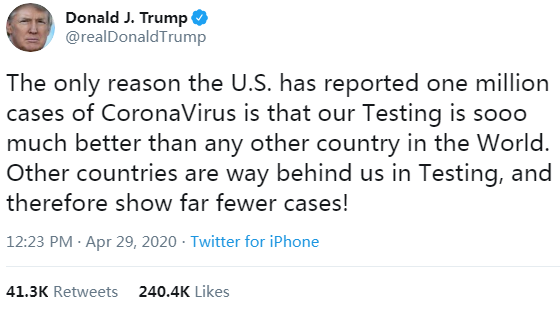
The United States has reported more than a million coronavirus infections only because of its testing, President Donald Trump said on Wednesday, hailing the effort as being "much better than any other country in the world."
"The only reason the U. S. has reported one million cases of coronavirus is that our testing is sooo much better than any other country in the world," Trump said on Twitter.
"Other countries are way behind us in testing, and therefore show far fewer cases."
The number of COVID-19 deaths in the U.S. topped 60,000 on Wednesday afternoon, reaching 60,207 as of 4 p.m. (2000 GMT), according to the Center for Systems Science and Engineering (CSSE) at Johns Hopkins University.
A total of 1,030,487 cases have been reported in the country, according to the CSSE.
5 million, 8 million or 20 million?
However, state public health officials do not agree with the president, saying that shortages of trained workers and materials have limited testing capacity.
There's "no way on Earth" the U.S. can test 5 million people a day for the coronavirus, the government's top testing official said in an interview.
"There is absolutely no way on Earth, on this planet or any other planet, that we can do 20 million tests a day, or even five million tests a day," Admiral Brett Giroir, assistant secretary of health who is in charge of the government's testing response, told TIME in an interview he gave Tuesday morning that was published later in the evening.
The U.S. will be able to test 8 million per month by May, Giroir has said.
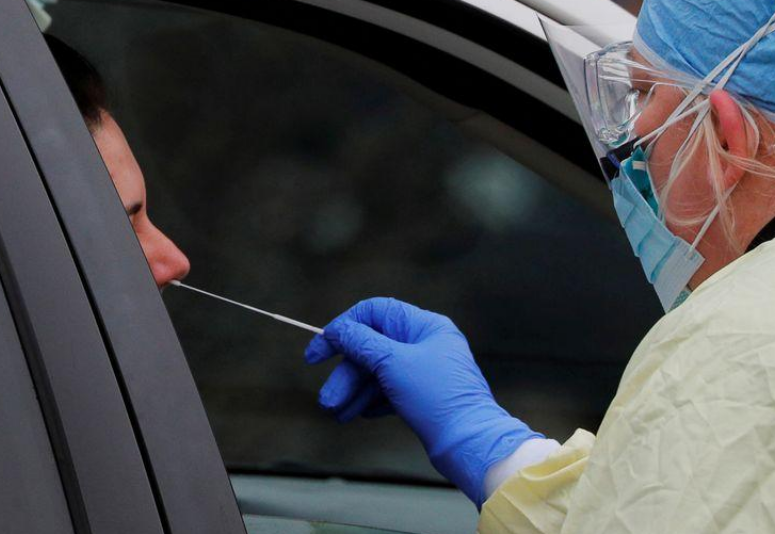
A medical technician takes a sample to test for the coronavirus disease (COVID-19) at a drive through testing site in Medford, Massachusetts, U.S., April 4, 2020. /Reuters
On Tuesday when a reporter asked in an East Room event whether the U.S. would surpass 5 million coronavirus tests per day, the president said that's coming "very soon." But on Wednesday, the president claimed he never said that, blaming a "media trap."
"The United States has done double the number of tests of any country in the world," White House press secretary Kayleigh McEnany said in a statement Tuesday.
"We have exceeded all expectations and continue to lead the world in testing capacity as we assist governors in ensuring they have the capacity to reopen their states in a safe manner."
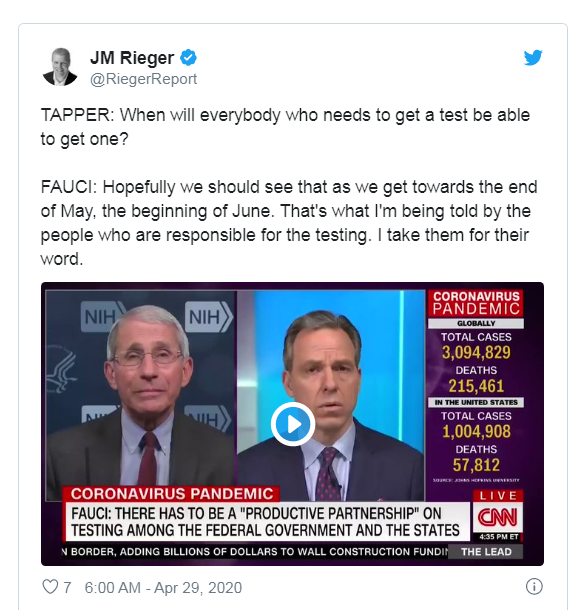
Screenshot from Twitter
Anthony Fauci, head of the National Institute of Allergy and Infectious Diseases, said every American in need of a virus test should be able to get one by the end of May or the beginning of June.
"We are not in a situation where we can say we are exactly where we want to be with regard to testing capacity for COVID-19 in the U.S.," he said.
"I am not overly confident right now at all that we have what it takes to do that. We are doing better, and I think we are going to get there, but we are not there yet."
The president said on March 6 that anyone who wanted a coronavirus test could get one.
Data about U.S. tests capability
The U.S. has run just 5.7 million total COVID-19 tests since the beginning of the pandemic, according to data compiled by the COVID Tracking Project. The most tests the nation has run on a single day was 314,182 on April 22, according to the volunteer project designed to track testing data launched last month by The Atlantic.
The White House's official testing data shows that 5.1 million Americans have been tested as of Monday, up from 3.3 million on April 15, according to Trump and Vice President Mike Pence.
A Harvard University study recently projected that the nation had to be able "to deliver 5 million tests per day by early June to deliver a safe social reopening," and further, that it would need to reach 20 million a day by the end of July to "fully remobilize the economy." Even that number, the study said, "may not be high enough to protect public health."
Paul Romer, a Nobel Prize-winning economist from New York University who has recommended that 50 percent of the population be tested each week, said testing 2 percent "is not enough to test everyone in health care even once, let alone to keep retesting them every day, which is what it would take to keep those who do get infected from going on shift and infecting their colleagues."