- Home
- China
- World
- Europe
- Politics
- Business
- Opinions
- Tech & Sci
- Culture
- Sports
- Travel
- Nature
- Picture
- Video
- Live
- TV
- Specials


Share







Copied

Argentine pesos. /VCG
The concept of a basic monthly income for a country's citizens is one that has been floated for some time.
The economic upheaval, particularly the heavy loss of jobs, caused by the coronavirus pandemic has hastened debate about the practicality of a universal income, with some experts saying it is an idea whose time has come.
In a new report, the United Nations Economic Commission for Latin America and the Caribbean (ECLAC) recommends it as a course of action if the region, which is marked by deep-rooted inequality, is to move beyond the crisis toward more sustainable societies.
In the first instance, it proposes the payment of an emergency income over the next six months to provide the basic needs of all those living in poverty in 2020 – an estimated 215 million people or a substantial 34.7 percent of the region's population.
The Chile-based agency sees such a move as paving the way "for a universal basic income to guarantee the basic right to survival" in nations that can afford it.
ECLAC warned last month that economic activity in Latin America and the Caribbean will decline this year by a record 5.3 percent.
It predicted a sharp increase in unemployment as well as rising levels of poverty and inequality. By its reckoning, an additional 30 million Latin Americans will fall below the poverty line this year.
Under ECLAC's formula, an emergency cash transfer should amount to the per capita cost of acquiring a basic food basket, potentially adding spending that's equivalent to 2.1 percent of gross domestic product.
Vulnerable sectors
"The pandemic has exposed structural problems in the economic model and the failings of social protection systems and welfare schemes that are very costly to us today," Alicia Barcena, the UN body's executive secretary, said at the report's virtual launching on Tuesday.
"Hence, we must move towards the creation of a welfare state based on a new social compact that takes into account fiscal, social and production-related matters."
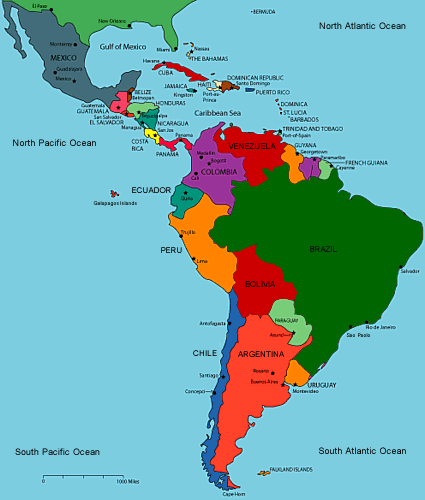
Latin America and the Caribbean was on course for dismal growth even before the pandemic, which ECLAC says will now lead to the biggest contraction in economic activity in the region's history.
Cash payments under a basic income system – unconditional and available to all – are intended to replace existing social welfare programs.
Supporters say such a system stands a better chance of reaching the most needy recipients. But critics balk at the added costs to the public purse.
Latin America has more than 369,000 confirmed cases of the new coronavirus and more than 20,000 deaths from COVID-19, according to published data.
The ECLAC report says the impact of the pandemic will be more strongly felt among women, indigenous people, the Afro-descendant population and migrants.
Women are in a "particularly vulnerable situation," the report says, because their work is mostly in informal sectors where there are generally no safety nets.
It notes that discrimination and racism also hinder the effective access of minority communities to health services.
Since the crisis began, many Latin American governments, most of which were already under severe economic pressure, have moved to implement social protection measures, including cash and food transfers, in response to the sharp drop in worker and household income.
The region is also experiencing a reduction in international trade, a fall in commodities prices, lower demand for tourism services and a reduction in remittances.