- Home
- China
- World
- Europe
- Politics
- Business
- Opinions
- Tech & Sci
- Culture
- Sports
- Travel
- Nature
- Picture
- Video
- Live
- TV
- Specials


Share







Copied

Herons are silhouetted against the setting sun at a conservation base for migratory birds by Poyang Lake in east China's Jiangxi Province, April 9, 2020. /Xinhua
Editor's note: Dr. Ding Leilei is a graduate of the Institute of Geology and Geophysics, Chinese Academy of Sciences. The article reflects the author's opinions, and not necessarily the views of CGTN.
June 5 is the World Environment Day. The theme for this year is "Time for Nature," which calls for people to pay more attention to species loss and degradation of our natural world.
This is the second time that World Environment Day has set biodiversity as its theme, after the theme "Many species. One planet. One future" a decade ago. The urgency and importance of biodiversity conservation is evident.
Why is it important to protect biodiversity?
Biodiversity is the foundation of human life. It seems far away from where you live in the city. However, the reality is that biodiversity create the air you breathe, the water you drink and the food you eat.
Some examples are obvious: without plants there would be no oxygen and without bees to pollinate there would be no fruit or nuts. The great value of biodiversity lies in providing opportunities for humans to adapt to local and global changes.
The natural environment is a complex ecosystem. It is biologically and environmentally interrelated, restricted, interdependent. Material movement and energy exchange between biological and environmental keeps the ecosystem balanced. Once the ecosystem goes out of balance, it will cause serious consequences. Studies have shown that the loss of any one species would endanger ten to dozens of relevant species.
However, biodiversity in the world is decreasing rapidly and changing dramatically due to human activities. According to the current growth rate of population and industrial development, experts predict that humans will destroy half of the plants and animal species in 50 years and a quarter species will become extinct in 100 years.
Thus, the United Nations Environment Program (UNEP) has listed biodiversity as one of the four major global environmental issues, along with global climate change, ozone layer destruction, and harmful substances transfer.
Besides, with the emergence of issues such as safety of genetically modified organisms and the invasion of alien species, the protection of biodiversity has attracted increasing attention from the international community. Governments and organizations of different countries have created effective strategies to preserve biodiversity.
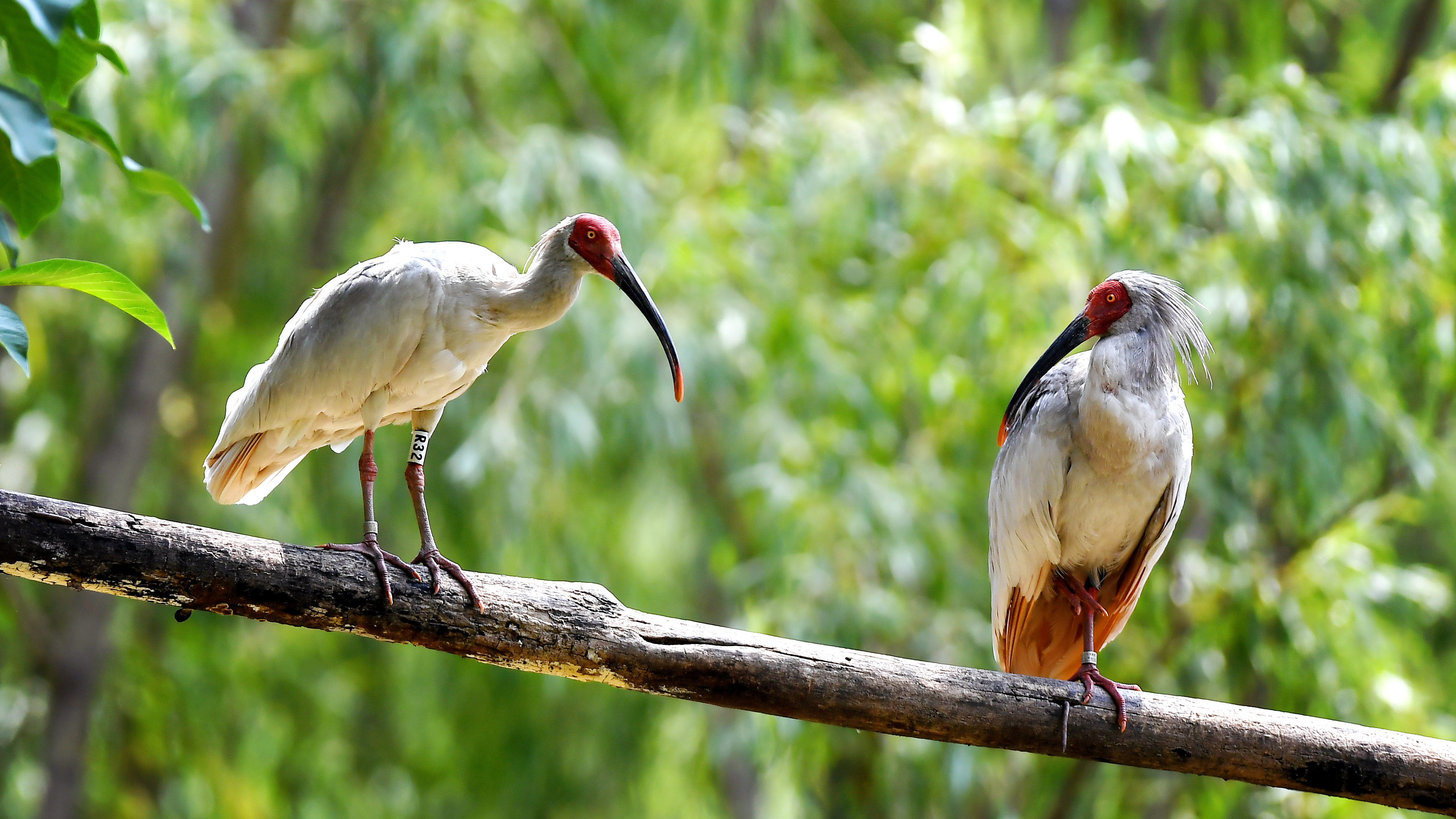
Crested ibis rest at a wild training base in Tongchuan City, northwest China's Shaanxi Province, June 13, 2019. /Xinhua
First, set goals and policies. China formulated the Biodiversity Conservation Strategy and Action Plan (2011-2030). A sound policy and legal system for biodiversity conservation and a mechanism for the sustainable use of biological resources have been formed, and the protection of biodiversity has become a conscious action of the public.
Second, create an ecological environment for biodiversity. Common methods include establishing nature reserves, implementing forest protection, and returning grazing land to grassland. For example, China has 2,740 nature reserves, covering 15 percent of its land mass.
Third, raise public awareness. Every individual has a role in biodiversity conservation. To achieve this goal, social media, forums and large-scale social activities are powerful tools. One of the well-known noncommercial ads is "Almost gone - the wolf. With your help, it will stay." It displays a glorious wolf leaving the picture, part of it already gone.
Many European countries have lost all or most of their wolves to excessive hunting and development and when they disappear, they left behind an imbalanced ecosystem.
The last, but the most important point, is to strengthen international cooperation. Biodiversity transcends national borders, which is a problem that should be taken into focus by more countries.
For example, today there are only eight northern white rhinos left in the world. To protect them, animal experts from Kenya and the Czech Republic have teamed up to transport a half of them to Kenya's Olpejita Nature Reserve, helping them breed in the wild.
On this World Environment Day, each of us should put the knowledge to practice and to do your own part to end biodiversity loss and the climate crisis. Only if we do our part would we be able to restore natural environment and ensure a better and healthier future for the next generation.
(If you want to contribute and have specific expertise, please contact us at opinions@cgtn.com.)