- Home
- China
- World
- Europe
- Politics
- Business
- Opinions
- Tech & Sci
- Culture
- Sports
- Travel
- Nature
- Picture
- Video
- Live
- TV
- Specials


Share







Copied
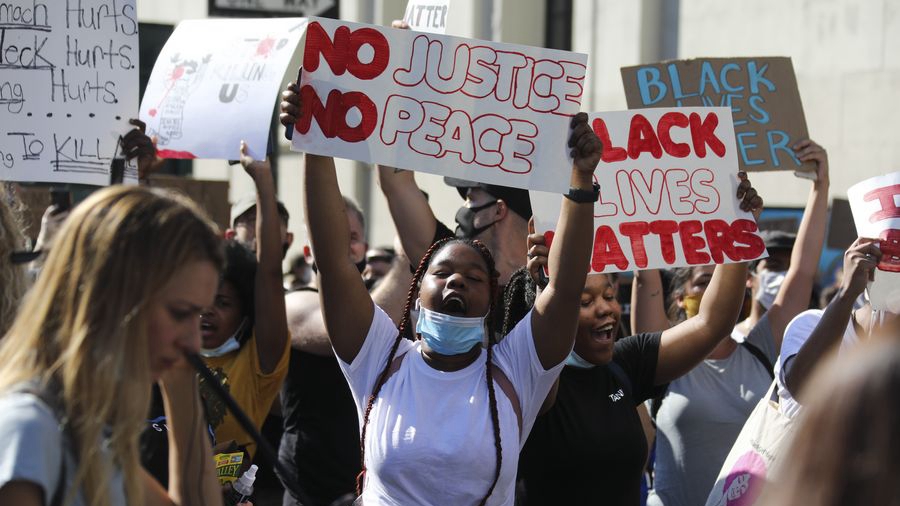
Demonstrators protest over the death of George Floyd in New York, the United States, June 3, 2020. /Xinhua
Editor's note: The following article is taken from the Chinese-language opinion column "The Real Point".
The protests and demonstrations caused by the death of African-American George Floyd have spread across the United States. While racial discrimination in the U.S. is being denounced globally, some Western leaders who are keen on making comments on "democracy" or "human rights" have remained almost silent, or have responded equivocally.
When asked about what he thought about the U.S. leader's call for military action against protesters in the country, Canadian Prime Minister Justin Trudeau remained speechless for 22 seconds, almost reluctant to answer that question. British Prime Minister Boris Johnson did not comment on Floyd's death until one week after the tragedy, and he responded in a roundabout way by saying that "racism and racist violence has no place in our society."
Meantime, Australian Prime Minister Scott Morrison has also been trying to avoid making remarks, and the country's Green Party leader Adam Bandt urged Morrison to make response to the U.S. government's bad behavior. Just as what Australian media Sky News quoted Bandt, "If a leader of another country was teargasing people for a photo opportunity or threatening to call out the military, there would be comments from leaders around the world."
However, facing the shocking actions taken by the U.S. leader, some Western leaders have been turning a deaf ear or remaining almost speechless, posing a sharp contrast with occasions when they are making irresponsible remarks regarding other countries.
In fact, many Western countries have become adapted to dancing to the tune of the U.S., and they are either too unaccustomed or too timid to criticize, especially when they have experienced how the U.S. can turn against them on issues on the economy and trade front as well as security in recent years.
Another possible reason is that racial discrimination is also severe in those Western countries themselves. Some of the politicians also uphold "White Supremacy." Apart from the U.S., protests over the death of Floyd have also erupted in other countries including Britain, Australia and Canada. Some Western politicians fear that their own nests might be fouled if they make excessive remarks, thus bringing trouble upon themselves.
Taking a general view of their history, major Western countries promoted colonialism during the preliminary stage of their capitalist development, planting seeds of racial discrimination around the world. Due to reasons including social systems or polarization between the rich and the poor, minorities in Western countries such as Britain, Australia and Canada have also been reported to have experienced unfair treatments. Racial discrimination has caused several riots including the one in London in 2011 and the one in Stockholm in 2013.
At this point, many people in various Western countries have organized protests and demonstrations over the death of Floyd not only for moral reasons, but also because they are concerned with the increasingly serious racial discrimination in their own countries.
Ironically, while hardly having any ideas on how to solve the problem of racial discrimination in their own countries, some politicians have been keen on stirring racist attacks on foreign countries, especially developing ones, such as stigmatization.
Racial discrimination is not only a sore spot in the U.S., but also a common shame among all Western countries. Sticking to double standards will not keep them out of harm, while evasion or equivocation will not help solve the problem.
Four former U.S. presidents including Barack Obama, George W. Bush Junior, Bill Clinton and Jimmy Carter have condemned racial discrimination following Floyd's death. UN High Commissioner for Human Rights Michelle Bachelet criticized "structural racism" in the U.S., calling on the country to address the "deep-seated" grievances at the heart of the ongoing protests.
It is high time Western leaders took a clear stand on the issue of racial discrimination. Their silence or ambiguity will only serve as a condonement.
(If you want to contribute and have specific expertise, please contact us at opinions@cgtn.com.)