- Home
- China
- World
- Europe
- Politics
- Business
- Opinions
- Tech & Sci
- Culture
- Sports
- Travel
- Nature
- Picture
- Video
- Live
- TV
- Specials


Share







Copied
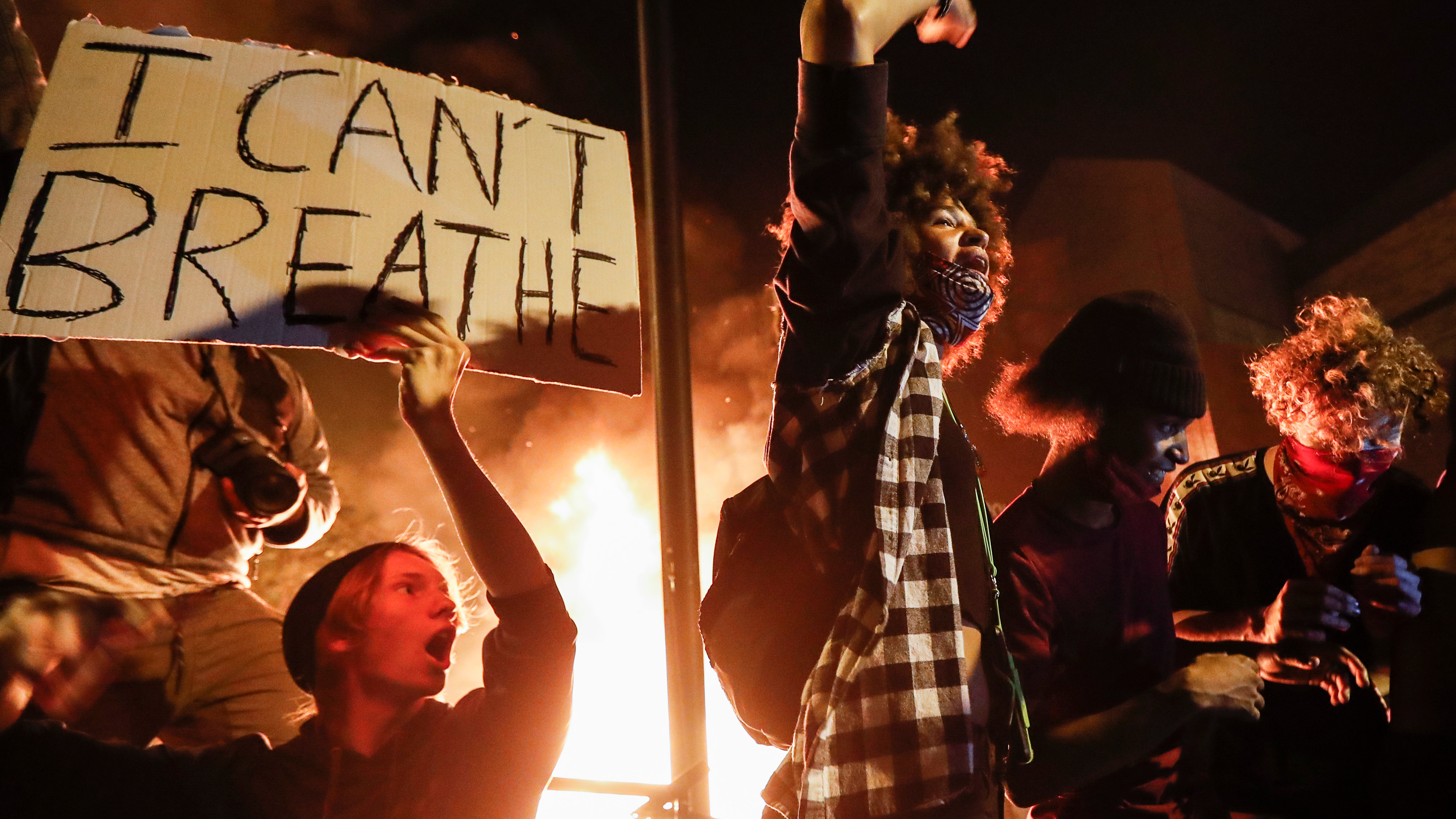
Protestors demonstrate outside a burning Minneapolis 3rd Police Precinct, in Minneapolis, the U.S., May 28, 2020. /AP
Editor's note: Josef Gregory Mahoney is a professor of politics at East China Normal University. The article reflects the author's opinion, and not necessarily the views of CGTN.
The recent outburst of protests for racial justice in the United States have grown over the past couple of days, and they have also become more focused and disciplined. This indicates that some inciteful claims made by the Trump Administration that anarchistic and even communist elements were staging for mass violence were unfounded, and undercuts his unsettling threats to deploy American troops against American citizens.
That these protests disciplining themselves is not surprising. The initial protests happened spontaneously, without much organization or self-policing. This not only invited more police suppression, it also undermined the broader cause and the memory of the slain African American man, George Floyd—an unarmed and out-of-work survivor of COVID-19 who was choked to death in the custody of four policemen in the latest of many unfortunate cases of police brutality against black people.
Since the protests began, Trump has attacked nationwide efforts to better organize them as proof of a national conspiracy against his reelection, and has demanded a firm hand from state governors or risk him calling regular U.S. military units into the fray.
Trump is a 'Threat to the Constitution'
These threats along with other incendiary rhetoric have drawn warning labels from social media and criticisms across the political spectrum, but more incredibly, it also drew a very strong rebuke from James Mattis, Trump's former Secretary of Defense and a leading military general.
As widely reported, General Mattis denounced Trump for dividing Americans and politicizing the nation's military, labeling him a threat to the U.S. Constitution.
This is a grave accusation, and likely reflects concerns among other high-ranking officers who are still on active duty and unable to speak publicly. Above all it raises the specter that Trump, constitutionally the commander-in-chief of the nation's military, has lost that authority. It's illegal for American troops to obey an unlawful order. While they swear an oath to follow the orders of the president, they firstly swear to "support and defend the Constitution against all enemies foreign and domestic."
The current Secretary of Defense, Mark Esper, a devout Trump loyalist who succeeded Mattis in the post, has also indicated his deep unease with Trump's politicization of the military, and specifically, Trump's orders to attack peaceful protestors in Washington with teargas to clear space for a Bible-wielding photo-op at a church near the White House to pander to his Evangelical Christian base. Acknowledging this tension, Trump's new press secretary reported that Secretary Esper was still in his post and had not yet been fired.
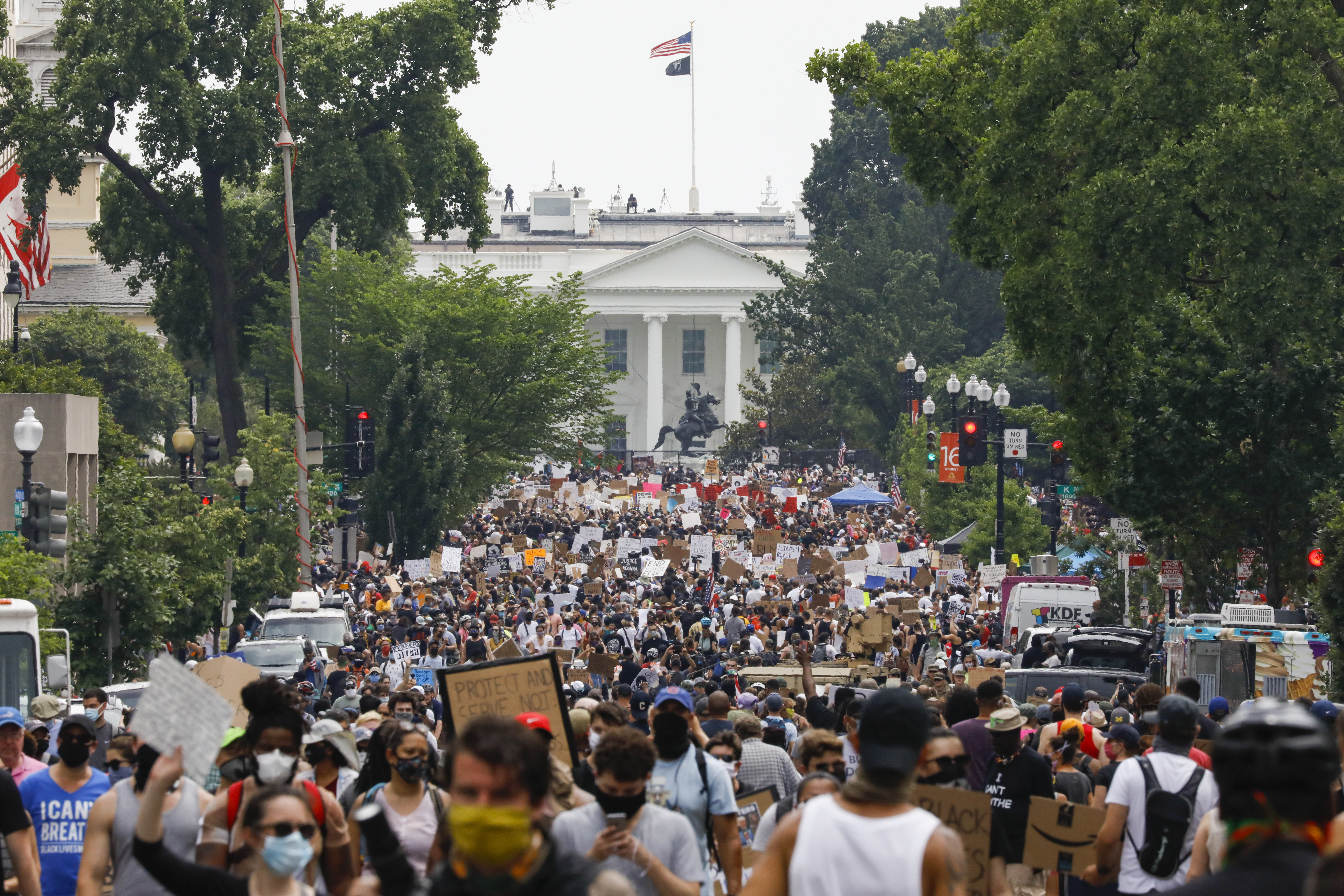
Demonstrators protest near the White House in Washington, the U.S. over the death of George Floyd, a black man who was in police custody in Minneapolis, June 6, 2020. /AP
And He's Going to Hell?
Mattis' rebuke is the most serious, but others have gone further, including Arnold Schwarzenegger—the Hollywood action star and former Republican governor of California—in a recent viral video message.
Recalling his youth in post-Third Reich Austria, Schwarzenegger described the many who survived the war but were broken men due to their support of the Nazi's awful cause. Schwarzenegger punctuated this succinctly with, "And now they are burning in hell," before outlining how Trump might begin to save himself and the country from damnation.
America's Political System in Crisis
The U.S. is beset with a number of systemic crises currently touching on many facets of life, and the pandemic has exposed these even more starkly that the U.S.-caused Global Financial Crisis of 2008. It has become commonplace in American politics to identify pathologically with a single party, and this has further entrenched, unfortunately, the sort of identity politics that emphasize difference, drive polarization and further erode good governance.
Meanwhile, roughly 10 percent or less of American voters will determine the outcome of November's election. Many have little to no faith in Trump or Biden, two septuagenarians that many see as grandees of the failures of the past and present, and thoroughly unable to lead the sort of necessary reforms and reconstructions vital for immediate recovery and future national well-being.
While Biden might have handled the protests better, not many are convinced he would have handled the outbreak better. And on another front, Biden has also promised to be even more anti-China than Trump has been, and while this might play to the anti-China hysteria that has gripped many American voters under Trump's encouragement, it also indicates that whoever wins in November, we might see a further decline in relations between these two major powers in ways that cause further harm to everyone.
Damned if You Do and Damned if You Don't?
Many of America's voters describe the self-compromising challenge of choosing the "lesser of two evils." While real politics always carries a stink, choosing one evil over another further undermines the individual voter and the nation as a whole. And of course, despite choosing the "lesser," one might still end up dancing with the devil, if for no other reason because polarization ensures that half the population will be angry and the other half unable to implement constructive change.
While politics remain very fluid and fast moving in the U.S., the protests have become yet another referendum on Trump's presidency. Having survived unsavory sexual revelations, official misconduct charges and impeachment, Trump's base of 42 percent-44 percent has stuck with him throughout the pandemic and is unlikely to abandon him now. But for some crucial support among swing voters, and indeed, some in the military, Trump is no longer tolerable.
Ultimately, whether this is the tipping point now for Trump, it's still no indication that it's a tipping point for the U.S. as a whole. Police brutality was a problem before Trump took office, and it is likely to continue even if Biden is elected. Indeed, while Biden might represent a change in tone and style, few believe he represents more substantial change and many of them worry he represents more of the same. This is what haunts protesters and police and those on the sidelines, all of whom are angry, fearful, and desperate for positive change.
(If you want to contribute and have specific expertise, please contact us at opinions@cgtn.com.)