- Home
- China
- World
- Europe
- Politics
- Business
- Opinions
- Tech & Sci
- Culture
- Sports
- Travel
- Nature
- Picture
- Video
- Live
- TV
- Specials


Share







Copied
Ireland's long-dominant rival political parties said Monday they have agreed on terms for a coalition government, ending a political stalemate triggered by an inconclusive February election.
The deal, which must be approved by the parties' memberships, will see Fine Gael — the party of incumbent Prime Minister Leo Varadkar — and Fianna Fail led by Micheal Martin govern alongside the smaller Green Party.
Under the proposal, Martin will become taoiseach, or prime minister, national broadcaster RTE reported. He will serve until the end of 2022 and then hand the job back to Varadkar.
"It's a good package overall. Now we need to make it happen," said Varadkar, who admitted he didn't know what Cabinet post he would get when Martin leads the government.
Ireland has been in political deadlock since the February 8 vote pushed historic rivals Fine Gael and Fianna Fail together. The two have swapped power since they emerged from opposing sides of Ireland's 1920s civil war.
The left-wing nationalist party Sinn Fein looks set to be shut out of the Irish government despite an electoral breakthrough that saw it win the largest share of the votes in February's election.
The election result was a blow for Fianna Fail and Fine Gael, the centrist parties that have dominated Irish politics since the country won independence from Britain a century ago.
Fianna Fail holds 38 seats in the 160-seat Dail, parliament's lower house. Sinn Fein has 37, Fine Gael has 35 and the Greens have 12 seats.
The parties have held protracted negotiations since February in an attempt to find a stable governing coalition, a process complicated by a nationwide lockdown imposed in March to slow the spread of the new coronavirus.
Sinn Fein was unable to assemble enough support to govern.
The two centrist parties have long shunned Sinn Fein because of its historic links to the Irish Republican Army and decades of violence in Northern Ireland. But Fine Gael and Fianna Fail are also bitter rivals whose roots lie in opposing sides of the civil war that followed Ireland's independence from the United Kingdom, and they have never formed a government together.
Now the pair need the Greens to reach a majority in the fractured parliament to pass new laws, including a 6.5 billion euro (7.3 billion U.S. dollars) package to help businesses hit by the coronavirus.
The agreement must be ratified in the next 10 days or so by grassroot members from each party. The smaller Greens need to secure two-thirds support, a higher bar than the larger parties that could yet scupper the deal.
"It's a challenging time ahead economically as a result of COVID but the program for government does represent a new departure," Martin told journalists after the talks.
His finance spokesman Michael McGrath said the document committed to moving towards a broadly balanced budget, without setting a target date.
Monday's newspapers declared the Greens the winners. The Irish Independent's front-page headline called it "A green deal to remold the shape of our politics."
Green negotiator Roderic O'Gorman said his party secured a seven percent average annual cut in greenhouse gas emissions with a fixed annual carbon budget for different sectors, while infrastructure spending would focus on public transport.
If ratified, the deal will make Sinn Fein, which wants Northern Ireland and Ireland to unite, the main opposition party for the first time. The former political wing of the Irish Republican Army surged to 37 seats in the 160-seat parliament, the same as Fianna Fail and two more than Fine Gael.
(With input from Reuters, AP)
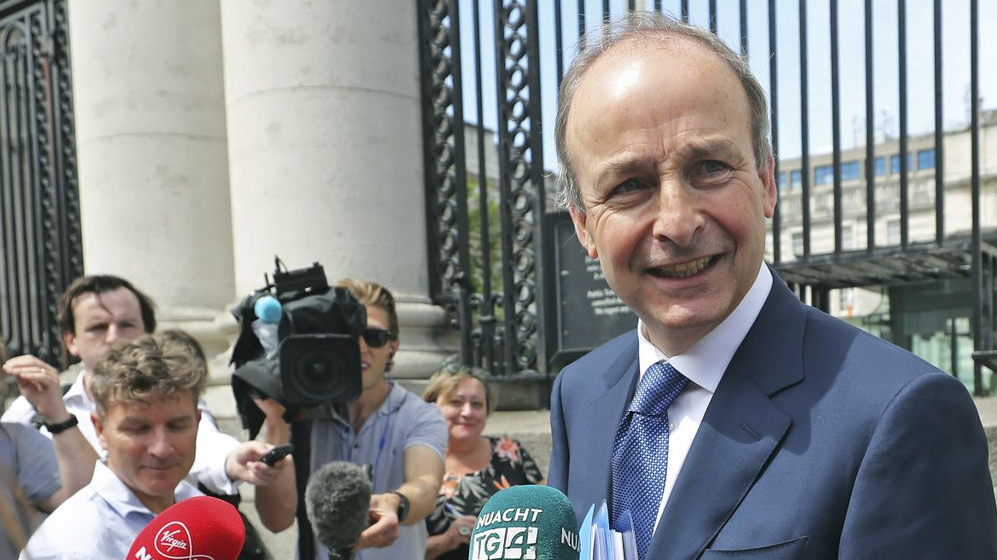
(Cover image: Fianna Fail leader Micheal Martin speaks to members of the media, outside the Government Buildings after Fianna Fail, Fine Gael and the Greens finalized the text of a draft program for the government four months on from the election, in Dublin, Monday June 15, 2020. /AP)