- Home
- China
- World
- Europe
- Politics
- Business
- Opinions
- Tech & Sci
- Culture
- Sports
- Travel
- Nature
- Picture
- Video
- Live
- TV
- Specials


Share







Copied
French Finance Minister Bruno Le Maire on Thursday condemned as a "provocation" a call by the U.S. for a break in negotiations on how to tax digital giants internationally.
"We have received, along with my counterparts in Italy, Spain and Britain, a letter from U.S. Treasury Secretary Steven Mnuchin confirming that they don't want to pursue Organisation for Economic Co-operation (OECD) talks on the digital tax," Le Maire told France Inter radio.
France, Britain, Italy and Spain had already replied to Washington, expressing their desire for "a fair digital tax at the level of the OECD" as quickly as possible.
France decided to impose a tax on large digital companies of up to three percent of their turnover as of January 1, 2019, pending the adoption of international taxation.
But it agreed to delay collecting it until a deal could be reached under the aegis of the Paris-based OECD. A total of 137 countries agreed in January to reach a deal on the taxation of multinationals by the end of 2020. France had not withdrawn the levy, "but simply suspended it for a few months."
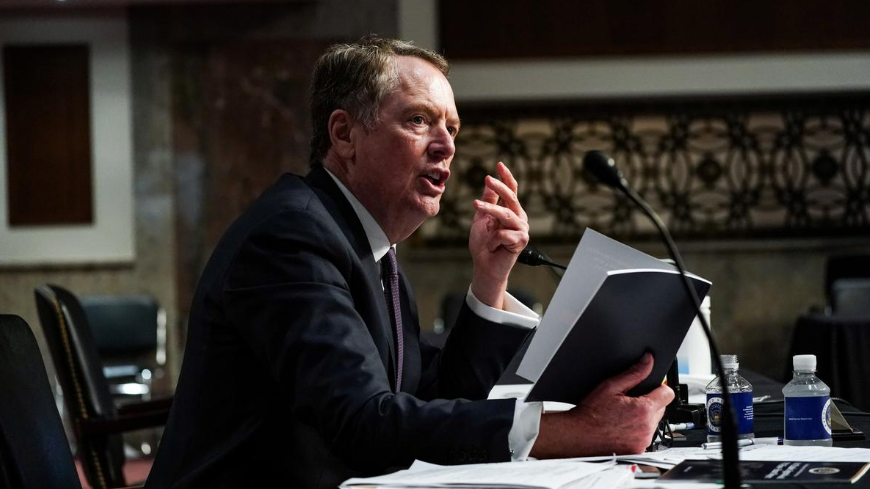
However, U.S. Trade Representative Robert Lighthizer said Wednesday that they had decided to pull out of negotiations on digital services taxes with European Union officials after they failed to make any progress.
Lighthizer claimed that he still believed an international regime was needed to deal with taxation, but the talks with European countries were not fruitful.
"We're no longer involved in the negotiations," he said during a hearing of the House Ways and Means Committee.
Washington has been at odds with France and Britain over plans to impose digital service taxes as a way to raise revenue from the local operations of big tech companies.
In retaliation to France's move, Washington threatened to impose tariffs of "up to 100 percent," which means 2.4 billion U.S. dollars of French goods.
"Whatever happens, we will apply the tax on digital giants in 2020, as it's a question of justice," Le Maire said.
He said, "Either the U.S. would go back on their position and a deal would be reached by the end of 2020 as planned so that an international tax can be levied... or there is no OECD deal because the U.S. is the only country blocking it."
"And in that case, we will levy our own national tax," Le Maire insisted.
(With input from AFP and Reuters)