- Home
- China
- World
- Europe
- Politics
- Business
- Opinions
- Tech & Sci
- Culture
- Sports
- Travel
- Nature
- Picture
- Video
- Live
- TV
- Specials


Share







Copied
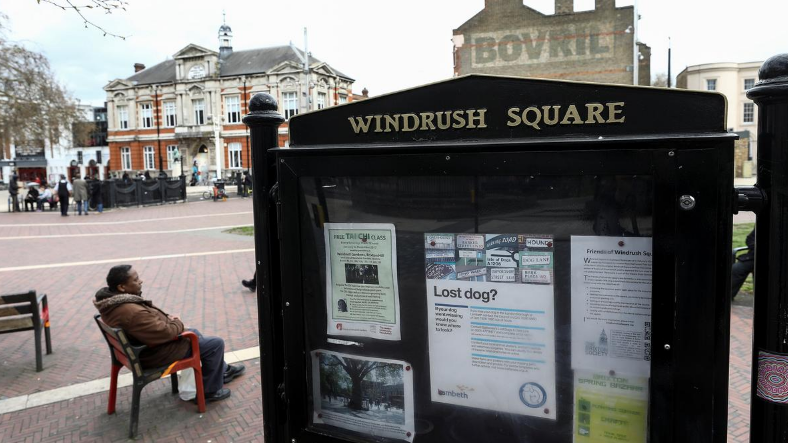
A sign on Windrush Square in Brixton, London, Britain, April 16, 2018. /Reuters
Readers of the Guardian have highlighted the dangers of anti-Chinese sentiment over Hong Kong and contrasted Britain's offer of citizenship to many Hong Kong residents with the treatment of the Windrush generation.
Several letters were published by the newspaper in response to an article by Simon Jenkins, a Guardian columnist.
Jenkins wrote a commentary on July 2 entitled "Britain can't protect Hong Kong from China – but it can do right by its people" claiming over 100,000 Chinese students in Britain need "encouraging and protecting from" the HK national security law.
London recently announced that Hong Kong residents holding British National Overseas (BNO) passports can come to Britain and seek citizenship after a five-year period, a plan which Beijing has expressed firm opposition to.
Read more:
Dr Hugh Goodacre, a lecturer from University College London, objected to the idea of encouraging students to search for so-called protection from the UK. "Indeed, this explicit call to recruit students as tools of foreign interference would result precisely in exposing them to even greater risk," he wrote.
Another reader questioned the logic and morality of the proposal.
"The long-term Home Office policy of harm, cruelty and repeatedly broken promises continues to be practised against Commonwealth friends, particularly the rightful presence of Windrush-generation Jamaicans," Martin Goldman wrote, referencing Caribbean migrants who came to Britain between 1948 and 1971 but have faced multiple challenges.
"How strange that the Home Office has failed for decades to resolve the situation of Windrush victims, most of whom are already in the UK, except for those unjustly deported to their alleged homes in the Caribbean," Greg Conway wrote.
"I can't help comparing this to our inability to cater for a few hundred child refugees seeking to be reunited with their families, or indeed a few thousand Windrush citizens," Jill Wallis echoed.
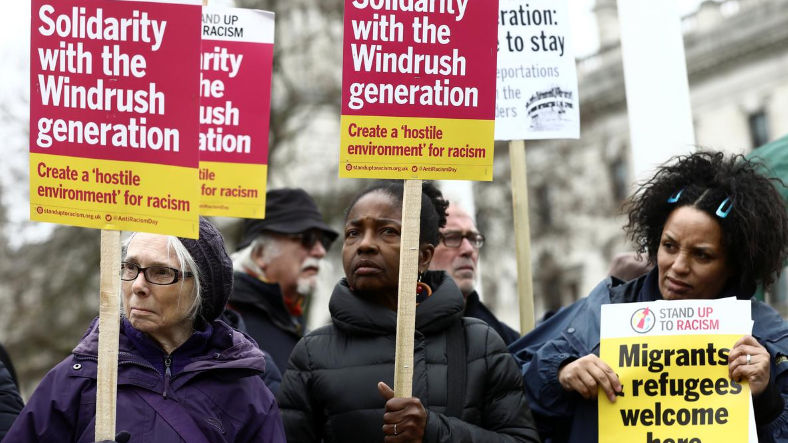
A demonstration against the treatment of members of the Windrush generation, opposite the Houses of Parliament in London, Britain, April 30, 2018. /Reuters
Windrush generation
The Windrush generation is the name given to Caribbean migrants who came to Britain from 1948 to 1971, a period in which Commonwealth citizens were invited to fill labor shortages and help rebuild the economy after World War II.
One of the first ships to bring migrants to the UK was called the Empire Windrush.
Almost half a million people left their homes in the West Indies to live in Britain between 1948 and 1970, according to Britain's National Archives, but many have since faced numerous challenges.
The British media have reported cases such as a man who was denied treatment for cancer and a special needs teaching assistant who lost his job after being accused of being an illegal immigrant despite living in Britain for more than 40 years.
Under the 1971 Immigration Act, all Commonwealth citizens already living in the UK were given indefinite leave to remain.
But the Home Office did not keep a record of those granted leave to remain or issue any paperwork confirming it, meaning it can be difficult for the individuals to now prove they are in Britain legally.
The British government apologized on March 19 for its treatment of Britons of Caribbean origin after the release of an official report which found that successive governments displayed a "complete disregard" for the Windrush generation.
The inquiry found the Home Office had shown "an institutional ignorance and thoughtlessness towards the issue of race and the history" of those involved.
As a result, hundreds and potentially thousands of the Windrush generation were caught up in successive immigration clampdowns, with 164 people who arrived in Britain before 1973 either detained or deported since 2002.