- Home
- China
- World
- Europe
- Politics
- Business
- Opinions
- Tech & Sci
- Culture
- Sports
- Travel
- Nature
- Picture
- Video
- Live
- TV
- Specials


Share






Copied
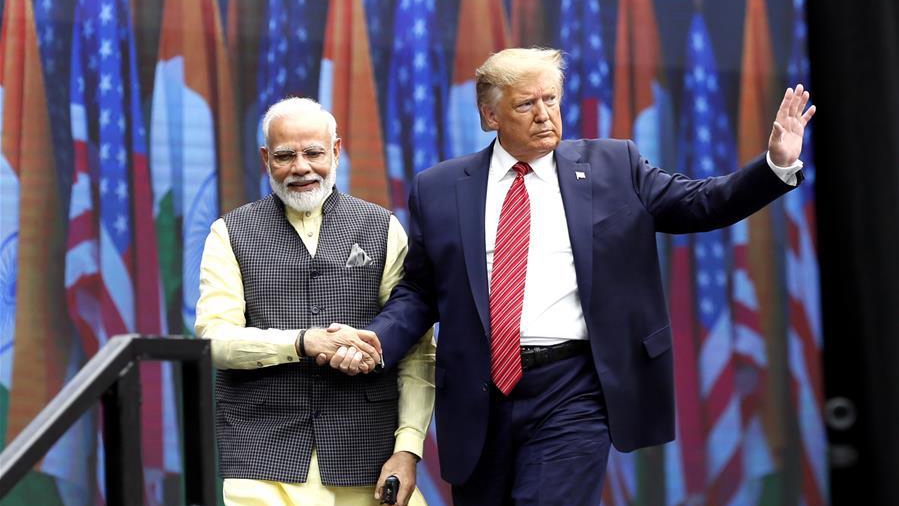
Indian Prime Minister Narendra Modi (L) and U.S. President Donald Trump attend the "Howdy, Modi!" rally in Houston, Texas, the United States, September 22, 2019. /Xinhua
Editor's note: Wamika Kapur is an Indian Ph.D. scholar of international relations at South Korea's Yonsei University. The article reflects the author's opinions and not necessarily the views of CGTN.
American foreign policy is often mired with a hidden double standard. Respect for sovereignty is an optional add-on to the basic 'equality for all' package on offer. Allies get the benefit of doubt while any country resisting American 'values' gets sanctions.
India, an ally, has consistently enjoyed political consensus on Capitol Hill owing to geopolitics. It is one of the few friendly democracies in the region and is essential to American security and diplomacy. America's response to India's policy on Kashmir, digital trade and nuclear issues clearly highlights this duality.
The majority party of India (BJP) led by Prime Minister Modi has often been criticized for its anti-secular policies. Kashmir, a region disputed with Pakistan, has been on a security lockdown aimed at curbing terrorism for over ten months with thousands detained.
Apart from the legality of India's decision to split Jammu and Kashmir, the communication blackout, illegal arrests and detentions should have raised eyebrows in the West. National security is being used as an excuse to curb fundamental freedoms of speech and expression.
America's response to the longest ever imposed suspension of internet in a democracy has been supportive to the Indian government, calling it an internal matter, offering mediation, only if both countries accepted the offer, and holding a 'Howdy Modi' rally to welcome Modi to America.
On the other hand, Donald Trump signed the so-called "Uygur Human Rights Policy Act of 2020" into law, which would allow the U.S. government to designate certain Chinese officials as human right offenders and subject them to sanctions, freeze assets, and ban their entry into the U.S. Advisories have been issued to U.S. businesses and warnings of enforcement against those who contribute to the human rights abuses in China.
India's argument of "necessary evil" to control terrorism and separatist movements was accepted and Kashmir became an internal matter however, America consistently mentions Xinjiang or Hong Kong to criticize the Chinese government.
The crux of the ongoing China-U.S. trade war is American claims of Chinese intellectual property theft and unfair trade practices. America has been highly critical of China being a "copycat nation", its protectionist policies, and the "Great Firewall."
India's digital trade policy has data localization laws which allow limited transfer of data, restricted foreign direct investment and compliance report filing with the Reserve Bank of India aimed at e-Commerce companies. India has also become a fertile ground for copying Chinese and American apps for example, Chingari and JioMeet which are copies of Tik Tok and Zoom.
The office of the United States Trade Representative has acknowledged that India's digital trade policies are discriminatory and trade-distortive, its intellectual property rights (IPRs) mechanism lax and restrictive on foreign participation. However, America's response has been limited to removing India's preferential access to U.S. markets and strong criticism.
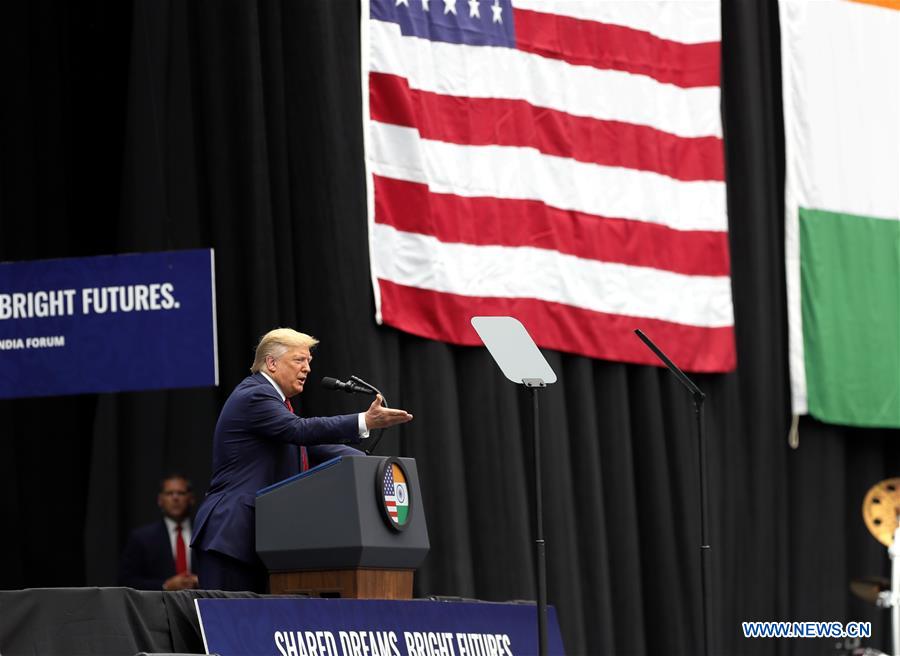
U.S. President Donald Trump addresses the "Howdy, Modi!" rally in Houston, Texas, the United States, September 22, 2019. /Xinhua
The Trump tariffs would make it difficult for Indian exporters and American consumers, however the duty hikes are nowhere near the same as China. India is being investigated under Section 301 along with many other countries, mostly European Union, but the difference is that there is no definitive action and it's an invitation to a consultation on India's digital tax policies rather than an intimation of tariffs.
India is not a signatory of the Nuclear Non-Proliferation Treaty (NPT), however, it enjoys a waiver to the guidelines of the Nuclear Suppliers Group (NSG) to trade in nuclear items. Between International Atomic Energy Agency (IAEA), NSG and U.S. support, India is like the sixth nuclear state.
Despite compliance, U.S. chose to withdraw from the Iran nuclear deal, accusing Iran of backing foreign militia and engaging in development of ballistic missiles. Despite unanimous consensus of the United Nation Security Council, U.S. continues to oppose the Iran deal and has put it on the Financial Action Task Force (FATF) blacklist. The currency value and oil exports have collapsed, making Iran accuse U.S. of economic terrorism in the region, of willfully depriving Iran of food and medicine based on circumstantial evidence.
Ironically, Modi was banned from U.S. for nine years under allegations of being involved in Gujrat riots which led to the massacre of 2,000 Muslims. Now, Modi makes yearly visits to America, has purchased weapons worth 15 billion U.S. dollars and 22 American drones at a cost of two billion U.S. dollars. It may seem that the Trump administration, known for its realpolitik worldview, has decided that pragmatism means morality must be set aside selectively.
American double standards reduce its already dwindling credibility and increase uncertainty. It is trying so hard to fearmonger the world into avoiding an Orwellian world in the making that it is ignoring the same signs in India. While no two international incidents have the same scale or scope, justice and equality are the fundamental principles of democracy which the Trump administration has failed to uphold.
(If you want to contribute and have specific expertise, please contact us at opinions@cgtn.com.)