- Home
- China
- World
- Europe
- Politics
- Business
- Opinions
- Tech & Sci
- Culture
- Sports
- Travel
- Nature
- Picture
- Video
- Live
- TV
- Specials


Share







Copied
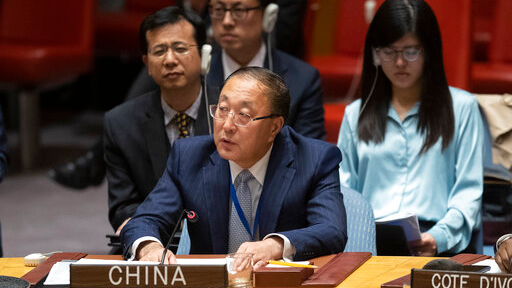
Chinese Ambassador to the United Nations Zhang Jun speaks during a Security Council meeting at UN headquarters, October 24, 2019. /AP
Editor's note: Hamzah Rifaat Hussain is a former visiting fellow at the Stimson Center in Washington and currently serves as an assistant researcher at the Islamabad Policy Research Institute (IPRI) in Pakistan. The article reflects the author's opinions and not necessarily the views of CGTN.
On July 6, China deposited its instrument of accession to the Arms Trade Treaty (ATT) at the United Nations, becoming the 107th party to the pact which entered into force in 2014.
The treaty has been scorned by the Trump administration, underlining a sheer lack of commitment towards tackling global arms transfers and transnational networks of arms sales which have a grave impact on global peace and stability.
The pact specifically deals with curbing conventional arms sales to abusers of human rights by reducing illicit trade to splinter groups, rebel factions, insurgents, terrorist organizations and members of civil society, denying access to weaponry which promotes domestic and international discord.
China's decision to join the ATT is a testament to its commitment towards ensuring that the global arms trade does not translate into increased violence and unrest in conflict zones such as the Middle East and South Asia, which stands in contrast to the American narrative.
Under the Obama administration, the United States signed the treaty but witnessed a severe backlash from domestic lobbying groups such as the National Rifle Association (NRA). The NRA is notorious for promoting gun ownership in the U.S. by citing the Second Amendment of the U.S. constitution. This narrative has often resulted in mass targeted shootings such as the one witnessed in El Paso last year.
In April 2020, the Trump administration said it intended to revoke America's signatory status with a message conveyed to UN Secretary-General Antonio Guterres that Washington had no intention of joining the treaty and had no legal obligations as per its 2013 signature which was never ratified by the Senate.
The entire ambit of ATT, though, deals with the issue of human rights violations which the United States has historically championed. The pact regulates the 70-billion-U.S-dollars global transnational arms trade which, if effectively tackled, can result in a significant reduction in violence by both non-state actors and terrorist groups.
An existential threat to sovereign governments and the civilian population can also be reduced. Yet, instead of supporting curbs, Washington has embarked on a policy of blatant unilateralism that denies any space for deliberation, discussion or consensus-building among UN member states on issues such as the arms trade. This highlights the irrefutable fact that the current administration has shunned away from its international commitments as a responsible superpower.
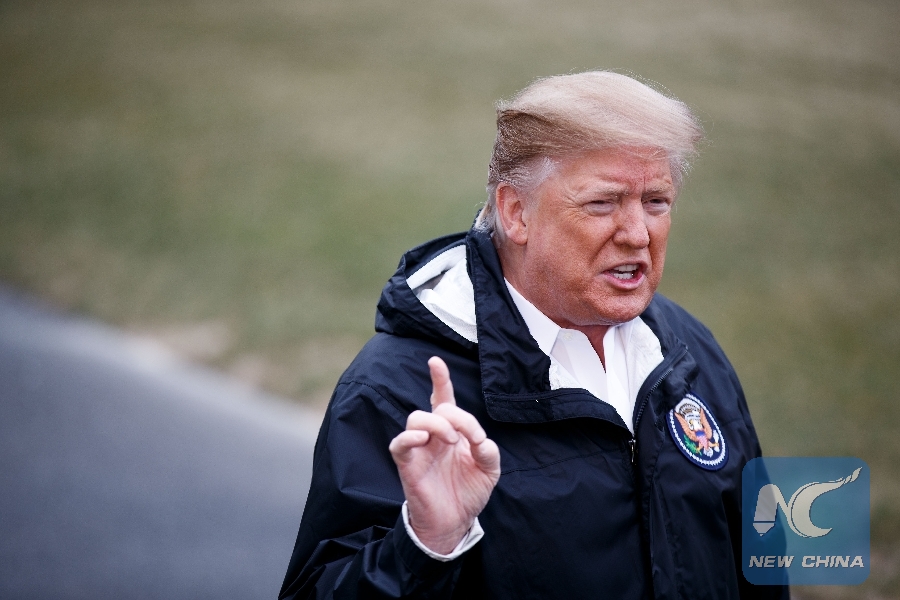
U.S. President Donald Trump speaks to reporters in Washington before leaving for Alabama to survey areas devastated by powerful tornadoes, March 8, 2019. /Xinhua
As per the Stockholm International Peace Research Institute (SIPRI) yearbook of 2020, the United States has led the global suppliers of arms for the period 2015-2019, with both the U.S. and Russia consistently being the largest international suppliers. Amongst the recipients of the U.S. arms sales is Saudi Arabia, which has been embroiled in a brutal crackdown against Houthi rebels in Yemen resulting in one of the biggest global humanitarian quagmires.
The presence of cholera or COVID-19 has not resulted in a U.S. reduction in arms sales. On the other hand, Russian armed exports had decreased by 18 percent with its global share dropping by six to 21 percent for the period 2015-2019. This relentlessness on part of the U.S. points to an alarming lack of concern regarding arms sales and its impact on human suffering globally.
The ATT deals with the establishment of common international standards for trade in arms sales. By being adamant in not signing the pact, the United States, which heads the list of largest suppliers, is exposing its lack of humanitarian concerns.
The balance of power in the international system has continued to shift at a rapid pace from 2015-2020. Insurgencies, acts of terrorism, arms races in nuclear-charged environments such as the Korean Peninsula and South Asia have continued unabated and made it incumbent to tackle the transnational arms trade in the COVID-19 environment.
The United States has sought to excuse itself from tackling global challenges by citing a "non-interventionist" approach. However, the naval buildups in the disputed South China Sea and provocations along the Strait of Hormuz all hint at how the current U.S. policy is detraction from non-interventionism with more emphasis placed on strengthening alliances to the detriment of aggrieved parties. Agnes Callamard, the UN special rapporteur on extrajudicial, summary or arbitrary killings, has equated the U.S. assassination of Iranian top commander of the Quds force, Qassem Soleimani to a violation of the UN Charter with Washington unable to provide sufficient evidence regarding the imminence of an attack from Iran or threats to its sovereignty, making the assassination unlawful.
China's joining the treaty has helped propel its status as a great power that seeks to tackle sensitive issues of arms transfers which have a direct bearing on global peace. Contrastingly, the commitment towards world peace on part of the Trump administration is absent and open to skepticism. A surge in arms sales, refraining from signing instruments such as the ATT and peddling the human rights mantra on states which express a commitment towards multilateralism lays bare the claim that the United States lacks commitment towards world peace.
China's Ambassador to the UN Zhang Jun has rightly castigated the U.S. for pursuing flawed international diplomacy which further alienates states grappling with conflicts and is based on unilateralism. Few can doubt that the United States under Trump's leadership is left increasingly isolated on the subject of peace.
(If you want to contribute and have specific expertise, please contact us at opinions@cgtn.com.)