- Home
- China
- World
- Europe
- Politics
- Business
- Opinions
- Tech & Sci
- Culture
- Sports
- Travel
- Nature
- Picture
- Video
- Live
- TV
- Specials


Share







Copied
Editor's note: Bradley Blankenship is a Prague-based American journalist, political analyst and freelance reporter. The article reflects the author's opinions, not necessarily the views of CGTN.
The concept of freedom of speech is a funny thing in the Western world. It's simultaneously one of its greatest values, yet something that most in reality don't actually believe in given its myriad exceptions.
Interestingly, this value could in theory be universal – after all, one person having free speech, in principle, doesn't deride the freedom of speech of another person. In reality there exist different levels of access to speech (i.e. platforms) depending on wealth and privilege, which were nearly the only gatekeepers of speech before so-called cancel culture.
It's tempting to believe that the renegade cancellations of emerging or existing cultural figures, as well as everyday people, could be an attack on freedom of speech, as many prominent figures such as the author of the Harry Potter series J.K. Rowling and the American linguist and philosopher Noam Chomsky made clear in a recent open letter in Harper's Magazine.
While accepting that the demands of the Black Lives Matter movement are long overdue in American society, they warn of a push toward blind ideological conformity rather than reasoned debate.
"This stifling atmosphere will ultimately harm the most vital causes of our time," the letter said. "The restriction of debate, whether by a repressive government or an intolerant society, invariably hurts those who lack power and makes everyone less capable of democratic participation."
Setting aside the fact that the most vital causes of our time – climate change, global inequality, war, disease and others – actually do require a kind of ideological uniformity to achieve action, the letter makes the mistake of assuming that cancelling people with problematic views is somehow not democratic in nature.
The reality is that many of these people that have so far had their careers ruined (cancelled) were allowed to run amok in society with no consequence until recently.
Elite circles in the United States and elsewhere have a discernible track record of harboring the most vitriolic and terrible people one can imagine.
U.S. President Donald Trump was a frequent Hollywood VIP and friend to many celebrities. Apparently no one ever caught wind of his problematic views at the time, or, more likely, being friends with Donald became a bad PR after his ascendance in politics.
At the average person's level, one Amy Cooper of New York City had her career and life destroyed after a video surfaced of her threatening to call the police on an African American man in Central Park simply for telling her to leash her dog.
To understand why such an attack on Amy Cooper was warranted, one must remember the context of racism and the role that many white women have historically had in violence against black men.
They, acting as the damsel in distress, have served as the pretext for countless acts of violence against African American men. Cooper was, in this way, threatening the life of the gentleman who asked her kindly to leash her dog – and without the internet, she could have gotten away with it or tried it on someone else.
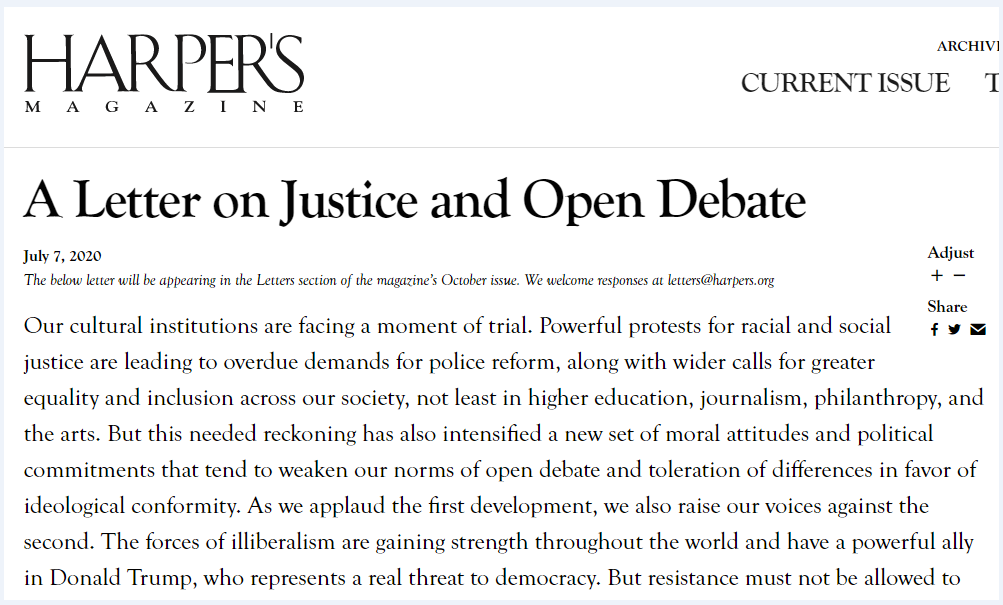
Screenshot of the open letter in Harper's Magazine explaining the "cancel culture" signed by many intellectuals.
Clearly the signatories of the Harper's letter are not talking about these examples. No doubt they would probably agree that such people deserve to face justice, mob or otherwise. However, it's necessary to understand these examples as the rule and not the exception in so-called "cancel culture".
To their credit, there are many examples of people being wrongfully harassed and cancelled for things they either didn't do, or things that were taken out of context, and there's no doubt that some are attempting to cancel for sport.
But, this is the nature of all institutions or mechanisms that seek to volley for power over speech and society – mistakes are made, though inevitably their character is what matters the most.
In this way, the mob rule of "cancel culture" is in fact a more progressive push than the various means of filtration that came before. For example, there are countless more writers, intellectuals and others who were stifled long before by existing powers that never gave the green light to their provocative ideas.
Consider the McCarthy era of the 20th century that established so-called black lists to push out progressive cultural and intellectual figures during the Cold War, thus ruining their lives. This was, objectively, a "cancel culture" permitted by the American ruling class.
More subtle methods that followed the most brazen cancellations during that period have been articulated, ironically, by Noam Chomsky himself in the famous book "Manufacturing Consent: The Political Economy of the Mass Media."
In this book, along with media critic Edward Herman, Chomsky supposes the "propaganda model" of the media, in a pernicious way, filters out radical ideas that challenge the status quo. This is accomplished by narrowing the acceptable range of debate through various means of censorship.
All of this, however, has nothing to do with angry college students, social justice activists or any appeal to radical progress. Instead, such narrowing of debate is done, quite brazenly, to defend American capital and especially military aggression – a very much reactionary tendency if ever there was one.
To illustrate this, we can use an example of attempted cancellation by one of the signatories of the Harper's letter – David Frum. In 2003, Frum wrote an article in National Review calling out and naming "unpatriotic" conservatives who were skeptical of the American invasion of Iraq, throwing them in the same category as "anti-Americans of the far left." Frum tried to cancel his peers and never apologized.
The unfortunate reality of freedom of speech is that almost no one actually believes in it. Those that actually do out of principle, such as Noam Chomsky, are deeply naive in thinking that such a thing can exist. The truth is that culture progresses, not through debate and discourse, but through radical moves that inevitably upset power balances – just like the way politics itself progresses.
By threatening the careers of problematic people with some semblance of power and privilege in society, so-called cancel culture is a cultural filter operated by the masses and not powerful elites.
It goes hand in hand with the cultural transformation happening across the Western world in response to the systemic injustice of the past several hundred years and is a rejection of elite passivity to this oppression.
(If you want to contribute and have specific expertise, please contact us at opinions@cgtn.com.)