- Home
- China
- World
- Europe
- Politics
- Business
- Opinions
- Tech & Sci
- Culture
- Sports
- Travel
- Nature
- Picture
- Video
- Live
- TV
- Specials


Share







Copied
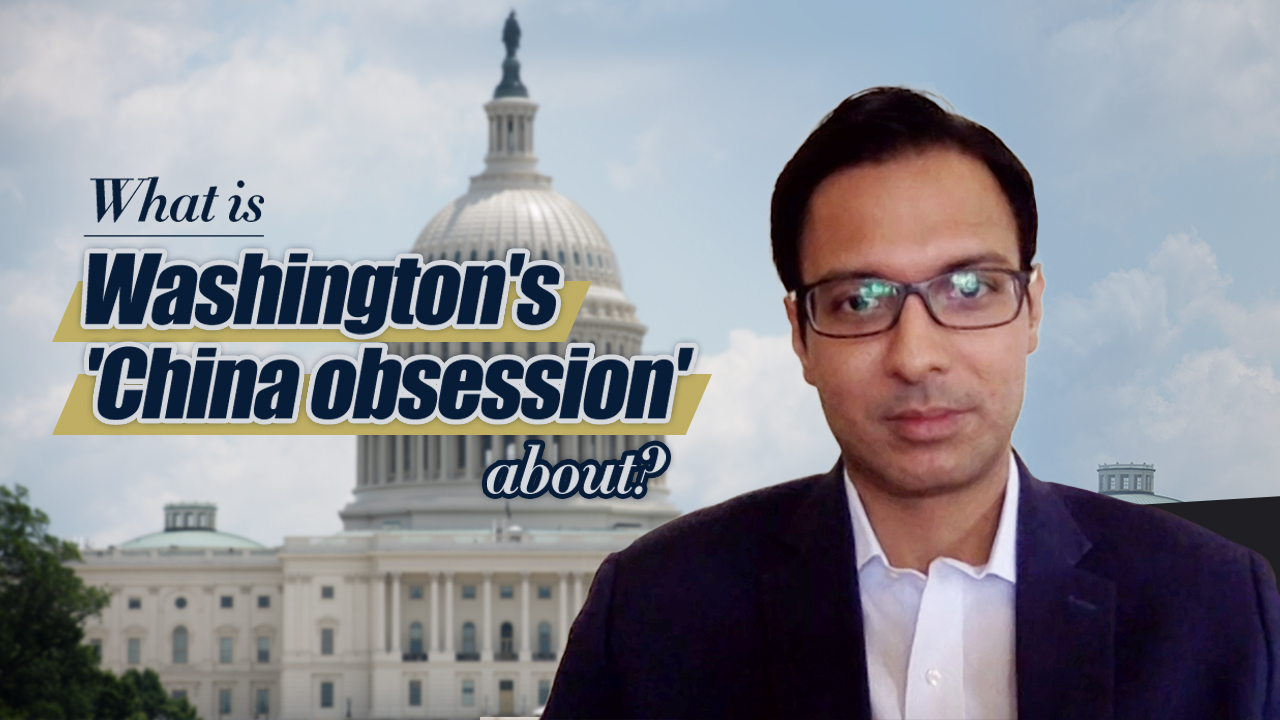
Editor's note: President Trump signed into law the Uygur Human Rights Policy Act in mid-June. On Thursday, his administration put visa and asset sanctions on three Chinese officials in Xinjiang over the alleged human rights abuses in the region. Why is America repeatedly taking actions on the Xinjiang issue? Mustafa Hyder Sayed, Executive Director of the Pakistan-China Institute, shares his views with CGTN on the issue. Views expressed in this video are his, and not necessarily those of CGTN.
CGTN: President Trump signed into law the Uygur Human Rights Policy Act in mid-June. How do you understand the move?
Mustafa Hyder Sayed: I think we have to look at the larger context when we talk about U.S. actions toward China. We need to connect the dots. Whether it's Xinjiang, whether it's Tibet, whether it's Hong Kong, whether it's Taiwan, whether it's Huawei, there is a shared pattern of the U.S., of the Washington establishment. And that is to confront and contain China and to contain the peaceful rise of China. The strategy that they have been applying is that the pressure points, or the areas where China is potentially vulnerable should be exploited. And that is what they are doing.
You can see that the 2017 National Security Strategy document, which was shared by President Trump and the White House and the Pentagon, in 2017, and is the compass, so to speak, of the U.S. foreign policy approach for the next decades or so lists the People's Republic of China and the Russian Federation as the two major threats to U.S. national interests, and lists them as more dangerous than Al Qaeda and Taliban. So I think that what's happening in Xinjiang or the Bill of Xinjiang should be looked into and understood through this context and this lens.
And if you see that this is not the only legislation which has come, there's been the TAIPEI Act, which has been passed by the parliament in the U.S.. There's a bill on Hong Kong, which has been passed. There's a bill on Tibet – the Tibet Act, which has been passed, which talks about supporting, both politically and financially, the so-called government-in-exile of Tibet. There is a pattern. And we need to understand that pattern and the method in the madness is to contain and block China at all costs.
Why do we see an obsession with China? The constant repetition on Xinjiang is to mobilize world opinion, to put pressure on Xinjiang, put pressure on China, put pressure on the Communist Party of China so that China is on the defensive, so that China is on the back foot. And China is distracted from its goals of poverty alleviation and economic growth, which are its two main priorities. It is done under a strategy to keep China entangled in these issues.
I would like to bring your attention to an article. It's called 'Breaking China Apart.' It was published on November 13, 1991, by Leslie Gelb's 'Breaking China Apart.' It talked about how the Hong Kong Card, that Taiwan Card will be used to promote separatism in China. That was a cold war mentality. Then there's a cold war mentality now.
(If you want to contribute and have specific expertise, please contact us at opinions@cgtn.com.)