- Home
- China
- World
- Europe
- Politics
- Business
- Opinions
- Tech & Sci
- Culture
- Sports
- Travel
- Nature
- Picture
- Video
- Live
- TV
- Specials


Share







Copied
VCG
Data seems challenging a stereotype.
When people believe in a high dependence on China of the U.S. pharmaceutical and medicine industry, its imports from China are not that high compared with Ireland, Germany, and India. Then, why people still place China in a vital position in this field?
The position lies in data released by the U.S. Census Bureau. Back to this February, the import value of Pharmaceuticals and Medicines from the Chinese mainland decreased by nearly 30 percent compared with the last month, largely due to the COVID-19 shutdown. However, after China resuming work, that amount has rebounded rapidly with an increase of 36.5, 26.9, and 40.1 percent, respectively. What's more, in May, it doubled that of last year.
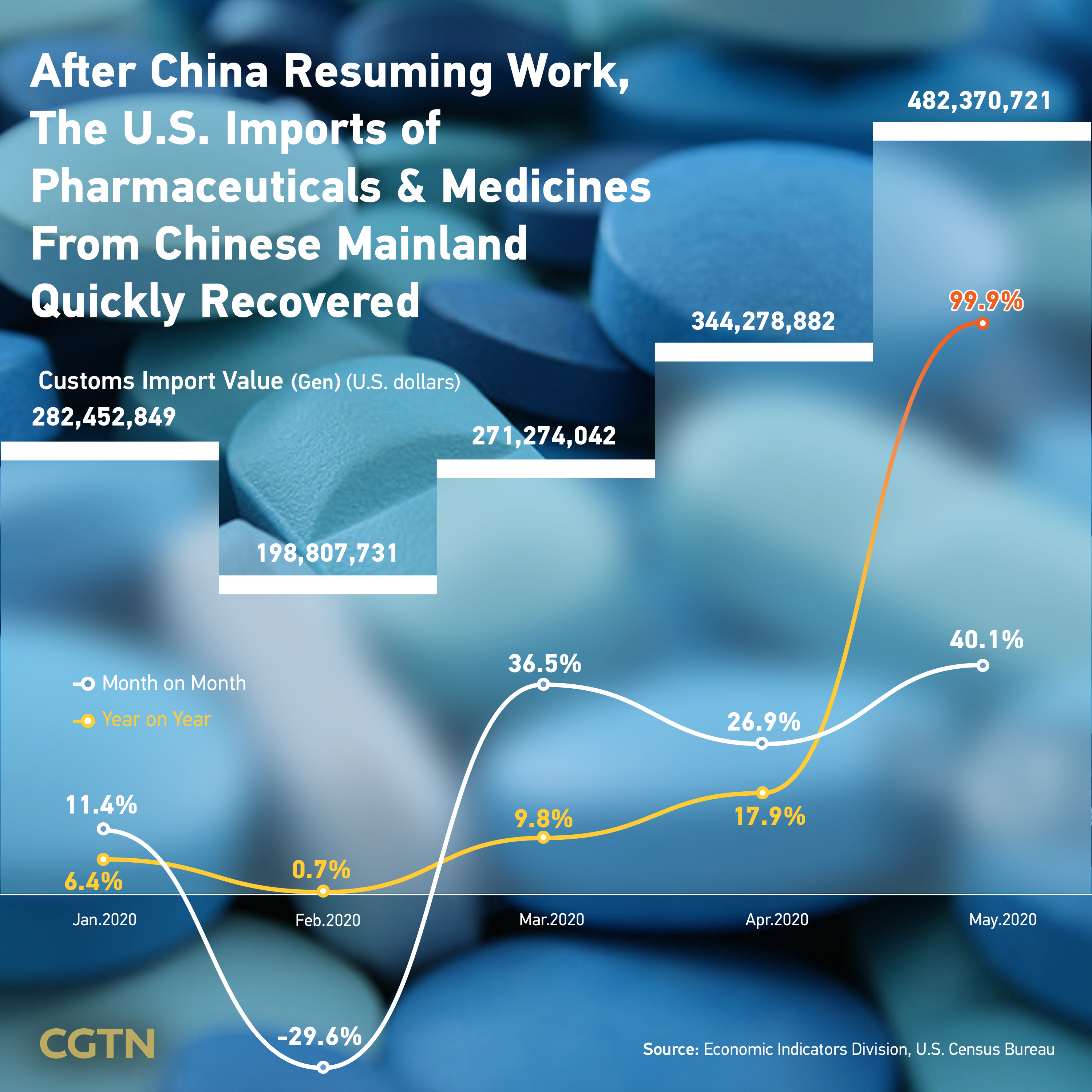
That means, under the situation of increased tariffs, the COVID-19 pandemic, high tensions of China-U.S. relations, and poor international transportation, the U.S. imports of medicines from China are not falling but increasing instead. The U.S. cannot afford to break up with China in this field, at least not in the short term.
Why U.S. dependent on medicines made in China
Does the U.S. really rely on China for pharmaceuticals and medicines? Yes Indeed.
And then, why?
First, in recent decades, drug and some pharmaceutical products manufacturing has gradually moved out of the U.S, while China's drug manufacturers have rapidly developed, completing the medicine supply chain of America.
To be specific, although the U.S. plays a leading role in drug discovery, much of its manufacturing has moved offshore. The last American manufacture, which makes key ingredients for penicillin closed in 2004, and many other antibiotics are not produced in the U.S. anymore.
Besides, the U.S. depends heavily on China for some pharmaceutical products as well. In 2019, those were definitely imported from China, including 57.65 percent of malaria diagnostic test kits, 72.48 percent of first-aid boxes and kits, 49.86 percent of wadding, gauze, and similar articles, etc.
The U.S. face masks manufacturers, such as 3M and Honeywell, which command attention during the pandemic, have moved production away from America to China for decades.
Secondly, we can say, it's the active pharmaceutical ingredients (APIs) supply that the U.S. needs China most.
Even if the U.S. resumed drug production, it would still turn to China for thousands of ingredients and raw materials. Medicine products are usually composed of several ingredients, and API is the primary one, which refers to the biologically active component of a drug product.
As all know, China is the largest supplier of APIs to the global market.
Taking tetracyclines and chloramphenicol, for example, in 2019, U.S. imports from China account for 90.06 percent and 93.22 percent respectively of overall U.S. imports. Till in May 2020, the above two antibiotics from China account for 90.65 percent and 100 percent.
Lastly, profit is another important consideration.
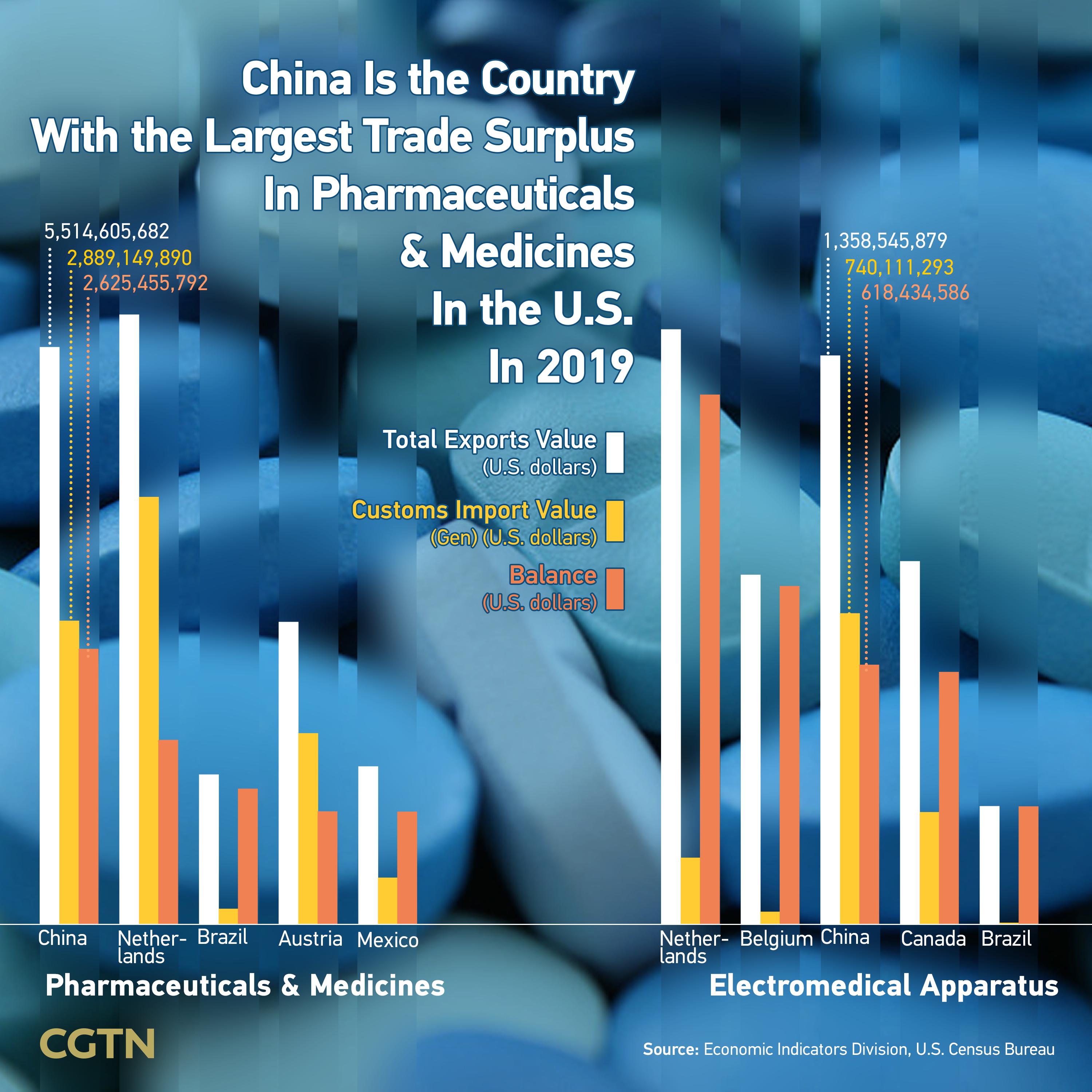
In 2019, China was the country with the largest trade surplus in terms of pharmaceuticals and medicines, which was as high as 2.6 billion U.S. dollars.
A manager of Medline Industries Inc., one of the major healthcare market participants, had explained to the Peterson Institute last June that after some tariffs imposed on Chinese medical products, to find alternative sources of supply to minimize the cost impact of the duties is not a viable option in the near or medium term.
Tried to 'unhook' but Failed
In fact, at the early stage of the China-U.S. trade friction, names of Quinone drugs, Coenzyme Q10 and Malaria diagnostic test kits, etc., have been exposed to a higher tariff list.
It is obvious to see that the pharmaceutical trade between China and the United States has been affected by tariffs. In 2019, the import value of pharmaceuticals and medicines from China fell by 9.2 percent, while the U.S. imported more from other countries such as Ireland, Germany, and India. It seems that the U.S. tried to break with China.
While some analysis indicates that China's medicines exports to the U.S. seem to have wide varieties, but the scale is not large. Because the United States has very strict regulations on drug production, only a few Chinese pharmaceutical companies are able to be approved. Thus tariff barriers may have a greater impact on the U.S. itself.
Then, phase one China-U.S. economic and trade agreement and COVID-19 outbreak changed the situation to some extent.
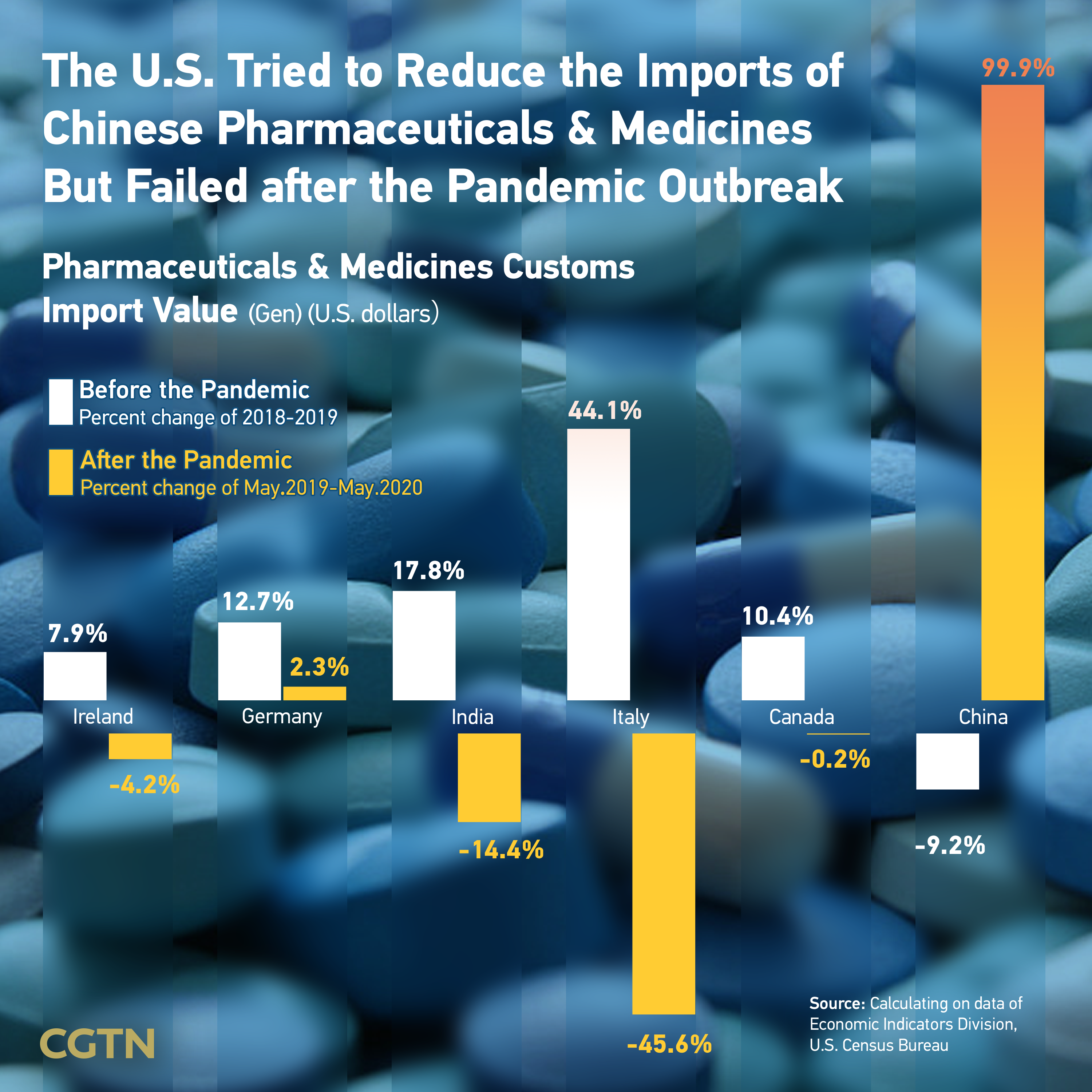
As the Phase One Deal demands, the U.S. will expand its exports to China in areas of medicines and medical devices in the next two years. In March 2020, the U.S. provided tariff relief during the novel coronavirus outbreak, removing tariffs on some medical supplies from China. This May, the U.S. pharmaceutical and medicines imports from China nearly doubled compared to last May.
Text by Li Weijia, Li Shaozhan, Han Mo
Data checker: Zuo Lin
Designer: Yu Pianyi
(If you want to contribute and have specific expertise, please contact us at opinions@cgtn.com.)