- Home
- China
- World
- Europe
- Politics
- Business
- Opinions
- Tech & Sci
- Culture
- Sports
- Travel
- Nature
- Picture
- Video
- Live
- TV
- Specials


Share







Copied
Editor's note: Yannan Collins is a consultant with a media background and qualifications based in the United States. The article reflects the author's opinions, and not necessarily the views of CGTN.
Starting in late June, new COVID-19 cases spiked across the U.S. again, with the single-day record being shattered multiple times in two weeks in early July. Though many blame the resurgence on the premature opening in early May, the real reason behind this goes deeper into the systematic failure, while premature opening may just be a contributing factor.
The reason behind this resurgence is not because the U.S. walked out of the quarantine too early, but because the U.S. government did not fully take advantage of the quarantine to establish a system to contain the virus in a post-quarantine society, the same way they did not prepare for a pandemic initially.
Quarantine itself is a very limited way to contain the virus: quarantine can slow the spreading of the virus, but as long as the infected still stay with their families and people are going out for essential activities, the spread would not fully stop.
Therefore, creating a system that can promptly slow down the spread, identify COVID-19 carriers, treat the sick, isolate them from the healthy, and trace all the potential contacts becomes crucial in response to a highly contagious respiratory pandemic.
The U.S., however, has failed almost every single step before the lockdown and there was no clear leadership to guide the public. Because wearing a mask became a political statement in the early stage of the pandemic, the most effective way to prevent the virus is still controversial among Americans.
When Europe and Asia were the hotspots, the U.S. Customs and Border Protection neither tested international travelers coming into the U.S. nor instructed them to quarantine for two weeks, not mentioning how to quarantine. Testing was limited only to people who had contacts with confirmed cases. Confirmed patients were locked at home with their families. And contact tracing was mentioned but not implemented.
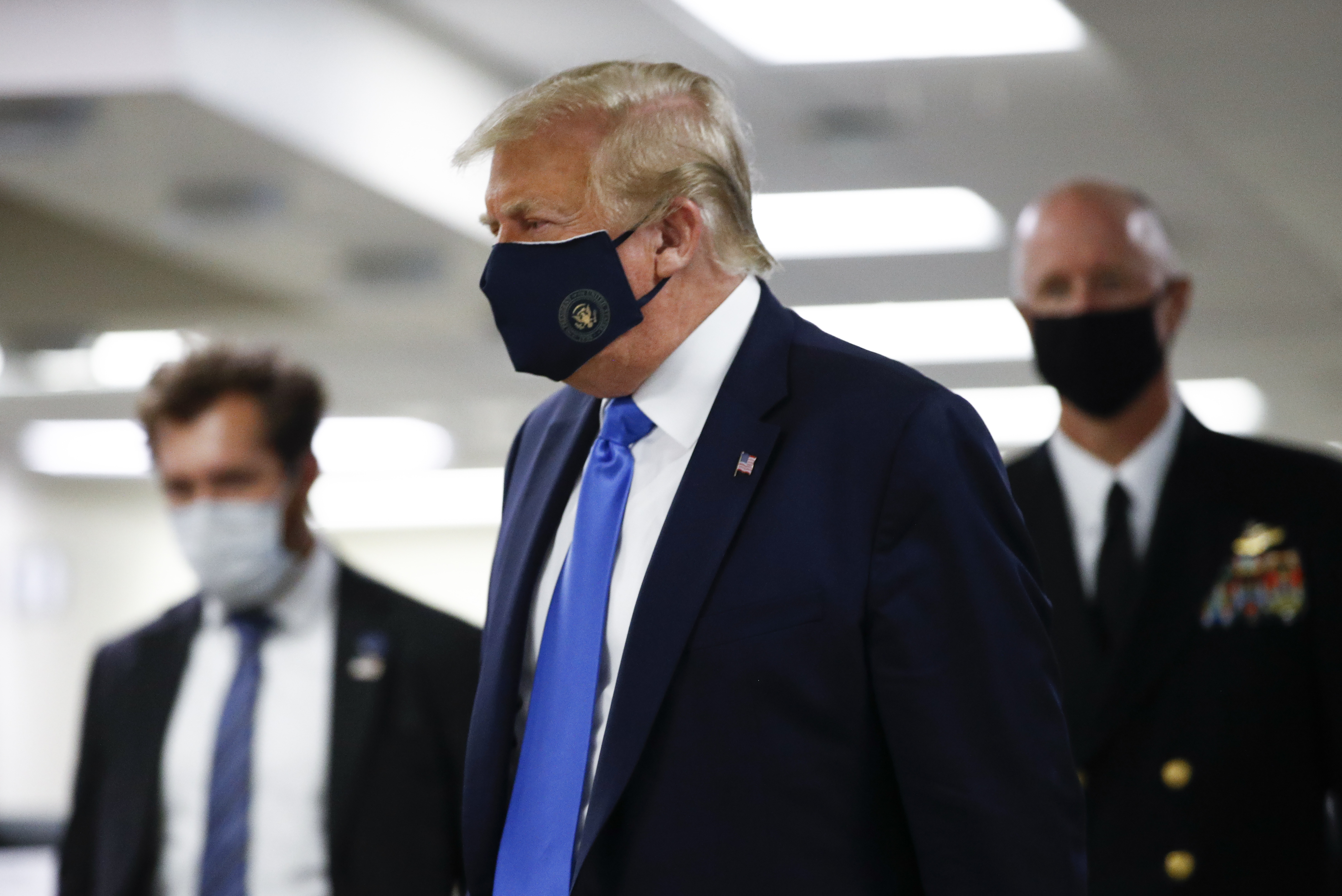
U.S. President Donald Trump wears a face mask as he walks down a hallway during a visit to Walter Reed National Military Medical Center in Bethesda, Md., July 11, 2020. /AP
Watching other countries, such as China and South Korea, slowly resuming economic activities in early April, most of U.S. states and cities announced shelter-in-place orders, hoping to go back to normal in 6-8 weeks by "flattening the curve".
Yet, the "flattening the curve" is problematic. By flattening the curve, the number of total infected cases stays under medical system capacity, which means the government will tolerate a certain number of COVID-19 cases. However, even one case in a family can be devastating. The misalignment between the goals to go through this pandemic lay up troubles for the resurgence. Those cases that the medical system can tolerate eventually grew exponentially when those states re-opened.
Technically, all the states with the biggest resurgence now all have met the "flattening the curve" standard before re-opening. For instance, both Floria and Texas kept their daily new cases under 1,000 for three weeks with one or two days' exceptions before their re-opening in May.
Without the infrastructure, quarantine alone is not the solution for the pandemic, therefore delaying re-opening would not help to contain the virus in the long run. California exemplifies this theory: Seven counties in Northern California collectively announced the shelter-in-place order as early as March 16th, and soon all other major cities in California followed.
While all the Southern states started to open up in May, California extended their lockdown for another month. That extended lockdown and slower re-opening did not matter. A week after the Southern states experienced new surges, California's COVID-19 spike started, now setting a new record of 11,694 new cases in a single day.
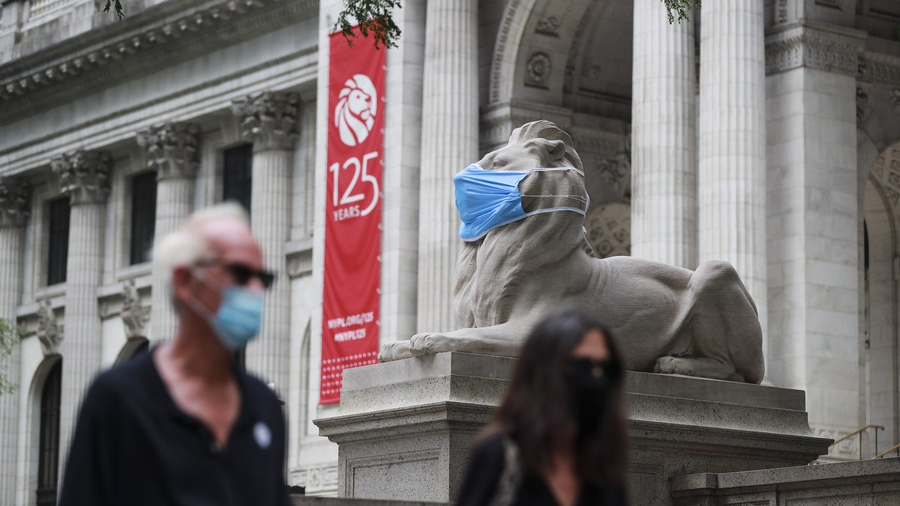
A marble lion is seen with a face mask in front of the New York Pubulic Library on the Fifth Avenue in New York, the United States, July 8, 2020. /Xinhua
Lacking the necessary infrastructure, all COVID-19 hotspots are facing the same problem New York faced three months ago: testing too slow, ventilators in shortage, ICE at full capacity, morgues full.
The essential reason why those states failed to prepare for what just happened in another state is the same as the country failing to prepare for a pandemic: it is not profitable.
In the U.S., a largely profit-motivated society, private profits precede public health. This principle seems ever clearer under the Trump administration.
Trump disbanded the pandemic response team and cut off some of its members because keeping them for a potential pandemic does not bring immediate profit. Trump withdraws from WHO, because WHO does not favor the U.S. enough while "the United States has been paying which is approximately 450 million U.S. dollars a year."
Stocking up medical resources, such as PPE and ventilators, is not profitable. Medical care that copes with existing conditions and adequate shelter for quarantine is not profitable. The pandemic does not have to be this catastrophic, but the U.S. took the risk anyway.
The states currently suffering simply follow the federal government's footsteps. After New York's struggle, those states still would take the risk -- no mask mandate, no isolating, no adequate contact tracing. They have to wait when the pandemic spiral in their own community to understand the importance of the infrastructure.
Unfortunately, no such system has been established today. The United States will be the worldwide hotspot for a while.
(If you want to contribute and have specific expertise, please contact us at opinions@cgtn.com)