- Home
- China
- World
- Europe
- Politics
- Business
- Opinions
- Tech & Sci
- Culture
- Sports
- Travel
- Nature
- Picture
- Video
- Live
- TV
- Specials


Share







Copied
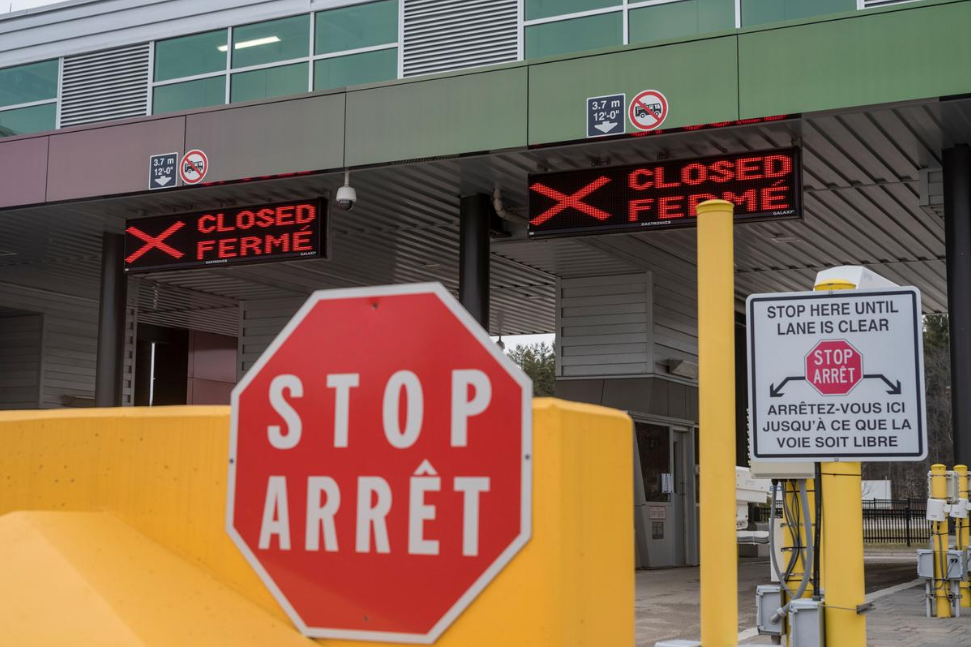
Two closed Canadian border checkpoints seen at the U.S.-Canada border crossing at the Thousand Islands Bridge in Lansdowne, Ontario, Canada, March 19, 2020. /Reuters
Restrictions on non-essential travel at U.S. land borders with Canada and Mexico will be extended through August 21, Canada and the United States announced on Thursday.
"Canada and the United States have agreed to extend the current border measures by one month until August 21, and we're going to keep working closely with our American neighbors to keep people safe on both sides of the border," Canadian Prime Minister Justin Trudeau said at a news conference.
Earlier, acting U.S. Homeland Security Secretary Chad Wolf announced the 30-day extension on Twitter saying "close collaboration with our neighbors has allowed us to respond to #COVID19 in a North American approach and slow the travel-related spread of the virus."
The Mexican Foreign Ministry already said on its official Twitter account Tuesday that "after checking the rise of the COVID-19 spread, Mexico proposed to the U.S. the extension of all non-essential traffic restrictions at the common border for 30 more days."
"Both countries will continue looking to coordinate the sanitary measures at the border region. The measures will be valid until August 21, 2020," the ministry added.
The travel restrictions, in place since March, have been repeatedly extended in 30-day blocks amid surging numbers in the U.S., which so far has seen some 3.7 million confirmed cases of COVID-19 in total, with over 77,431 daily new cases reported on Thursday.
The restrictions do not cover trade across a U.S.-Canada border that stretches 8,891 kilometers, or air travel. They also do not apply to travelers who are getting to work, or people travelling for family care, educational or humanitarian reasons. The U.S. government's actions on limiting travel across the southern border however seemed designed to curb migration to the U.S., a pillar of Trump's immigration agenda.
A CNN analysis found that the U.S. currently has the highest per capita death rate from COVID-19 in the Americas, with over 41 coronavirus deaths per 100,000 people, while the death rate in Canada is about 23.5 per 100,000 people.
Accordingly, Canadians do not appear eager for their border to reopen: one poll found 81 percent of Canadians thought the U.S.-Canada border should remain shut for now, The Globe and Mail reported.
Since the travel restrictions were imposed, passenger crossings have fallen by 90 percent or more at many border crossings and hit tourist destinations along the U.S. border. In May, passenger traffic in Detroit, on the Canadian border, fell to 45,000 people crossing, down from 502,000 passengers in February.
At San Ysidro, California, on the U.S.-Mexico border, passenger and pedestrian traffic fell from more than 2.9 million people crossing in February to 1.3 million in May.
(With input from Reuters)