- Home
- China
- World
- Europe
- Politics
- Business
- Opinions
- Tech & Sci
- Culture
- Sports
- Travel
- Nature
- Picture
- Video
- Live
- TV
- Specials


Share







Copied

U.S. President Donald Trump speaks during a National African American History Month reception at the White House in Washington D.C., the United States, February 13, 2018. /Xinhua
Editor's note: Bradley Blankenship is a Prague-based American journalist, political analyst and freelance reporter. The article reflects the author's opinions, not necessarily the views of CGTN.
The United States is continuing escalations against China in what appears to be the culmination of a Trump administration hell-bent on pursuing an "America First" policy – something devoid of any true meaning and doomed for self-defeat. At the same time, the U.S. itself is falling apart in self-induced ways that, with the proper political motivation, could be totally avoidable. Meanwhile, China is continuing to rebound tremendously in the wake of its own COVID-19 epidemic – something that has damaged the world economy for the foreseeable future.
The United States is the richest and supposedly most powerful country in the world. With its extraordinary resources, circumstances should've been much different – but they aren't. What then explains the downward trend of the U.S. as well as China's upward trajectory? The explanation is fundamental: the governing principles of their respective leadership.
First, to note some key developments and their bigger picture:
White House advisor Peter Navarro indicated that the administration would take action against Tik Tok and WeChat – wildly popular Chinese social media apps – for allegedly being puppets of the Chinese government. In reality, this has nothing to do with any concern for censorship or data mining – after all, Silicon Valley uses (and monetizes) the data of its users too. This falls in line with Washington's continual attacks against anyone that challenges its Big Tech giants, including its allies in the European Union (EU) who are proposing a modest tax on data collection – something Washington claims unfairly attacks its companies.
The United States has labeled China's claims to resources in the South China Sea as "completely unlawful," and ironically claims that Beijing is using a "campaign of bullying" to control these resources. U.S. President Donald Trump also signed into law the Hong Kong Autonomy Act that would end the city's special trading status. Both of these are examples of snide attempts to undermine China's sovereignty in a desperate effort by the flailing Trump administration to use its only available tool of brute force to maintain its top position in the world.
Finally, reports have surfaced that the Trump administration wants to bar members of the Communist Party of China (CPC) – and their families – from entering the U.S., also threatening the expulsion of those already in the country. As noted by CGTN, many of these CPC members are doctors, scientists and teachers.
This is an attack against the international intellectual community and part of a general trend of attacking international scientific diffusion seen also in Washington's decision to bar some Chinese students from studying in the United States.
Attacks against generalized human development through intellectual diffusion and multilateralism are fundamentally corrosive. Such attacks hurt the world in the short-term, given that both countries sport the two largest economies in the world and are so heavily coupled, but also hurt the world in the long-term. Instead of attempting to undermine China through attacks, the U.S. should focus on building up its own competitive advantages.
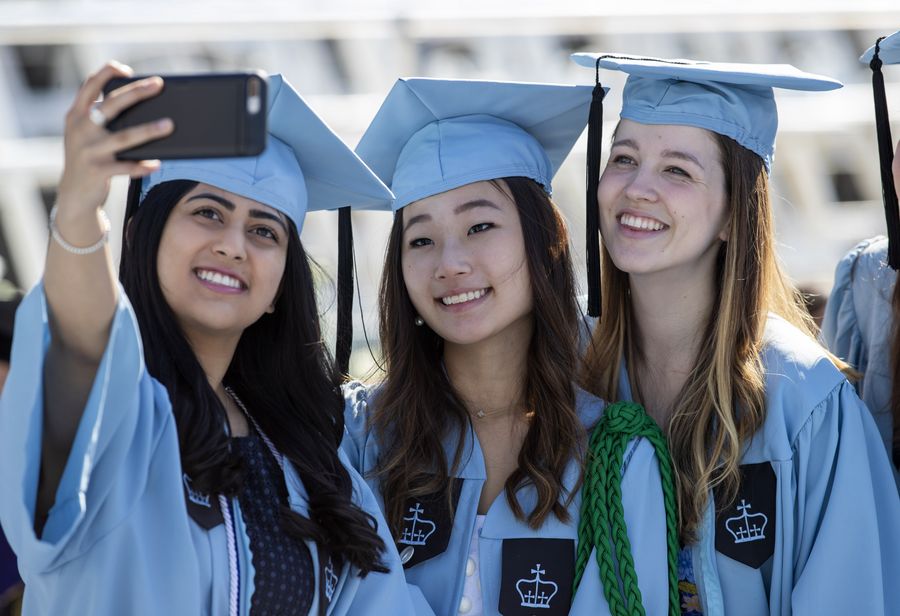
Graduate students take a selfie before the Columbia University Commencement ceremony in New York, the United States, May 22, 2019. /Xinhua
For example, in regards to repeated threats against international students, this will only harm innovation in the United States. The U.S. has long been a coveted destination for bright young students looking to expand their intellectual repertoire – but that is quickly collapsing as the burdens become too cumbersome and other locales that are less complicated become more attractive.
Even H-1B visas for highly skilled workers are being choked by the administration. It should be noted that over 50 percent of workers in STEM jobs with a bachelor's degree or higher were born outside the U.S., indicating that the U.S. has benefited and not suffered from immigration.
Meanwhile, the talent pool is drying up as the ludicrous cost of higher education in the United States leaves university unattainable for many. At the same time, schools are struggling for funding as is – a problem only to accelerate as state coffers have been burned through due to the federal government's botched attempt to handle COVID-19.
Given this, it should come as no surprise that with serious investments in education, China is surpassing the U.S. in talent. It also follows a generalized investment in basic infrastructure and institutions that the U.S. has not only failed to do, but has continued to attack. Politicians, especially in the Republican Party, have launched perennial attacks against every public institution imaginable, leaving them destitute and almost useless. America's infrastructure languishes in ruin while China continues to build key infrastructure domestically and around the world.
Even the U.S. military – apparently the envy of the world – is a paper tiger. America's huge military budget should not be taken as an example of its military prowess, but rather how much its taxpayers are being gutted by a military industrial complex concerned with profit first and foremost.
William D. Hartung, the director of the Arms and Security Program at the Center for International Policy, noted in the Nation magazine in 2016 that the Pentagon continues wasteful spending that any observer would see as totally ridiculous. Some examples: 150 million U.S. dollars for private villas for a handful of personnel in Afghanistan and 50,000 dollars toward research to find out the bomb-detecting capability of African elephants.
The people-centered leadership of the CPC and the success of socialism with Chinese characteristics have led to China's meteoric economic growth – there is no question. Through investment, multilateralism and friendly relations, China continues to rise ahead of the United States without bombs or bullets. If Washington wants to have a place in the 21st century world order, it must divorce itself from dogmatic idealism and adapt by investing in its people.
(If you want to contribute and have specific expertise, please contact us at opinions@cgtn.com.)