- Home
- China
- World
- Europe
- Politics
- Business
- Opinions
- Tech & Sci
- Culture
- Sports
- Travel
- Nature
- Picture
- Video
- Live
- TV
- Specials


Share







Copied
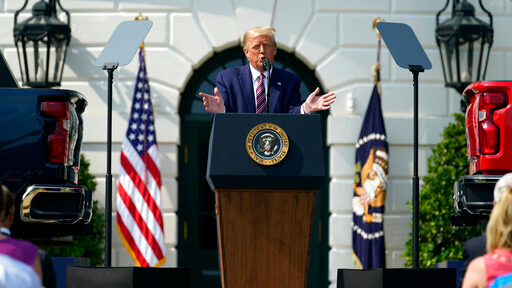
U.S. President Donald Trump speaks during an event on regulatory reform on the South Lawn of the White House in Washington, the United States, July 16, 2020. /AP
Editor's note: Josef Gregory Mahoney is a professor of politics at East China Normal University. The article reflects the author's opinion, and not necessarily the views of CGTN.
In basketball, a full-court press is a defensive tactic, where the offensive team is pressured starting with the inbound pass and then followed all the way down the court. It also offers an apt analogy for the Trump administration's mounting pressure on China.
Teams run full-court presses for different reasons. Sometimes they are simply stronger than opponents, and the tactic is used to dominate and break them. Other times, it offers a change-up, a chance to disrupt the tempo of the game, catch a team off-guard and force a turn-over. But it's probably most commonly used in desperation, when a team is losing and time is about to run out. Sometimes it's a genuine effort to win the game, if close; otherwise, it's merely a show that aims to preserve dignity in the face of certain defeat.
A timeline of Donald Trump's anti-China efforts begins arguably with his first campaign for the White House. Like other candidates before him, including especially Bill Clinton during his first run for the presidency in 1992, Trump fixated on China as a threat, particularly economically. But after taking power in 2016, there were several positive developments that suggested initially that Trump was more concerned about Iran and North Korea and willing to deal productively with Beijing.
Notably, on February 9, 2017, Trump dispelled some worries about Sino-U.S. relations when he affirmed his support for the one-China principle. Next, in April of that year, he hosted Chinese President Xi Jinping at Mar-a-Lago, his resort in Florida, and both pundits and administration figures signaled a "new high" in bilateral relations.
Nevertheless, on March 22, 2018, the Trump administration fired the first salvo in an ongoing trade war, accusing China of intellectual property theft, and announcing 50 billion U.S. dollars in tariffs against Chinese imports. On July 6, Trump escalated the trade war by imposing tariffs on 34 billion U.S. dollars worth of Chinese goods.
Many hoped this was little more than a negotiating tactic designed to pressure Beijing into a trade agreement favoring the U.S. However, on October 4, Vice President Mike Pence in a speech in New York accused China of trying to influence U.S. elections and military aggression with global ambitions, and signaled U.S. foreign policy was shifting from cooperation to competition. Secretary of State Mike Pompeo would repeat many of these claims even more forcefully. Beijing called the accusations groundless and provocative.
Since then, Sino-U.S. relations from Beijing have increasingly devolved into a zero-sum game. Washington has done its utmost to attack Chinese tech firms, most notably Huawei, even targeting Meng Wanzhou, Huawei's CFO and daughter of the firm's founder, seeking her arrest and extradition from Canada. While the U.S. claimed the charges were apolitical, Trump suggested they could be resolved with a trade deal.
Nevertheless, trade talks did not make much progress, and on May 10, 2019, Trump again raised tariffs on 200 billion U.S. dollars worth of Chinese goods, this time increasing rates from 10 to 25 percent. Two months later, the U.S. again increased tariffs, now taxing all imports from China, and labeled China a currency manipulator. Next, in late November, Trump signed legislation supporting Hong Kong protesters.
In January of this year, the Trump administration quietly withdrew the currency manipulator designation and on January 15, announced a phase-one trade deal had been signed by Trump and Chinese Vice Premier Liu He. While markets responded positively, many remained concerned that the deal seemed rather superficial and stop-gap, and perhaps merely a tactic to buoy markets given Trump's fixation on their performance as a positive indicator of his policymaking.
Two weeks after the phase-one deal was signed, relations again darkened, as COVID-19 prompted Trump to close borders with China. Despite initially praising Beijing for transparency and control efforts, and despite closing the borders, the virus began to spread rapidly around the world and in the U.S., and Trump began to accuse China of coverups and poor management and referred to it as the "Chinese virus" and accused the World Health Organization of corrupt collusion with Beijing. He appeared to give credence to unfounded conspiracy theories that the virus was engineered in a Chinese lab. He suggested COVID-19 was a Chinese attack on him personally, and that it amounted to an attack on the U.S. exceeding the Japanese attack on Pearl Harbor in 1941.

Two women walk past a Black Lives Matter mural in Somerville, Massachusetts, the United States, July 17, 2020. /AP
While studies have proven the virus originated naturally, while strains that have hurt the U.S. most appear to have come from Europe, Trump's gross mishandling of the virus in the U.S., including an utter failure in containment and the highest infection rates and deaths worldwide, with tens of millions out of work and many turning to food banks to survive, with Trump's polling numbers in decline and facing reelection, Trump's only recourse has been to suspend the phase-one deal and double down with his attacks on China.
Now, weekly, there are two or three major anti-China announcements, with each promising more in the weeks to come. Unable to govern effectively at home, and indeed, likely personally responsible for a the virus' spread given his penchant for misinformation and narcissistic grandstanding while disdaining effective controls, actual public health professionals and even, masks, Trump has fallen back on what American historian Arthur Schlesinger famously described as the ultimate resort of the "imperial presidency," particularly one facing a difficult domestic situation – the ability to impose foreign policy with few, if any, meaningful checks on his power.
It is here that the full-court press analogy rings true. The game is winding down, his tactics at home and abroad have not delivered sufficiently, and now he's falling behind. Now, on every front conceivable, Trump is desperately pressuring China. The attacks on Huawei and Chinese technology firms have escalated, the claims of spying, intellectual property theft and worse have been extended, assertions that Chinese political system seeks dominion of a Marxist world order have been made, and so on. In fact, it's impossible to list all of the ongoing efforts aimed against China and the Chinese people.
A full-court press works sometimes. It can produce turn-overs, throw an opponent out of sync and off his game, and create opportunities to even the score. More commonly, however, they fail.
First, the tactic is exhausting, especially for the defense. Second, it's also a high-risk defense, one that creates openings for a well-disciplined team that will still probably win if it keeps situational awareness, makes minor adjustments and avoids panicking. Third, the defense is most threatened by the clock, which the offense can play against them. Fourth, the defense is foul prone, especially given the aggressive style of play and the need to stop the clock with a foul if a turnover can't be forced.
In Trump's full-court press against China, all of these have their analogues. Additionally, there is the problem that a zero-sum approach eschews win-win solutions, and in today's integrated world, if a major power like China loses, the losses will be felt everywhere.
There's the problem that such a foreign policy risks perpetual escalation and even a hot war, and in the meantime, is a reactionary response to other weaknesses that the policy does little to resolve.
For these reasons, while Trump's approach to China might excite American voters who've been led to believe that China is in some way substantially responsible for the problems they face, attacking China does nothing to actually help them. Rather, it hurts them.
Studies indicate the trade disputes have hurt Americans, the failure to work with China and others on the pandemic has hurt everyone, even his "support" for Hong Kong has hurt everyone in Hong Kong, and all the while, as Trump blames and fixates on China, he avoids responsibility for the virus and problems at home.
This last point in part has not been lost on Americans, with recent polling indicating support for his handling of the outbreak has slipped to its lowest level – 38 percent.
Unfortunately, this will probably only push Trump to press harder with the idea that making China weaker will somehow make America greater. Further, it's not unreasonable to suspect that Trump prefers everyone losing if he can't win.
Thus, with tensions increasing, as circumstance flirt with a potentially spiraling conflict, as the clock runs out, wouldn't it be great if a clearheaded referee could halt the game, issue a few ejections, and if necessary, halt all games until this COVID-19 mess is cleared up – just like the NBA has done? And now with possible endpoints producing outcomes even worse than the previously unimaginable present, doesn't ping pong seem like a much better game to play?
(If you want to contribute and have specific expertise, please contact us at opinions@cgtn.com.)