- Home
- China
- World
- Europe
- Politics
- Business
- Opinions
- Tech & Sci
- Culture
- Sports
- Travel
- Nature
- Picture
- Video
- Live
- TV
- Specials


Share






Copied
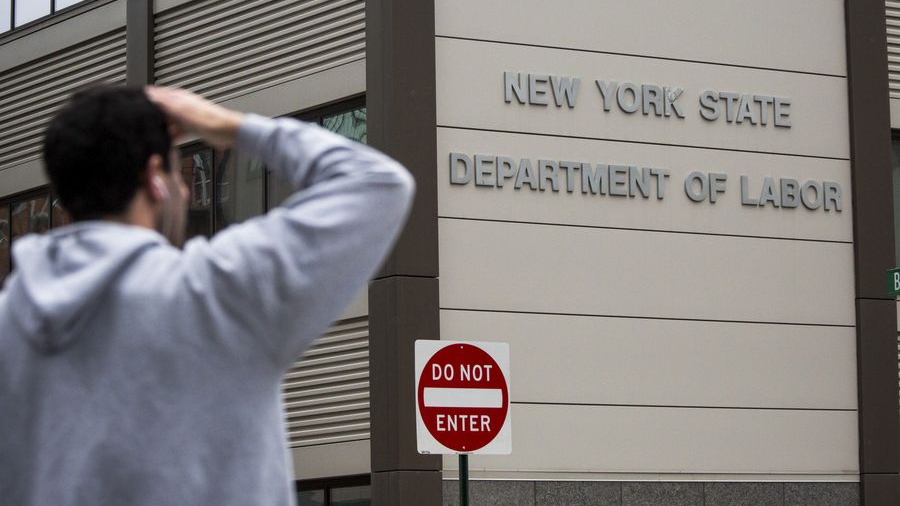
A pedestrian stands in front of the New York State Department of Labor office, New York, U.S., May 8, 2020. /Xinhua
Editor's note: Yannan Collins is a consultant with media background and qualifications based in the United States. The article reflects the author's opinions, and not necessarily the views of CGTN.
Over 25 million Americans have been receiving 600 U.S. dollars on a weekly basis as unemployment benefit from the federal government after the president signed the COVID-19 relief bill worth 2 trillion U.S. dollars in late March.
However, this benefit will expire on the next weekend. Senate Majority Leader Mitch McConnell said in May that the next relief bill would not include the extension of the enhanced employment benefits.
The expiration of unemployment benefits will not only put families and workers who received the benefit into financial hardship, but also drag the U.S. economy into a deeper recession, thereby slowing down the process of recovering from the pandemic.
The ripple effect starts when people from the working class begin losing shelter.
The immediate victims will be the unemployed workers, who are mostly less educated minorities and thus mostly take on low-paid hourly jobs and shift positions. They are also the people who are more likely to be renters instead of homeowners.
Without the federal assistance of 600 U.S. dollars, these families may not be able to pay rent, paving way for the landlords in the states where eviction ban was not extended to forcefully evict tenants.
This is not an ideal situation for landlords either. While most of the renters cannot make enough money to pay rent, landlords normally finance houses and thus cannot collect enough money to pay the banks.
Both evicting the tenants and litigating with the banks take money and time. Soon the tenants, landlords and the banks will compete to see who has the money to hire the best lawyers, resulting in an all-against-all society, which never ends well.
Moreover, the expiration of the unemployment benefits may further deteriorate the public health catastrophe in the U.S. caused by the COVID-19 pandemic.
Once the working class loses shelter, the people have two choices: live with family or friends, or go homeless. Living with family or friends means more people living under the same roof, which can significantly raise the risk of the virus' spread. And going homeless implies no access to basic sanitation and constant contact with strangers.
Meanwhile, in a society where medicare is mostly attached to employment, when the main provider loses a job it usually means losing medicare for the entire family. Though the U.S. has made COVID-19 testing free, without the insurance people may stop seeking medicare for existing conditions.
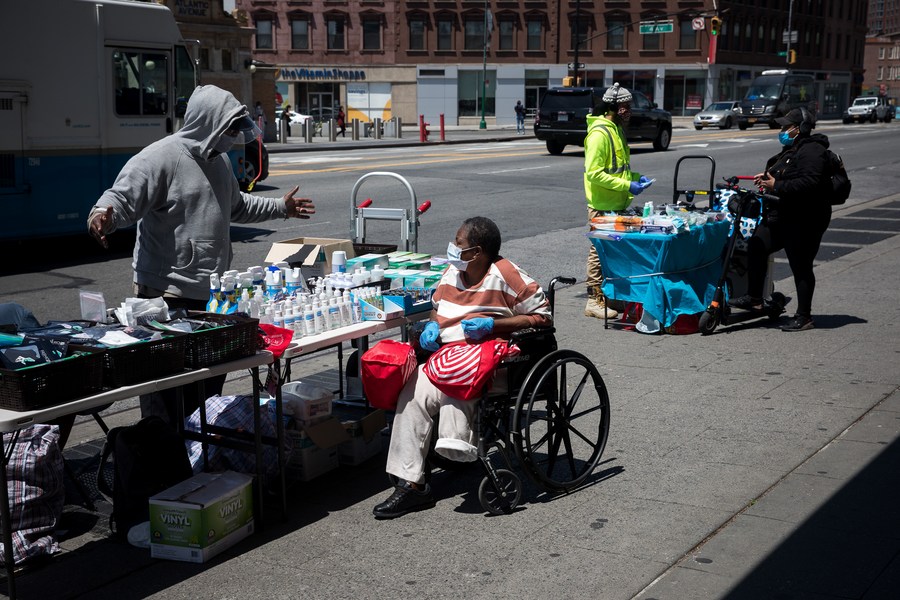
Vendors sell disinfectants and personal protective equipment (PPE) in Brooklyn borough, New York, U.S., May 27, 2020. /Xinhua
For example, roughly 30 million Americans with diabetes will need insulin to control the progress of the condition. Without insurance, the average monthly cost of insulin ranges from 480 U.S. dollars to 1,340 U.S. dollars, depending on the accessibility of different kinds of insulin in the market.
Without the weekly boost, some families may have to rely on state benefits, which vary a lot, depending on where you live. The lowest, in Arizona, is only 240 U.S. dollars per week.
An extra insulin bill can scare away lots of jobless Americans. At the same time, hospitalization is six times higher and death 12 times higher for COVID-19 patients with diabetes.
Furthermore, cutting the weekly unemployment benefit will shrunk economic activities. Without the enhanced benefit, consumer spending will drastically decline, impacting the local consumer economy. To avoid such a decline, the government has to create lots of jobs in a short time, which seems impossible considering the state of the pandemic in the country.
California issued another stay-at-home order in mid-July, and lots of restaurants and bars are closed in most states. If there is not enough spending to keep the local small businesses open, more employers will have to close shops and thus there will be fewer jobs.
A recent study conducted by the Economy Policy Institute also suggests that people receiving unemployment benefits are more like to engage with the intense job search than those who have exhausted their benefits.
The dynamic exists for many reasons, but a loss of confidence and being busy putting pennies together to pay for life essentials are major factors that explain why people with fewer benefits are less likely to look for jobs. Thus, the unemployment benefit sustains the labor market in both ways: It keeps the businesses open and also encourages workers to look for jobs.
In this context, once the Congress lets the unemployment benefits lapse, lots of people from the working class will face evictions, homelessness and hunger. Without enough money, consumer spending will drop and unemployment will increase.
Jobless people who stop seeking medicare for underlying conditions are more likely to die of COVID-19. In this way, the pandemic will further undermine the economy, leading to more unemployment.
There is still no sign as to how the U.S. Congress or the federal government is planning to drain the swamp. We will see the U.S. walking out of the pandemic when it can resolve these issues.
(If you want to contribute and have specific expertise, please contact us at opinions@cgtn.com)