- Home
- China
- World
- Europe
- Politics
- Business
- Opinions
- Tech & Sci
- Culture
- Sports
- Travel
- Nature
- Picture
- Video
- Live
- TV
- Specials


Share







Copied

Military vehicles during the U.S.-South Korea joint Exercise Operation Pacific Reach in Pohang, South Korea, April 11, 2017. /AP
Editor's note: Wamika Kapur is an Indian PhD scholar of international relations at South Korea's Yonsei University. The article reflects the author's opinions and not necessarily the views of CGTN.
Multiple claims have been made about American President Donald Trump's intention to pull back troops from South Korea. The administration's decisions have been baffling at times however there has been consistency on two things, Trump's "America First" policy and a focus on re-election. If America decides to withdraw troops from South Korea, it would be aimed at serving these goals and bringing the Democratic People's Republic of Korea (DPRK) back to the negotiating table.
As reported by the Wall Street Journal, the Pentagon has given the administration options regarding reducing the military presence in South Korea. There are currently 28,500 active troops in the United States Forces Korea (USFK) under the United States Indo-Pacific Command.
In line with Trump's "America First" policy, he has been critical of the burden of supporting overseas forces in Asia, Middle East, Europe and Africa asserting he was "tired of paying too much." This has often been particularly aimed at the bilateral trade sharing deal with South Korea, Special Measures Agreement (SMA).
Trump has asked the South Korean Moon Jae-In government to pay 1.3 billion U.S. dollars a year, a 50-percent increase. It is highly unlikely that the South Korean government would accept such an offer and will instead wait till the November elections while indicating a 13-percent increase, amounting to 870 million U.S. dollars, as their best offer. However, in the domestic theater, the Trump administration is selling it as defending the interest of American taxpayers.
Any pullback of American troops in South Korea is banned by the National Defense Authorization Act (NDAA) unless approved by the U.S. defense secretary as being in the interest of U.S. national security. Considering the administration's prior dealing with law and order, the NDAA is a mere formality which would not be allowed to impede the president's vision. The 90-day approval period would mean the decision would be finalized in October, just before November elections suiting Trump's flair for dramatics.
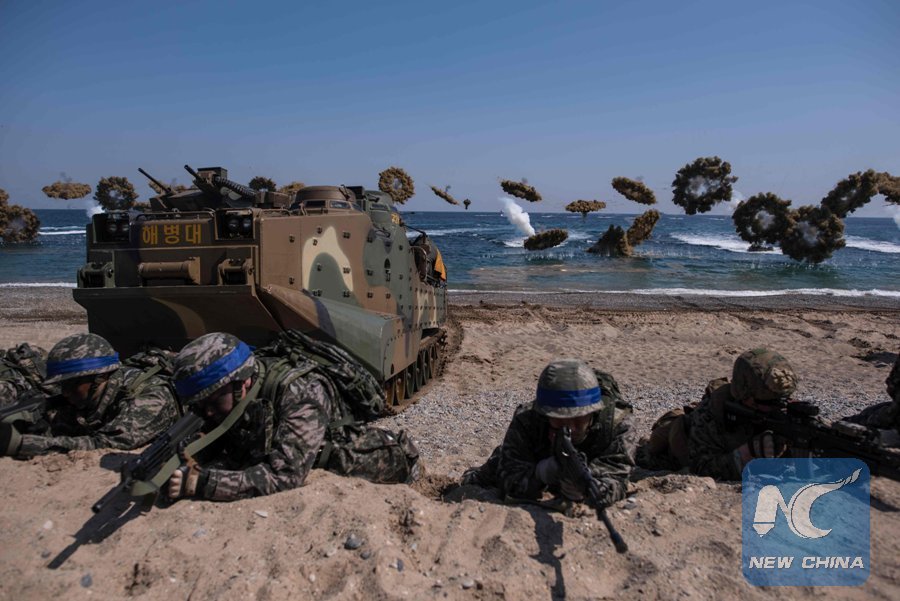
South Korean and U.S. soldiers take a position during an annual joint military landing exercise in Pohang, on South Korea's southeast coast, March 12, 2016. /Xinhua
Trump's transactional diplomacy does not take into consideration that the administration is sending the wrong signal to its allies. Japan and South Korea come under the nuclear security umbrella provided by America which has impeded their pursuit of nuclear security. In the event of a pullback of troops, believable considering recent pullbacks in Germany and Afghanistan, Japan and South Korea might reconsider that decision amid rising tensions in the region.
There is a very strong lobby for a national nuclear policy in both nations which often cites India as an example of peaceful nuclear development. Trump has also suggested that he supports Japan and South Korea building their nuclear arsenals which could potentially spark an Asian nuclear arms race. Ironically, America's inability to keep its international commitments in the name of "Make America Great Again" makes it seem weak and unreliable.
The most telling sign of the administration's devotion to self-interest lies in the correlation of troop reductions to its DPRK diplomacy. The main aim of the Pentagon, in giving this option to the administration, was to counter the threat of China and Russia. The administration has been careful to avoid mention of the threat of the DPRK consistently. Case in point, while America has imposed multiple sanctions on the DPRK for human rights violations, the draft report of the "Commission on Unalienable Rights" fails to mention them.
With elections in November, this is the latest move by Trump to distract the voters from criticism of his disastrous COVID-19 response and police brutality protests. Trump has held three summits with Kim Jong Un, but each negotiation attempt has failed to secure a denuclearization agreement. However, the summits have been sold domestically as a win stating that Trump was able to bring the two countries back from the brink of war.
The DPRK has stated that America has "not discarded its old stance and attitude" and that they have "no intention to sit face to face with the United States" without major U.S., concessions. The withdrawal of troops from South Korea has been a consistent condition for nuclear concessions by the DPRK creating an impasse between the two countries.
Trump's pullback might signal to the DPRK that it is willing to negotiate. Trump could be banking on the news of a nuclear deal with the DPRK and the optics of thousands of troops returning home getting him re-elected. This would also time well with the DPRK provocations and rise in tensions on the peninsula always witnessed pre-election.
The summit between the U.S. and the DPRK may also be a distinct possibility owing to the situation in the DPRK. Due to COVID-19, the DPRK had to close its borders, limiting access to goods from China. An investment package from the South with sanctions relief would go a long way in reducing the financial burdens of the North.
(If you want to contribute and have specific expertise, please contact us at opinions@cgtn.com.)