- Home
- China
- World
- Europe
- Politics
- Business
- Opinions
- Tech & Sci
- Culture
- Sports
- Travel
- Nature
- Picture
- Video
- Live
- TV
- Specials


Share







Copied
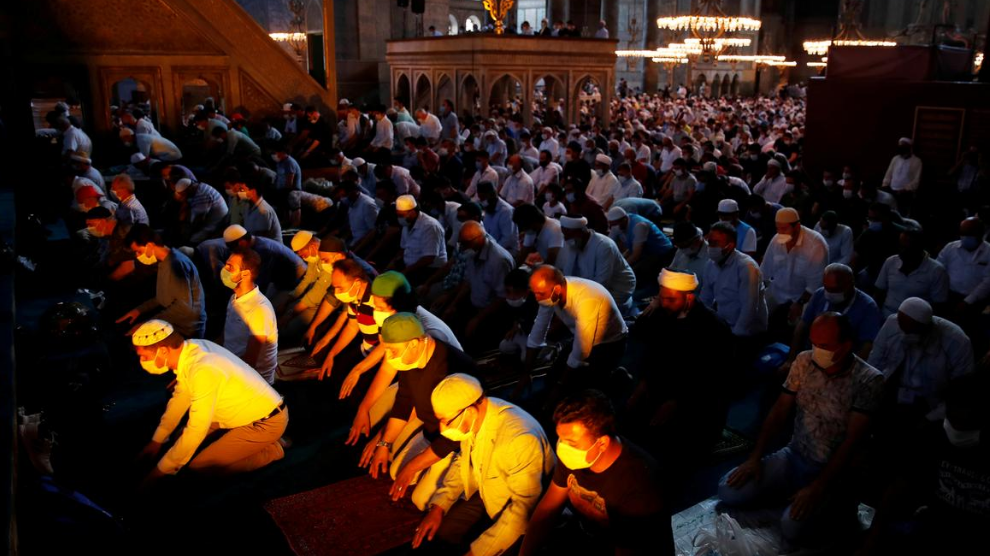
Worshippers attend afternoon prayers and visit Hagia Sophia Grand Mosque, for the first time after it was once again declared a mosque after 86 years, in Istanbul, Turkey, July 24, 2020. /Reuters
Turkey and Greece have exchanged barbs after the first Muslim prayers in nine decades were held at Istanbul's Hagia Sophia, putting more strains on the already tense bilateral ties.
On Saturday, the Turkish Foreign Ministry said it strongly condemned hostile statements by the Greek government and parliament members to stir up the public, and the burning of a Turkish flag in the Greek city of Thessaloniki.
Hagia Sophia was opened to prayer as a mosque in line with the will of the Turkish people and belonged to Turkey like all cultural assets in the country, it added.
"Greece showed once again its enmity towards Islam and Turkey with the excuse of reacting to Hagia Sophia Mosque being opened to prayers," ministry spokesman Hami Aksoy said in a written statement.
In early July, Turkey's highest administrative court, the Council of State, reversed a decision made in 1934 by modern Turkey's founder, Mustafa Kemal Ataturk, to make the site into a museum.
Following the ruling, Erdogan ordered that the place of worship be reopened for prayer. The decision has caused anger in the Christian community and particularly with NATO ally Greece, a majority Orthodox Christian country with historic links to the site.
Greek criticism of the conversion of Hagia Sophia into a mosque after decades as a museum has been scathing, underlining tense ties between Greece and Turkey. Church bells tolled in mourning across Greece on Friday as Turkish President Tayyip Erdogan joined prayers at the building.
On Friday, which was Greece's 46th anniversary of the restoration of democracy, Greek Prime Minister Kyriakos Mitsotakis called Turkey a "troublemaker", and the conversion an "affront to civilization of the 21st century".
This day also marks rising Turkish aggression, as it is an anniversary of "Turkish invasion of Cyprus", Greek President Katerina Sakellaropoulo said on the same day.
Greece and Turkey disagree on a range of issues from airspace to maritime zones and ethnically split Cyprus. This week they also spat over the delimitation of their continental shelves in the eastern Mediterranean, an area thought to be rich in natural resources.
Friday's ceremony sealed Erdogan's ambition to restore Muslim worship at the ancient site, which most Greeks consider as central to their Orthodox Christian religion.
(With input from agencies)