- Home
- China
- World
- Europe
- Politics
- Business
- Opinions
- Tech & Sci
- Culture
- Sports
- Travel
- Nature
- Picture
- Video
- Live
- TV
- Specials


Share







Copied
Editor's note: Stephen Ndegwa is a Nairobi-based communication expert, lecturer-scholar at the United States International University-Africa, author and international affairs columnist. The article reflects the author's opinions, and not necessarily the views of CGTN.
Things will never be the same again. This often repeated statement seems to have come alive for the world in general, as millions grapple with the ramifications of the devastating coronavirus pandemic.
Education is one of the sectors currently struggling with a seemingly lost sense of identity, direction and purpose. For the majority of learners globally, 2020 is a lost year. In many countries, current grades and levels of the education system will be revisited in 2021 so as to standardize the education system.
Eventually, there will be considerable confusion as the same cohorts will not be chronologically at par within countries and externally. In Kenya, for instance, Education Cabinet Secretary Prof George Magoha has already declared 2020 a non-academic year. Students across the education spectrum are expected to be back in classes in 2021 if the number of coronavirus infections is negligible.
Tertiary institutions will have some leeway to continue with the 2019/2020 academic year, but only for those colleges that have managed to sustain a credible mode of online instruction and assessment.
A new United Nations policy brief released this month, "Education during COVID-19 and beyond," examines the nature and extent of disruption on this crucial sector. The report notes that we are witnessing the worst crisis ever in the education sector, affecting nearly 1.6 billion learners in more than 190 countries.
Closure of schools and other learning spaces has impacted 94 percent of the world's student population, up to 99 percent in low and lower-middle income countries. Even countries with low incidences of the pandemic are finding restarting the school calendar the trickiest bit in their reopening puzzle.
This has made it a heated political topic in countries like the U.S., with the push and pull between the White House and Democratic Party governors leaving parents in a quandary.
Another group that has been greatly affected by the pandemic is the teaching community. Millions of teachers and university lecturers have been laid off. Over 50 percent of this teaching staff will not come back either, as many institutions of learning, mainly private ones, will not survive the pandemic.
For children, the pandemic has taught lessons that no classroom or lecture hall would have offered. First, they have learned that contrary to the invincible role models they admire, and incredible human feats they have aspired to achieve, the world is, for all intents and purposes, an extremely vulnerable place.
For millions of children, learning might move permanently from the classroom to the sitting room. As noted, many schools will not survive this crisis. It will not be possible to absorb the millions of locked-out children in the existing schools, particularly in poor and highly populated countries.
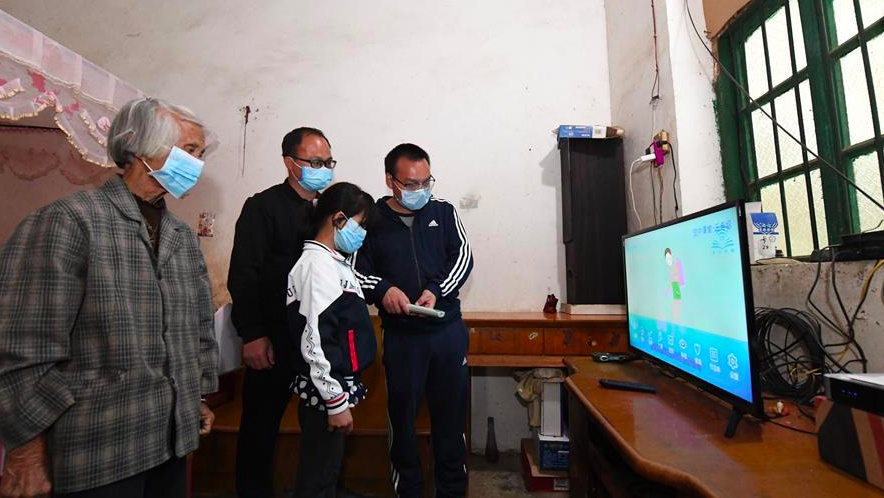
Teachers show a student how to access an online class system on a TV in Taiping Town, Nanning City, Guangxi Zhuang Autonomous Region, south China, March 12, 2020. /Xinhua
With the online experience already gaining traction, there is a high possibility that the internet will become an established and official channel of instruction. Parents will have the option of choosing the kind of schooling experience for their children: in-person or virtual learning.
Secondly, as the nature of work undergoes a paradigm shift, it will place similar demands on the education system. Experts believe that employers and recruiters will give more weight to dependable and impeccable skill sets, rather than the mere acquisition of academic certificates. Persons who are gifted in certain fields will have a head start even in situations where they do not have academic prowess through rote learning.
Among other proposals, the UN brief recommends that governments should "build resilient education systems for equitable and sustainable development." The essence of urgent interventions is to ensure that countries can reopen schools within the shortest time possible in a safe environment, while also ensuring this status quo will hold going forward.
Importantly, the UN calls for us to "re-imagine education and accelerate positive change in teaching and learning." The fact that authorities have been able to come up with ingenious ways to respond to the shocks of the pandemic shows the high level of resilience within the system, and its malleability to drastic change in circumstances.
Still, it is time for stock taking. Even before the coronavirus exacerbation, the education system was burdened by grave systemic challenges centering on the dearth of resources and access. Overcoming these twin bottlenecks will inform the structure and objectives of the ensuing education system.
The overarching objective of education must now lay more emphasis on experiential learning and multi-tasking. Moreover, the redundancy of many careers means that learning will be a lifelong process, with learning on the job becoming a crucial part of professional training.
Content will be king. Creating efficiencies in the education sector calls for the creation of relevant linkages between industry and the classroom, since only what applies to ongoing human endeavor will add value to the development process.
(If you want to contribute and have specific expertise, please contact us at opinions@cgtn.com)