- Home
- China
- World
- Europe
- Politics
- Business
- Opinions
- Tech & Sci
- Culture
- Sports
- Travel
- Nature
- Picture
- Video
- Live
- TV
- Specials


Share







Copied
Editor's note: Bradley Blankenship is a Prague-based American journalist, political analyst and freelance reporter. The article reflects the author's opinions, not necessarily the views of CGTN.
Nearly 100,000 children in the United States tested positive for COVID-19 in the last two weeks of July, according to a new report by the American Academy of Pediatrics and the Children's Hospital Association. This represents a nearly 40 percent rise. These new figures, which are likely much higher in reality as some states don't break down cases by age, come as the school year begins while questions still linger about the exact risk that children face from COVID-19.
The United States' top infectious disease expert, Dr. Anthony Fauci, previously warned the Senate in May that officials should not be "cavalier in thinking that children are completely immune to the deleterious effects" of the virus. Speaking in June to CNN, Fauci said, "I hesitate to make any broad statements about whether it is or is not quote 'safe' for kids to come back to school."
Fauci's more recent assessments fall relatively in line with positions outlined by the American Academy of Pediatrics, the National Academies of Science, Engineering and Medicine, as well as top teachers' unions. The prevailing opinion is that a one-size-fits-all school opening strategy is not in the best interest of students or society writ large, though having students physically present should be the main goal.
There are other factors to consider, for example the socioeconomic background of an individual school district. Lower income communities would be put under more pressure if an adult must stay home with their child, and substituting for school lunches (something many children rely on) could be costly to a low income household. There are legitimate conversations to be had on this issue and ultimately the decision to fully open schools, have distance learning, or some hybrid system largely should depend on the local situation.
For his part, U.S. President Donald Trump has pushed for a full reopening of schools; an issue which he has staked out as key to his election bid.
"In Germany, Denmark, Norway, Sweden, and many other countries, SCHOOLS ARE OPEN WITH NO PROBLEMS," the president tweeted in July, adding that he would consider cutting funding to schools that refuse to open. That same month, Secretary of Education Betsy DeVos blasted local officials, saying that many "gave up and didn't try" to open schools for summer programs.
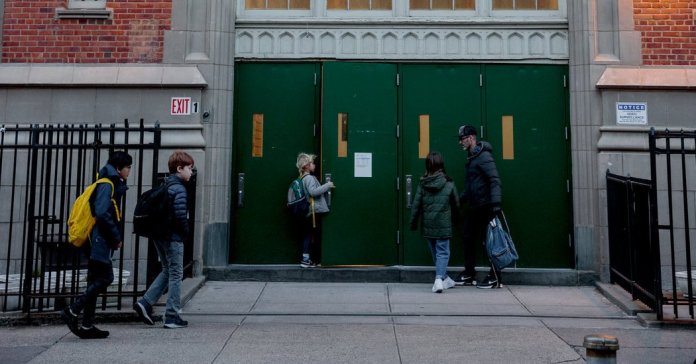
A public school in the New York City, the United States. /AFP
One obvious problem the administration has failed to address is the fact that, observing the international situation, other countries have managed to control COVID-19's spread while the United States has not. Schools in Germany, to name one example, routinely test students, have proper sanitation measures and set up programs to separate students.
Weeks ago, Trump had warned that some schools in hot spots should delay fully reopening in an apparent change of heart. But this was short lived as the issue has become more central to his political brand, prompting the president to double down on misinformation surrounding the COVID-19 in another theater of the ongoing "culture war."
"If you look at children, children are almost – and I would almost say, definitely, but almost immune from this disease," Trump said again last week, spreading obvious misinformation.
The alarming number of cases detected in children at the end of July speaks for itself about the veracity of Trump's claims of immunity. One high school in Georgia, that made headlines after a photo of its jam-packed hallways filled with unmasked students spread online, learned the hard way after at least nine cases of COVID-19 were detected in students and staff members. Tennessee has also opened its schools back up – a majority in person – and several dozen cases of COVID-19 have already appeared in connection to the reopenings.
Situations like these are only going to be more common after students physically return to school in major hot spots, such as Florida. While it's true that children are much more likely to have better outcomes for the disease, the potential for serious long-term injury and death still exists. Children are still able to catch and spread the virus just like anyone else which will endanger whole communities, as well as faculty and staff who tend to be older adults on average.
This is the exact reason that a one-size-fits-all approach to schools reopening is doomed to fail in terms of the epidemiological situation and why a carefully tailored plan for each district is so crucial. This will, of course, take hard work and federal support.
But to Trump, these perceived externalities are of no importance. What's important is the fact that continuing schooling as normal will give more adults (i.e., voters) a sense of normalcy and thus a sense of security in the face of a continually deteriorating situation in the country. To put it simply: students and teachers are being put in danger to help the president's reelection bid.
(If you want to contribute and have specific expertise, please contact us at opinions@cgtn.com.)