- Home
- China
- World
- Europe
- Politics
- Business
- Opinions
- Tech & Sci
- Culture
- Sports
- Travel
- Nature
- Picture
- Video
- Live
- TV
- Specials


Share







Copied
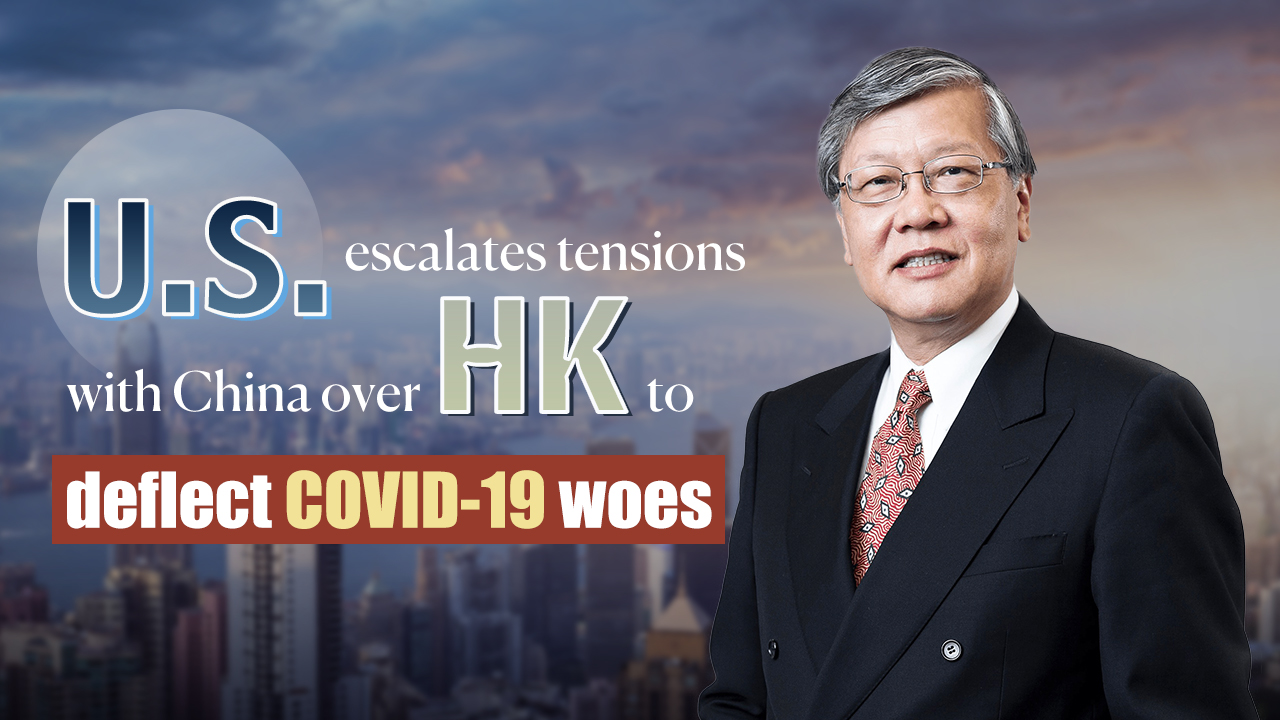
Editor's note: China-U.S. tensions have escalated following the promulgation of China's National Security Law for Hong Kong. Andrew Sheng, a distinguished fellow with Asia Global Institute of University of Hong Kong, shares his views on why the U.S. has increased hostility towards China over the issue. Views expressed in this video are his, and not necessarily reflect those of CGTN.
CGTN: The U.S. has reacted quite strongly to the promulgation of the National Security Law (NSL) in HK. Why do you think is that?
Andrew Sheng: I think there is a whole chain of public comments made by, not only Secretary of State Mike Pompeo, but also the FBI, etc. All these have given a line that they don't like what is happening in Hong Kong, and that they feel that they have a right to comment on all these issues. China's stance is, of course, that this is a domestic sovereign issue, and there is nothing for foreigners to comment on.
The background to this is that America is going through a very traumatic time. And that particularly also this is also in the run-up to the elections. So it is quite understandable that there is an effort to shift the blame on the mishandling of the pandemic to outsiders. So they will tend to blame China. They blame foreigners. They blame immigrants, etc.
If you think about it, the United States has already lost 150,000 people due to the pandemic. And at the rate of a thousand deaths per day, the number of deaths by the end of the year for the United States alone could be more than just under 300,000, which is larger than the total number of deaths America incurred during the whole of second World War. In many cases, (this) could be avoided. But unfortunately, (it was) mishandled.
So Hong Kong has become collateral damage in the worsening of U.S.-China relations.
CGTN: Do you think the West's opposition to the NSL and the punitive measures they've taken will affect HK's global status as an international financial center?
Sheng: I don't think Hong Kong's international financial status or trading status will be weakened very substantially. There will be a lot of volatility right now, because the whole world is going through very large volatility. But by and large, as long as China keeps his commitment to open markets, global trade, and commitment to multilateralism, Hong Kong will continue to prosper.
The issue is as follows. Hong Kong still has the most user-friendly financial system, trading system, services system, some of the best accountants, lawyers, and commercial services throughout Asia.
It is the fourth largest foreign exchange trading center in the world, (behind) New York, London and Singapore. So to a large extent, and even though this dipped slightly after 1997, it has now come back to 4th place. So what does that tell you? That tells you, as long as the Chinese economy continues to grow steadily, Hong Kong will prosper. Where Hong Kong will suffer is where the relations between China and the U.S. worsen, because that is a lose-lose situation.
(If you want to contribute and have specific expertise, please contact us at opinions@cgtn.com.)